soupsong.com

January 30, 2009

Taking the soup pulse of the French economy
Filed under: History and culture, Restaurant review, Soup, soup recipes — pat @ 7:20 pm

Le Pain de la Bourse

Le Pain de la Bourse

A day away from the national strike, Dominique strikes a pose in front of the Bourse

A day away from the national strike, Dominique strikes a pose in front of the Bourse

Yes, it LOOKS like there’s “Pain in the Bourse” in Paris, and today’s national strike to draw attention to France’s part of worldwide international fiscal misery would support that, but in fact Le Pain de la Bourse is a darling little cafe just across the street, as you can see, from the Bourse–and its name means “The Bread of the Bourse” (and not the kind of “bread” that means money).

Do you love it? The heart of French financial markets is located in the Palais Brongniart, neoclassically built in the over-the-top 19th century by Emperor Napoleon’s architect Alexandre-Théodore Brongniart. Why did Napoleon commission Brongniart to build it? Because he loved how Brongniart had designed the layout for Père Lachaise Cemetery, now, of course, the revered home of (sigh) Jim Morrison of the Doors and zillions of other really more interesting people. Not that Jim isn’t interesting.

So Dominique (pictured) and I arranged to meet to discuss the state of things. Obama’s first days as President–she’d gone to the inauguration party at Hôtel de Ville, with lots of noise, interminable lines to get drinks, but high joy from beginning to end; I’d stayed home and watched first French TF1 then CNN with champagne and a friend. Then an embassy bookclub trip she is arranging to Orleans to follow in the footsteps of Joan of Arc, after reading Mark Twain’s fictionalized biography on same that he (wrongly) described as his “greatest work.” An Opera Comique performance that we couldn’t get tickets to. The upcoming national strike that would shut down metro, regional and neighborhood trains and flights across the country today. “Let’s try Le Pain de la Bourse,” she said. And so we did.

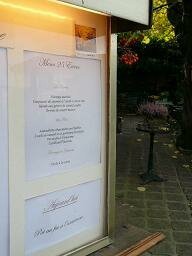
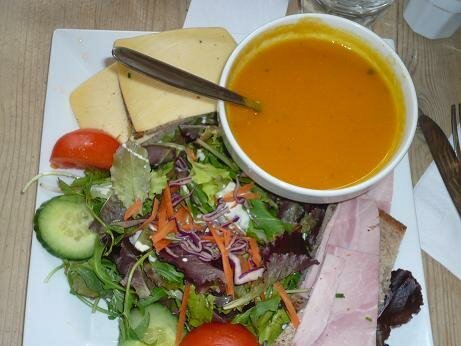
It was such a cute little place. Menu of the day on the chalkboard. 11,80 euros ($17) for soupe de potiron (pumpkin soup), open-face sandwiches of ham and gouda cheese on Poilâne-style bread, and salad.

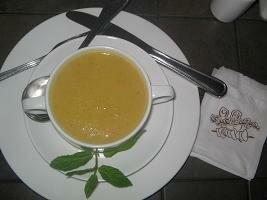
We agreed the soup was terrific, but not for the reasons you’d suppose. It was so pure and simple…so French. Pumpkin cooked in seasoned water with a little mince of parsley, then pureed. That’s it. It’s not meant to bowl you over; not meant to challenge your palate with different flavors and textures and colors; not meant to fill you up. Soup in France, for the most part, is, in the words of Auguste Escoffier (that early 20th century “king of chefs and chef of kings”) designed to “put the heart at ease, calm down the violence of hunger, eliminate the tension of the day, and awaken and refine the appetite”

And it did. Markets are failing. Davos is dour. Strikes are pending. But Dominique and I sat in the shadow of the French Bourse (Per Bloomberg, “France’s CAC 40 retreated 2.2 percent” that day) and felt as if our hearts were at ease, the violence of hunger had been calmed, the tension of the day just evaporated, and our appetites were awakened and refined–which was too bad, when you look at the rest of the plate with its little cheese tartine, its little ham tartine, and a big mass of mesclun salad, not very well dressed. Oh well.

All things considered, it was a very enjoyable lunch indeed and we recommend the restaurant for its breakfast, brunch, and lunch:
Le Pain de la Bourse
33, rue Vivienne
75002 Paris
telephone: 01.42.36.76.02

And if you’re hankering after true French housewife pumpkin soup, please take a look at the original recipe of my marvelous Touraine professor of many years ago, Mme. Marie-Josie Diacre, at Soupsong’s Soupe au potiron. I cannot help be reminded, during this perilous fiscal time, that Jack Sprat also turned to pumpkins in times of trouble.

December 23, 2008

Just in time for Christmas: Russian Borscht

Filed under: History and culture, Soup, soup recipes — pat @ 2:04 pm

All the makings of a great holiday borshch

All the makings of a great borshch

Enough to send you off carolling

Enough to send you off carolling

Way back in 1997, not long after I’d launched soupsong.com, Sándor Fenyvesi–air traffic controller at Budapest approach–contacted me over my website with this great recipe for borscht, which he’d acquired under the communist regime when he was sent as an 18-year-old Hungarian boy to a special school in Latvia. Thus began a great friendship between my family and his. We freely exchanged recipes between our websites, exchanged life stories and points of view, and met for the first time in Budapest in 2000 when I was in town measuring the Hungarian Police Museum for an exhibit the FBI was about to mount there.

What is it about soup lovers? Every contact I’ve made over my website has turned into a love feast. Sanyi and Kati welcomed me into their home, introduced me to their 3 young boys, and fed me Hungarian delicacies–a truly exquisite day.

Yet who could have predicted that 8 years later their eldest son Gergely would end up in Paris, a bright and raging capitalist at Société Générale? That’s him in the picture. He’s come to dinner when my family has been in town. He’s taken care of my cat Min and my apartment when I was in Amman. Now we are occasional and enthusiastic partners in soupmaking.

It was freezing when he arrived on Saturday morning with a fine bottle of Château Les Ancres 2005, a Grand Vin de Bordeaux, in hand. We stashed it in the kitchen, picked up the market bag, read over his Dad’s recipe, and headed to the fabulous open air food market on av. Woodrow Wilson, bottom of the 16th Arr. You see the results in front of him–gorgeous beef bourguignon with some bone thrown in; slab of bacon; veggies freshly pulled from the ground; herbs; seedy pumpernickel bread; crème fraîche d’Isigny. He’d also brought an ace up his sleeve–a special borscht flavor pack from his Ukrainian friend Marika.

Let me tell you, this was a day’s work, thanks to making the beef stock from scratch–and we loved it that way: time to do some Christmas shopping, time to watch Claude Chabrol’s “This Man Must Die”, even time to open that great wine as we were getting close, “just for a sip.” Then the payoff, which you can see with your own eyes. Absolutely heavenly layers of flavors and textures and colors.

Doesn’t it put you in the Christmas spirit for this eminently Christmas soup from the Ukraine and Russia? Gergely and I highly recommend that you dust off that soup kettle and get to work. You’ll find Sanyi’s recipe at Soupsong’s Ukrainian Borscht.

And stay tuned for future adventures into soupmaking with my Hungarian connection. “Are you telling me,” said Gergely in astonishment, “that you don’t know Újházy Tyúkhúsleves?” Sounds like a January project to me….

December 17, 2008

Urbanspooning at Le Gorille Blanc

Filed under: History and culture, Restaurant review, Soup — pat @ 10:03 am

Yes, I'm a fan of urbanspoon.com

Yes, I'm a fan of urbanspoon.com

Plus I make great soup

Plus I make great soup

Back in September, when I was hyperventilating over the beauty of my just one-year-old granddaughter Rosalind in Seattle, I got taken out to lunch by the urbanspoon.com guys, where daughter Meg had been working part time. Don’t know about urbanspoon.com? You should. Among other amazing things that it does, it lets you use the GPS on your ipod to locate the closest, say, SOUP restaurant to your own two feet at that moment, then draws you a map to get there and lets you read reviews about it before you walk through the door. I tried it out on Patrick’s ipod–incredible and incredibly easy. Plus I got the t-shirt. “Take it to Paris,” Adam said, “we’d love to urbanspoon that city too.”

So when Ana suggested we Pudlo on Friday night, I finally remembered to pop the t-shirt in my bag for a trial spin.

Pudlo?

That’s the brilliant Gilles Pudlowski’s restaurant guide of Paris. Ana and I go Pudloing the way Oscar Wilde’s Algy Moncrieff goes Bunburying.

La Gorille Blanc is a Pudlo “Special Favorite.” It’s in the 7th Arrondissement on the Left Bank, within spitting distance of the great Bon Marche department store and food emporium. Bernard Arény has made a truly sweet spot of it, bringing in a great chef with a fabulous menu, and consecrating the place to Flocon de neige (Snowflake), the astonishing albino gorilla who was captured in equitorial Guinea by the Fang tribe in 1966 and thence transported to the Barcelona zoo. Snowflake lived to the great age of 40 and fathered some 21 babies, none of them albinos. When Arény visited him in Barcelona, it was love at first sight.

The restaurant is tiny, charged with a warm, rich, and silvergleaming atmosphere, and hung with portraits of Snowflake. Ana and I are the first people in the place (typical Americans–”only” 7:30 pm) and it’s a good thing, cause we cheerfully go about making asses out of ourselves. “Ha ha ha,” says Ana, “My friend is going to write up this evening’s meal on the Internet, is it okay to use the camera?” “Ha ha ha, oh yes, that’s fine,” says the darling waitress. M. Arény is in the background, very chic in his brick red shirt and black trousers. Ana takes a picture of me tucking the Urbanspoon t-shirt under my jacket and posing next to a picture of Snowflake climbing a ladder. Nope, can’t see the logo. How about putting the t-shirt logo on top of the photo? Non, non, non! M. Areny rushes up with a different and great photo of Snowflake’s head and takes over the stage managing of the whole shot, pictured. We love it and hope you do too. And we’re all relieved that we got THAT out of the way.

Now we’ve ordered. We’re embarked on a lovely pichet of St. Emilion Bordeaux. And oh la la, the soup arrives and it’s gorgeous! Un velouté de chataignes en cappuccino aux cèpes séchés, or creamy chestnut soup with a porcini mushroom emulsion, splashed with paprika and topped with chervil. Oh my. Ana and I both want to dive in head first, but the staff springs into photography support. I take a picture with the flash and it doesn’t do the dish justice. Candlesticks appear from all directions and we end up with the photo you see. It DOES do the look of the soup justice, but not the taste and feel. The soup is light, rich, and sweet but goes into palate overdrive when paired with the musky froth of deeply flavored mushrooms. Something to suck through your teeth and savor in small swallows, if only you had that kind of self control.

And the rest of the dinner follows suit, Ana so happy with la terrine de champignon à la crème d’ail (mushroom terrine) and both of us with le fricassé de lapin et oignons aux raisins secs (stewed rabbit), not to mention the superb desserts–price for each of us, including wine and tip, 45 euros. Not bad!

We highly recommend it: LA GORILLE BLANC
11 bis, rue Chomel
75007 Paris
01.45.49.04.54

I’ll work on developing a recipe for this marvelous chestnut soup, but in the meantime, if you simply must have chestnut soup today, try the much heartier Hungarian recipe for Creamy Chestnut and Smoked Ham Soup on my website.

November 27, 2008

Brussel pouts

Filed under: History and culture, Restaurant review, Soup, soup recipes — pat @ 10:08 am

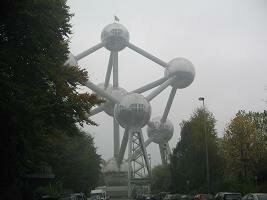
atomium, still futuristic after all these years

atomium, still futuristic after all these years

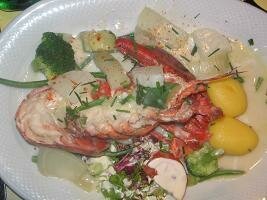
waterzooie avec homard?

waterzooie avec homard?

“Want to go to Brussels this weekend?”  My friend Stu emailed, posing the question.  You know I did.   

“Only if we can see the Atomium,” I  banter back. ”Deal.” “AND that I get to eat Waterzooie, classic Belgian soup.”  “Okay, okay!”

Four hours and a lot of traffic and and a lot of rain later, first stop: the Atomium.  It was the centerpiece of the 1958 World’s Fair, and it is still breathtaking and breathtakingly modern, sitting off in its own remote field.

Now for the waterzooie.  Here’s what I said about it 10 years ago when I published the chicken version on soupsong.com: 

Waterzooie or Waterzootsje–originating in Flanders–is one of the great national soups of the world. Belgians are pretty loose with the ingredients, though. Not only does every family have its own recipe that varies eggs, cream, and lemon–but some use fish instead of chicken. In fact, Escoffier himself captured the recipe as a fish and wine soup. Apparently wine is the ONLY ingredient all these variations have in common–and even then I have heard of variations that recommend dark Belgian beer instead of wine. This particular recipe, however, is made for the hearts and stomachs of poultry lovers–it is chicken times a thousand, and wonderfully silky and rich to boot. And just exactly what does Waterzooie mean? I hunted for weeks to find out. It translates to “a simmering, watery thing.” In other words, eggs and cream notwithstanding, the broth should not be too thick. Serve hot as a meal to 8 people–ideally with boiled potatoes, brown bread, and butter on the side.”

But as we listened to the blandishments of resto pimps on the crowded rue des Bouchers (street of butchers), we heard “Free aperitif!” “Free waffles!” “Special beer!” “Waterzooie with lobster!”

“Lobster! Did you hear THAT?”

Now we are in a bidding war of restaurants promising this heavenly dish and eventually end up in La Belle Epoch, where we are ushered to a tight little table in an elevated corner overlooking the street’s wet cobblestones. The waiter stares at us in disbelief. “We have no waterzooie with lobster.” We assure him that’s the only reason we’re sitting in his restaurant. He huddles with the man out front and comes back, grim-faced. “Okay, we have waterzooie with lobster.” “How much for it?” Stu thinks he says 13 euro.

And here you see it. Not a soup. Not 13 euro, but 30–about $43. So we don’t recommend La Belle Epoch by a long stretch. But for all that, the lobster waterzooie was absolutely delicious. And we highly recommend the chicken waterzooie recipe on soupsong.com. Marvelous!

November 20, 2008

Bouillon Chartier celebrates Nouveau Beaujolais

Filed under: History and culture, Restaurant review, Soup — pat @ 9:35 pm

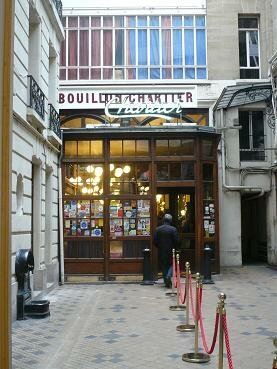
Le Bouillon Chartier

Le Bouillon Chartier


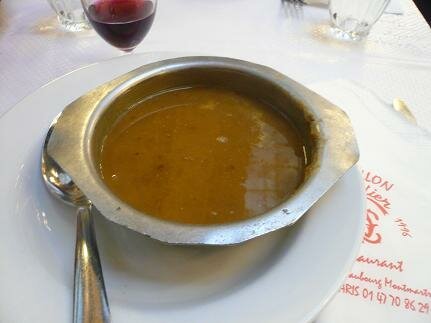
Potage aux legumes

Potage aux legumes

 It’s November 20 in Paris and the streets are littered with gigantic wine bottle balloons labeled Nouveau Beaujolais 2008.  “Come on,” said Dominique, “let’s meet at Bouillon Chartier for lunch.”

I love this place. It’s hiding in an alley (see above) not far from the Bourse, has the look and feel of an earlier century or two, serves great food, and today is serving the first sips of the New Beaujolais.

Our maitre d’ guides us over oceans of empty tables and invites us to squash into a tiny table in a tight corner that’s already occupied. The attractive couple looks up in surprise. We protest; it’s no use. Non, no tables for two people only, says the maitre d’, the place will soon be packed. And of course it is, but in the meantime we have bonded with the couple over the unfairness of life. When my soup arrives (above), the woman asks me what I think of it. Deficient, I say. They laugh and agree. It’s the only soup on the menu, potage aux legumes, and it’s thin, ungarnished, and served in a lugged metal bowl that’s clearly been banged all over the kitchen. The woman gamely lends me her glass of the new wine to add a little class to my photo.  “My empty glass would tell a better story,” says the man.

The soup is tasty, though, with the bite of onions, pepper, and a splash of cognac enlivening the dark green lentil puree–and a great entree to the excellent quenelle de brochet sauce nantua that follows.  The conversation is stimulating and convivial. The atmosphere amusing–all rosy walls and impossibly high ceilings with elegant moldings; waiters bustling in their traditional “room clothes” scribbling the order and adding up the bill on the white table cover; passion for dining and arguing just about evenly divided.   All in all a delicious lunchtime on a festive winter day in Paris.

I highly recommend it:  Le Bouillon Chartier
7 RUE DU FAUBOURG MONTMARTRE 75009 PARIS
01 47 70 86 29
email :
Pour les réservations, écrire à :

November 12, 2008

Patriotic poems and pot au feu in small town France

Filed under: History and culture, Restaurant review, Soup, soup recipes — pat @ 7:41 pm

Honoring Barbizon heroes on 11/10

Honoring Barbizon heroes on 11/10

Leave the cold; enter pot au feu heaven

It was a funny day, me deliberately leaving behind all the heavily “planned activities at US battlefield cemeteries for Veteran’s Day” to strike out into the French countryside.  On such an autumn holiday I thought why not explore the landscapes of the Barbizon school, maybe even climb around the fabled rocks and crags of Fontainebleu forest?   I sure wasn’t in any hurry to get up or get out; wasn’t even sure the car would start after all those weeks in Amman.  But there I was in a parking lot behind the town around noon, picking my way over  John Constable Way and up and down the steps of St. Martin Chapel, emerging, to my complete surprise, into the main town square just as the music struck up.  You can see the chapel in the picture, partly blocked by the giant head of Vercingetorix, doomed leader of the Gauls against Caesar’s legions in 51 BC, who was the centerpiece of the town’s war memorial, funded in part by American subscription. 

Everyone in town showed up.  It was not our Veterans’ Day commemoration; it was specifically the 90th anniversary of Armistice Day, the end of the brutal and devastating trench warfare of WWI that literally destroyed the flower of France.  And those losses were very specific for the families who showed up at the ceremony.  Old fat guys carried the flags and laid the flowers.  The mayor, sashed in red, white, and blue, gave a moving speech.  Eight kids read the poems they’d written to honor the dead and (always) La Gloire de France, though all the red-faced boys had to be coaxed by the local teacher to read their works of art.  I was completely surprised and moved–this was no big orchestrated ceremony with political overtones; this was all about people like you and me thinking about family members who went off to war for any number of reasons and laid down their lives for it–or, with any luck, lived to tell about it.

So what’s the upshot?  Everyone left the ceremony and immediately filled up all the restaurants in town to enjoy the day.  Restaurant La Boheme featured one of the great soul foods of France–pot au feu.  It is exactly the right dish for a cold day in autumn and so soulful in its simplicity and heartiness that I hope you will just bite the bullet and make it from scratch.  Easy enough to do, if you just take it in stages: Classic pot au feu.

November 5, 2008

Royal soup on the heels of an American election day?

Filed under: History and culture, Soup, soup recipes — pat @ 8:11 pm

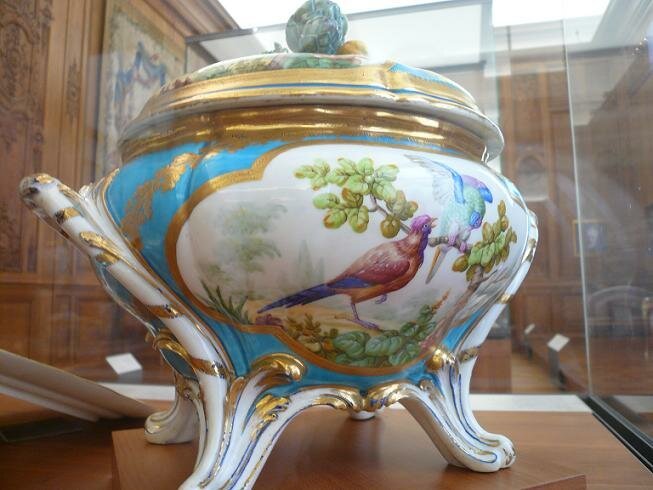
Sèvres Pot à oille standing tall in the Petit Palais

Madame de Pompadour surveys her lover Louis XV and her soupe domain

Ahem, may I first say:  it’s a great day to be an American.

Okay, I promised you Madame de Pompadour, a Sèvres tureen, and a soup recipe, and I am going to deliver.  Just look at the pictured beauties.  Disoriented from 3 weeks under the hot blue skies of Amman, I set out on a cold, rainy lunch hour to reconnect with Paris.  Bang!  Almost immediately I found this gorgeous pot à oille, (a round instead of oval tureen) in the Petit Palais, just across and up the street from my office.  Funny how one little item can lead you such a merry chase all over French history, manners, customs, and cuisine.

It turns out that soup tureens were not made or used until the late 17th century.  Before then, poor families would eat directly out of the cooking pot with big spoons; rich families had their soup ladled from the kitchen marmite into individual bowls, covered, and served at table.

Then Saxony porcelain companies created gorgeous tureens for serving the soup course at table.  Think Royal Meissen/Dresden china.  Suddenly there was a charming way to focus attention on the Lord or Lady of the table doing the ladling, which, after all, is graceful and not as tricky as carving a roast.  This new fashion caught the attention of Louis XV’s official mistress, Madame de Pompadour, and she thought it would be awfully nice to rival Dresden with a French china that would blow it out of the water.  That’s when she discovered the small Sèvres factory around Chateau de Vincennes, very French, on the southeastern corner of Paris.

In no time at all she got the King’s interest and endorsement, moved the operation not far from Versailles, and hired the most exquisite artists (Boucher!) and craftsman to produce a soft-paste porcelain brilliant with colors and designs never before imagined.  Like the beauty pictured here.

And there you have it.  At the end of the production line, there were the petits soupers, two or three times a week, where Madame de Pompadour would cosily serve the King and an intimate group of guests–like her favorite, Voltaire–in the King’s private dining room, appropriately decorated with De Troy’s “Lunch with Oysters” and Lancret’s “Lunch with Ham.”  On the menu:  an exquisite soup to whet the appetite.

Two have come down through history named after the woman herself.  The clear Soupe à la Pompadour is a delicate consommé thickened with tapioca, then heated with thin strips of black Italian truffles (ideally from Norcia in Umbria), of poached chicken breasts, and of tongue.  The thick Purée a la Pompadour , by contrast, is a tomato purée garnished with pearls of sago palm and a julienne of lettuces. I am going to try them out this week and post the recipes on the weekend.  Perfect for an election party?  Why not?

October 24, 2008

Benign Neolithic Bi-Babies Bless Lentil Soup

Filed under: History and culture, Soup, soup recipes — pat @ 10:25 am

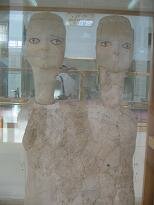
Neolithic cuties from Ain Ghazal

Neolithic cuties from Ain Ghazal

Hisaa al adas

Hisaa al adas bhamud

Okay, this is my most shameless conjunction to date. This fabulous statue, dating back some 8,000 years and part of a family group at the Amman Archeological Museum, doesn’t have anything at all to do with this particular bowl of lentil soup.

This statue and the other 31 in existence were discovered at Ain Ghazal in 1974 when a highway was being bulldozed from Amman to the nearby city Zerqa. Back when I worked in Washington, DC, I’d fallen in love with one of them–it is dramatically spotlighted in a hallway at the Sackler Gallery–and now here I was, pretty much on the spot of its creation.

Ain Ghazal was inhabited for over 2000 years, starting around 7250 BCE, and over time its people developed complex rituals, created and buried these mysterious plaster statues, domesticated sheep and cattle, built plastered homes, and became subsistence farmers who grew wheat barley, chickpeas, peas, and…and…and…LENTILS. Whew, I knew I’d come up with a nexus if I did enough research.

To honor this great moment for me, standing in the museum surrounded by these sweet-faced ET-like creatures (and let’s not even think about the astonishing other exhibits–like actual Dead Sea Scrolls; ancient copper scrolls that tantalize with a story of a still undiscovered treasure site; Nabatean pornography; skulls and life-size pottery mummies; limestone and marble statues; the list is endless and endlessly rich), may I invite you to make and eat a bowl of Jordanian lentil soup? Hisaa al adas is a classic made from brown lentils, rice, herbs, and spices. Hisaa al adas bhamud, recipe below, is a rich lemony classic made of red lentils, vegetables, herbs, and spices–absolutely sensational!

Hisaa al adas bhamud for 4

5 cups water (or light broth)
1 and 1/2 cup red lentils
1/2 pound zucchini, chopped fine
2 medium potatoes, peeled and chopped fine
2 Tablespoons olive oil
1 onion, chopped fine
1 large clove garlic, crushed with 1/4 teaspoon salt
1/4 cup cilantro and/or parsley, minced
1 teaspoon cumin
1/4 cup lemon juice
salt and pepper to taste
Garnish: sprigs of mint and lemon slices

Bring the water (or broth) to a boil and add the lentils, return to a boil, reduce heat, cover and cook for 30 minutes. Add the zucchini and potatoes, reboil, then reduce heat, cover, and let simmer for another 20 minutes. Meanwhile, saute the onions in oil over low heat until transparent, then stir in the garlic and cilantro/parsley for a minute, then the cumin, and scrape everything into the soup, which has finished cooking, and simmer for 10 more minutes. When ready to serve, stir in the lemon juice, taste for seasoning, and ladle into bowls with a sprig of mint for garnish–or serve the mint and lemon slices on the side.

« Newer Posts

Powered by WordPress