soupsong.com

November 20, 2008

Bouillon Chartier celebrates Nouveau Beaujolais
Filed under: History and culture, Restaurant review, Soup — pat @ 9:35 pm

Le Bouillon Chartier

Le Bouillon Chartier


Potage aux legumes

Potage aux legumes

 It’s November 20 in Paris and the streets are littered with gigantic wine bottle balloons labeled Nouveau Beaujolais 2008.  “Come on,” said Dominique, “let’s meet at Bouillon Chartier for lunch.”

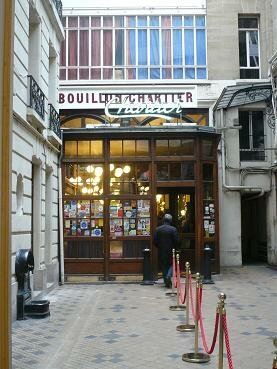
I love this place. It’s hiding in an alley (see above) not far from the Bourse, has the look and feel of an earlier century or two, serves great food, and today is serving the first sips of the New Beaujolais.

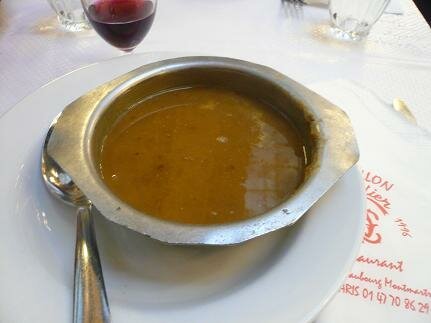
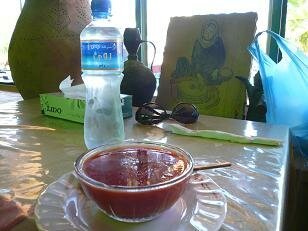
Our maitre d’ guides us over oceans of empty tables and invites us to squash into a tiny table in a tight corner that’s already occupied. The attractive couple looks up in surprise. We protest; it’s no use. Non, no tables for two people only, says the maitre d’, the place will soon be packed. And of course it is, but in the meantime we have bonded with the couple over the unfairness of life. When my soup arrives (above), the woman asks me what I think of it. Deficient, I say. They laugh and agree. It’s the only soup on the menu, potage aux legumes, and it’s thin, ungarnished, and served in a lugged metal bowl that’s clearly been banged all over the kitchen. The woman gamely lends me her glass of the new wine to add a little class to my photo.  “My empty glass would tell a better story,” says the man.

The soup is tasty, though, with the bite of onions, pepper, and a splash of cognac enlivening the dark green lentil puree–and a great entree to the excellent quenelle de brochet sauce nantua that follows.  The conversation is stimulating and convivial. The atmosphere amusing–all rosy walls and impossibly high ceilings with elegant moldings; waiters bustling in their traditional “room clothes” scribbling the order and adding up the bill on the white table cover; passion for dining and arguing just about evenly divided.   All in all a delicious lunchtime on a festive winter day in Paris.

I highly recommend it:  Le Bouillon Chartier
7 RUE DU FAUBOURG MONTMARTRE 75009 PARIS
01 47 70 86 29
email :
Pour les réservations, écrire à :

November 12, 2008

Patriotic poems and pot au feu in small town France

Filed under: History and culture, Restaurant review, Soup, soup recipes — pat @ 7:41 pm

Honoring Barbizon heroes on 11/10

Honoring Barbizon heroes on 11/10

Leave the cold; enter pot au feu heaven

It was a funny day, me deliberately leaving behind all the heavily “planned activities at US battlefield cemeteries for Veteran’s Day” to strike out into the French countryside.  On such an autumn holiday I thought why not explore the landscapes of the Barbizon school, maybe even climb around the fabled rocks and crags of Fontainebleu forest?   I sure wasn’t in any hurry to get up or get out; wasn’t even sure the car would start after all those weeks in Amman.  But there I was in a parking lot behind the town around noon, picking my way over  John Constable Way and up and down the steps of St. Martin Chapel, emerging, to my complete surprise, into the main town square just as the music struck up.  You can see the chapel in the picture, partly blocked by the giant head of Vercingetorix, doomed leader of the Gauls against Caesar’s legions in 51 BC, who was the centerpiece of the town’s war memorial, funded in part by American subscription. 

Everyone in town showed up.  It was not our Veterans’ Day commemoration; it was specifically the 90th anniversary of Armistice Day, the end of the brutal and devastating trench warfare of WWI that literally destroyed the flower of France.  And those losses were very specific for the families who showed up at the ceremony.  Old fat guys carried the flags and laid the flowers.  The mayor, sashed in red, white, and blue, gave a moving speech.  Eight kids read the poems they’d written to honor the dead and (always) La Gloire de France, though all the red-faced boys had to be coaxed by the local teacher to read their works of art.  I was completely surprised and moved–this was no big orchestrated ceremony with political overtones; this was all about people like you and me thinking about family members who went off to war for any number of reasons and laid down their lives for it–or, with any luck, lived to tell about it.

So what’s the upshot?  Everyone left the ceremony and immediately filled up all the restaurants in town to enjoy the day.  Restaurant La Boheme featured one of the great soul foods of France–pot au feu.  It is exactly the right dish for a cold day in autumn and so soulful in its simplicity and heartiness that I hope you will just bite the bullet and make it from scratch.  Easy enough to do, if you just take it in stages: Classic pot au feu.

November 5, 2008

Royal soup on the heels of an American election day?

Filed under: History and culture, Soup, soup recipes — pat @ 8:11 pm

Sèvres Pot à oille standing tall in the Petit Palais

Madame de Pompadour surveys her lover Louis XV and her soupe domain

Ahem, may I first say:  it’s a great day to be an American.

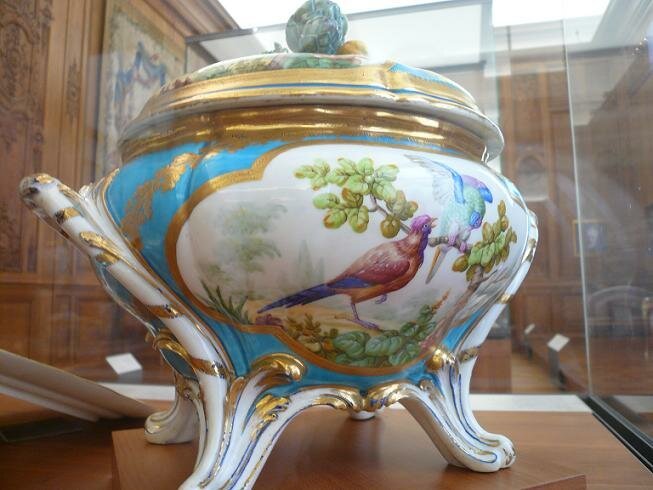
Okay, I promised you Madame de Pompadour, a Sèvres tureen, and a soup recipe, and I am going to deliver.  Just look at the pictured beauties.  Disoriented from 3 weeks under the hot blue skies of Amman, I set out on a cold, rainy lunch hour to reconnect with Paris.  Bang!  Almost immediately I found this gorgeous pot à oille, (a round instead of oval tureen) in the Petit Palais, just across and up the street from my office.  Funny how one little item can lead you such a merry chase all over French history, manners, customs, and cuisine.

It turns out that soup tureens were not made or used until the late 17th century.  Before then, poor families would eat directly out of the cooking pot with big spoons; rich families had their soup ladled from the kitchen marmite into individual bowls, covered, and served at table.

Then Saxony porcelain companies created gorgeous tureens for serving the soup course at table.  Think Royal Meissen/Dresden china.  Suddenly there was a charming way to focus attention on the Lord or Lady of the table doing the ladling, which, after all, is graceful and not as tricky as carving a roast.  This new fashion caught the attention of Louis XV’s official mistress, Madame de Pompadour, and she thought it would be awfully nice to rival Dresden with a French china that would blow it out of the water.  That’s when she discovered the small Sèvres factory around Chateau de Vincennes, very French, on the southeastern corner of Paris.

In no time at all she got the King’s interest and endorsement, moved the operation not far from Versailles, and hired the most exquisite artists (Boucher!) and craftsman to produce a soft-paste porcelain brilliant with colors and designs never before imagined.  Like the beauty pictured here.

And there you have it.  At the end of the production line, there were the petits soupers, two or three times a week, where Madame de Pompadour would cosily serve the King and an intimate group of guests–like her favorite, Voltaire–in the King’s private dining room, appropriately decorated with De Troy’s “Lunch with Oysters” and Lancret’s “Lunch with Ham.”  On the menu:  an exquisite soup to whet the appetite.

Two have come down through history named after the woman herself.  The clear Soupe à la Pompadour is a delicate consommé thickened with tapioca, then heated with thin strips of black Italian truffles (ideally from Norcia in Umbria), of poached chicken breasts, and of tongue.  The thick Purée a la Pompadour , by contrast, is a tomato purée garnished with pearls of sago palm and a julienne of lettuces. I am going to try them out this week and post the recipes on the weekend.  Perfect for an election party?  Why not?

October 29, 2008

Seduced by oysters

Filed under: Soup, soup recipes — pat @ 9:34 pm

Soup in my sink

Soup in my sink

Soup getting close to my belly

Soup getting close to my belly


It’s a cold autumn night in Paris and I’m walking home with my new hairdo from Mickael at en a parté, thinking about the new post I’m about to make on Sevrès tureens, Madame Pompadour, and 18th century French soup.  Then it hits me:  MUST HAVE OYSTER SOUP!   After all, I’m stopping by Casino’s anyway to check out the possibilities for Halloween candy.  And, how sweet, there they are:  a special on No. 3 oysters from Arcachon. Mmmmmmm.  It all comes together.  Plump, juicy oysters, butter and cream from Normandie, Muscadet wine from Bretagne–yes, definitely pop the first 6 oysters from shell to mouth to get into the spirit of the thing–and a nice garnish of cayenne pepper, shaved lemon peel, and parsley.  So if you can just hold off for another week about that incredible Soupe à la Pompadour, I’d love you to join me for Soupe aux Huitres.  It is SO easy and SO fast, especially if you don’t have to shuck the oysters.

SOUPE AUX HUITRES (for 4)

24 small oysters with their liquor (or 12 big ones, cut in half)
1 cup dry white wine
1 cup heavy cream
1/2 cup crushed biscuit crackers
6 Tablespoons butter, cut in little pieces
Salt (taste first, you may not need it) and finely ground white pepper

Garnish:  sprinkle of cayenne pepper, finely cut lemon peel, a few parsley leaves

Put the oysters, their liquor, and the wine in a saucepan and bring to a fast boil.  Immediately reduce heat to very low, skim as needed, then stir in cream, crushed crackers, and butter. Swirl the pan until the butter is incorporated.  Season carefully, swirling a little more.  Ladle into bowls and garnish with cayenne, lemon peel strips, and parsley.

October 24, 2008

Benign Neolithic Bi-Babies Bless Lentil Soup

Filed under: History and culture, Soup, soup recipes — pat @ 10:25 am

Neolithic cuties from Ain Ghazal

Neolithic cuties from Ain Ghazal

Hisaa al adas

Hisaa al adas bhamud

Okay, this is my most shameless conjunction to date. This fabulous statue, dating back some 8,000 years and part of a family group at the Amman Archeological Museum, doesn’t have anything at all to do with this particular bowl of lentil soup.

This statue and the other 31 in existence were discovered at Ain Ghazal in 1974 when a highway was being bulldozed from Amman to the nearby city Zerqa. Back when I worked in Washington, DC, I’d fallen in love with one of them–it is dramatically spotlighted in a hallway at the Sackler Gallery–and now here I was, pretty much on the spot of its creation.

Ain Ghazal was inhabited for over 2000 years, starting around 7250 BCE, and over time its people developed complex rituals, created and buried these mysterious plaster statues, domesticated sheep and cattle, built plastered homes, and became subsistence farmers who grew wheat barley, chickpeas, peas, and…and…and…LENTILS. Whew, I knew I’d come up with a nexus if I did enough research.

To honor this great moment for me, standing in the museum surrounded by these sweet-faced ET-like creatures (and let’s not even think about the astonishing other exhibits–like actual Dead Sea Scrolls; ancient copper scrolls that tantalize with a story of a still undiscovered treasure site; Nabatean pornography; skulls and life-size pottery mummies; limestone and marble statues; the list is endless and endlessly rich), may I invite you to make and eat a bowl of Jordanian lentil soup? Hisaa al adas is a classic made from brown lentils, rice, herbs, and spices. Hisaa al adas bhamud, recipe below, is a rich lemony classic made of red lentils, vegetables, herbs, and spices–absolutely sensational!

Hisaa al adas bhamud for 4

5 cups water (or light broth)
1 and 1/2 cup red lentils
1/2 pound zucchini, chopped fine
2 medium potatoes, peeled and chopped fine
2 Tablespoons olive oil
1 onion, chopped fine
1 large clove garlic, crushed with 1/4 teaspoon salt
1/4 cup cilantro and/or parsley, minced
1 teaspoon cumin
1/4 cup lemon juice
salt and pepper to taste
Garnish: sprigs of mint and lemon slices

Bring the water (or broth) to a boil and add the lentils, return to a boil, reduce heat, cover and cook for 30 minutes. Add the zucchini and potatoes, reboil, then reduce heat, cover, and let simmer for another 20 minutes. Meanwhile, saute the onions in oil over low heat until transparent, then stir in the garlic and cilantro/parsley for a minute, then the cumin, and scrape everything into the soup, which has finished cooking, and simmer for 10 more minutes. When ready to serve, stir in the lemon juice, taste for seasoning, and ladle into bowls with a sprig of mint for garnish–or serve the mint and lemon slices on the side.

October 15, 2008

Holy Land Soup in Jerash

Filed under: Soup, soup recipes — pat @ 2:29 pm

Temple of Zeus

Temple of Zeus

Hisaa al tomatem at the Royal Jordanian resto, thanks to Suleyman

Hisaa al tomatem at the Royal Jordanian resto,
with gracious thanks to Suleyman


One minute I’m swinging my feet in my Paris office, the next I’ve been offered a 3-week assignment in Amman, Jordan.  I booked my tickets the same day and flew in to Queen Alia airport last week. I hadn’t been to Jordan since 1987 when we drove as a family across the Allenby Bridge from Jericho to make our way down the King’s Highway to Petra.  This trip I had Jerash on my mind–a spectacularly intact Roman city that straddled a river and sat on top of Paleolithic, Neolithic, Bronze age and Greek civilizations, then came into its own under Roman rule.  Come the weekend, I jumped on a public bus at Abdali station and drove straight back in time for 2000 years.  You’re looking at Temple of Zeus remains through an arch of the magnificent South Amphitheater, which sat over 3000 people.  Five hours of time immersion later, I was ready to eat and headed to the open air Royal Jordanian Restaurant on the southern edge of the city. “Please help yourself to our buffet,” Suleyman said.  “Ah, but I’d really just like to refresh myself with soup and water.”  “Soup?  We don’t have soup–only in winter.”  “Oh dear, no soup?  No soup at all?” “Wait,” he said.  “Sit.  Be comfortable.”  And in no time at all, he miraculously produced a bowl of Hisaa al tomatem, a light tomato soup stuffed with small spicy lamb meatballs.  You can see how it sparkles.  It’s easy and fast to make–why don’t you make some for lunch today?

Hisaa al tomatem (for 6)

1 lb. ground lamb or beef
2 Tablespoons minced parsley
2 Tablespoons minced onion
1 teaspoon salt
1/4 teaspoon allspice
2 Tablespoons butter
1 pound crushed tomatoes (canned are fine)
4 cups light beef stock
1 cup cooked rice
1/2 cup chopped parsley
1/4 teaspoon allspice
salt and pepper to taste
Garnish:  serve lemon slices on the side

Lightly knead the minced parsley and onion, the allspice and salt into the ground beef and shape into small balls.  Fry in butter over medium heat for 5 minutes, then pour in the tomatoes and stock.  Bring to a boil, reduce heat, cover, and simmer for 15 minutes.  Add the cooked rice and simmer another 15 minutes.  Stir in the allspice, salt and pepper to taste, and chopped parsley, cover, and cook 5 more minutes.  Ladle into bowls and service with lemon slices on the side.

October 7, 2008

Velouté de coco, with a Green Fairy twist

Filed under: Soup — pat @ 3:45 pm

Bean soup by any other name would smell as sweet

Hoping for a night of decadence

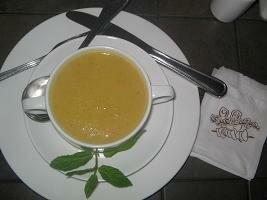
Brisk Friday night in Paris with woodsmoke in the air–Karen was on time, Barbara took the bus, Pat and Ana snaked thru 3 metro transfers to get to La Ferrandaise , just a few hops from the Sorbonne on the left bank.  Absinthe on our minds.  We’d been fantasizing all day, recalling the collective artistic madness this so-called Green Fairy spawned in the 19th  and early 20th century.  I said, “I’ll order soup so I can put this on my blog.”  Fine, they said, now let’s order the Absinthe.  So there you have it:  a picture of the soup and a picture of the elaborate Absinthe apparatus.

What about La Ferrandaise (8 rue Vaugirard, former home of controversial author Knut Hamson)?  Beef specialities from the Auvergne region of France.  Nice atmosphere but a cranky staff and a menu with ups and downs, not as exciting as it was when Ana and Barbara first stumbled on it and its absinthe connection last year.   The absinthe turned out to be a big glass of liquid licorice, pleasant–though no green fairies actually tapped us on our shoulders.  Much stranger than the absinthe was the soup, Velouté de coco, julienne de concombre acidulée (take a breath), crouton au raifort.  “It’s a cold soup,” the waitress said, clearly warning me off it.  “I love cold soup,” I said.  “Bring it on.”  And she did…but it was hot.  Imagine ceremonially pouring hot and creamy white bean soup over a bouquet of icy, marinated cucumber strips at table–and topping it with a crouton strip dabbed with horseradish. 

Well, you know, here we are, four women all pooped out on a Friday night after an intense work week, being rushed through our decadent glasses of absinthe.  I let it pass.  But when the course was cleared, I asked why that cold soup was served hot. “The manager thought you’d like it better hot,” she said.  “He was wrong.” I said.  “I was disappointed.”   No comment.

So no recipe for this one.  Maybe it would have been quite nice cold.  We’ll never know.  But I can highly recommend a hot French white bean soup that I think you’d like, brought to you straight from Ernest Hemingway gallivanting through the Pyrenees, with or without his fave absinthe: Hemingway White Bean Soup.

September 30, 2008

Soupsong Redux

Filed under: Soup — pat @ 8:35 pm

great lunch on a rainy day in Paris

great lunch on a rainy day in Paris

Hole-in-the-wall Edokko in a high rent district

Hole-in-the-wall Edokko in a high rent district

Poor old soupsong.com.  It’s been flat on its back for over 2 years now, while I’ve been painting the town rouge in Paris.  “Get off your derrière, Mom,” says daughter Meg.  “What the world needs now is soupe.  You get your act together and I’ll take it from there, tech/design wise.”

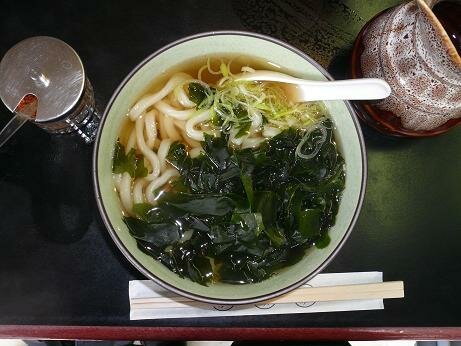
Pretty irresistible, administering the soup cure to the soup site.  Just what I was telling my chere amie Christine this week on rue du Faubourg St. Honore over a bowl of…wakame udon.  There we were at hole-in-the-wall Edokko, set akimbo to the Louvre and Cardinal Richelieu’s Palais Royale, and charging a cool 9,50 euro ($15.00) for a bowl of Japanese soup.  “Start right here with the udon, Pat,” counselled la belle Christine.  “People will think you’re really crazy to report on Japanese soup from the Land of Haute Cuisine.”

So, dear readers, it is my great pleasure to invite you back to the world of soupsong.com and to serve you a bowl of udon.

Mmmmmmmmmmm.  Thick chewy noodles in a fragrant broth with seductive bright green fronds of the fabulous wakame seaweed.  I’m just a couple steps from the Seine, but it sure smells like the salt spume of the ocean here at Edokko.  I didn’t have the recipe on my site, so: how to find the recipe, get the ingredients, and test it?

In fact, “Little Japan” in Paris is pretty much located on rue Sainte-Anne, a stone’s throw away from Edokko and named in 1667 to honor Louis XIV’s mom, Anne of Austria, upon her death.  It’s a short little street in a very old part of town, 4 blocks long and serpentine.  As you’d expect in Paris, it has art galleries, wine shops, beauty salons, lingerie stores, antique dealers, hotels, tabacs, a brasserie, and TWENTY-ONE JAPANESE RESTAURANTS.

I was not surprised.  There are some 25,000 Japanese living in Paris, and nearly a million Japanese tourists visit in the course of a year.  Japan has some 450 companies in France with about 57,000 employees.  But there’s a downside:  it’s called Paris Stress Japonnaise.

Harriet Rochefort, author of French Toast, has done the research.  Japanese are even more perplexed by the French than Americans are.  Who knew?  It’s not just the language barrier, she says, it’s the nuances; the nonverbals; the fact that the French talk a mile a minute, change the subject constantly, aggressively attack some topic to get a laugh, go ballistic, then shrug philosophically. All, really, for fun–except that Parisien Japanese horribly miss calm and discipline in their lives. Dr. Hiroaki Ota in Paris has 715 patients at his psychiatric clinic at Ste. Anne’s hospital in the 14th arrondisement for Paris Stress Japonnaise.  Japanese businessmen say darkly, “French talk as if they are strolling. The conversation doesn’t go anywhere.”

Totally frustrating! Totally maddening!  Totally stressful!

What’s the cure?  You see it in front of you: a nice calming bowl of soup. The ingredients were totally easy to find at Ace Mart at 63 rue Ste.-Anne–and you should have no trouble finding them either. I recommend making a bowl of  Wakame udon for lunch today.

« Newer Posts

Powered by WordPress