soupsong.com

December 10, 2008

Here’s looking at you, Dad

Filed under: Soup, soup recipes — pat @ 10:00 am
A toast to quick healing

A toast to quick healing

French chicken soup will drink to that

French chicken soup will drink to that

My Dad took an awful fall this past Friday night and split his hip bone in half.  Not something a former B-29 pilot likes to admit, even if he is an octogenarian+ with the weakest pins a man could ever be cursed with.  The good news is that it happened in Durham, NC, and he’s in the great Duke hospital for care–now titanium/ceramic man, convalescing with a hip replacement.  The bad news is that it happened in Durham, NC, and I’m here in Paris, France, feeling like a complete dumbbell of a daughter.

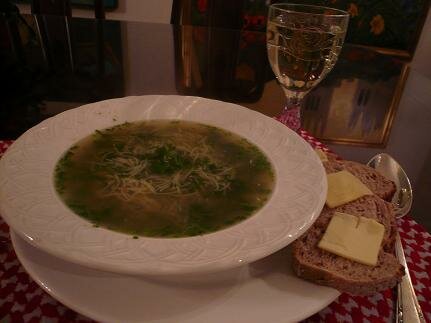
When in doubt, make soup.  In this case, I made a completely magnificent chicken stock last night and got in tonight from work to skim off the congealed fat and find it pure, strong, and heady.  Add pressed garlic, soup noodles, salt, and white pepper.  Toss in chopped greens at the end and top with parsley.  It’s called Savoyarde soupe de fides and is a soup famous for curing farmers in the snowy French Alps of what ails them.  You DO know about chicken soup curing what ails you, right? So why not use it to hasten the cure of a hip replacement?  That’s what I’m thinking.

There it is pictured, can’t you just smell the fragrance and imagine biting into those slices of pavé châtaigne pain (chestnut bread) slathered in AOC butter…sipping that glass of flinty Sancerre?

Open your mouth wide, Dad.  I’m about to email you some big spoonsful of Soupe de Fides. I think I can already hear the sweet sounds of it knitting your bones back together.

Soupe de Fides (for 2)

3 cups rich chicken stock
1 garlic clove, pressed
1/2 cup broken-up fine soup noodles
1/4 cup chopped fresh greens and herbs
salt and white pepper to taste
sprigs of parsley to garnish

Bring the stock to a boil over medium-high heat with the garlic and cook for a minute.  Add noodles and cook, uncovered, until they’re just done, from 3-5 minutes.  Add the greens/herbs just as you take the pan off the fire.  Stir, season with salt and pepper, ladle into two bowls, and top with sprigs of parsley.

Bon appetit…and get better, Dad.

December 5, 2008

What’s up, docteur?

Filed under: Restaurant review, Soup, soup recipes — pat @ 10:48 pm
A humble version of Crème Crécy, but in a proud setting

A humble version of Crème Crécy, but in a proud setting

View from the Louvre cafe, spiraling down the Pei pyramid into the heart of the old castle

View from the cafe, spiraling down the Pei pyramid into the heart of the old castle

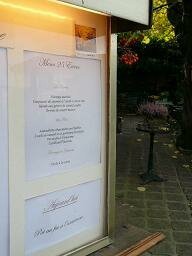
Such a miserable day. Cold rain coming down in buckets. Clearly time to execute my fave rainy lunchtime activity: Dash to the metro at Place Concorde, jump up two stops on Line 1, and worm my way underground to the Carrousel entrance of the Louvre. I’ve got the Bronzes Français exhibit on my mind. But as I start up the escalator to the Richelieu wing, I’m assailed by a tantalyzing aroma …and spot a café just right there on the balcony. No harm in seeing what’s on the menu.

Oh my, Bugs Bunny would be excited:  a steaming cauldron of Crème Crécy for 4,20 euro a shot. I can’t resist. There you see it–carrots times a thousand; piping hot; the first sip so sweet that you think the Louvre must surely be shopping at the local bio farm; a dash of white pepper, undersalted, tiny little sprigs of curly parsley. It’s exactly like so many French household soups: plain, pure, light, yet filling your belly and warming you up.

Carrots in France.  Totally interesting.  The French didn’t love them until well into the Middle Ages (originally from Afghanistan, they came in red, purple, black, yellow, and white varietals and weren’t hybridized to beta-carotene orange til the Dutch got their hands on them).  Then docs prescribed them for everything from sexual maladies to snakebite.  For good eyesight too, of course.  And the best ones were grown in Crécy, which famously gave the name to the classic carrot soup of France.  But Crécy-en-Ponthieu, the site of the English victory in 1346, up near Abbeville…or Crécy-en-Brie, to the east of Paris, in the cheese and sugar-beet district of the Marne?  I wouldn’t dream of chiming in on this enduring controversy.

But the fact is, this soup–evolving from purée to potage to crème–is eloquent, in its own way, and will definitely (according to my English grandmother) improve your eyesight. Why don’t you just drop everything and fly to Paris to take in both this humble purée AND the Louvre?

No? Well, it’s easy enough to put this soup on your table, wherever you are, and quickly, AND in a pumped up Escoffier version that is fabulous:

Crème Crécy for 4 people

2 Tablespoons butter
4 medium carrots, peeled and thinly sliced
1 onion, diced
4 cups chicken stock
1/2 cup rice
1 Tablespoon sugar (the sweetness!)
1 teaspoon salt
1 cup cream
salt and white pepper to taste
2 Tablespoons finely minced parsley
1 Tablespoon butter

In a large pot, melt the butter over medium low heat and toss in the carrots and onion. Cover and cook slowly for 15 minutes. Add the stock, rice, sugar, salt, and bring to a boil. Reduce heat and simmer for 45 minutes. Purée in a blender, add the cream and parsley, and return to a simmer. Season with salt and white pepper to taste. If you want a thinner soup, add hot water to taste. Simmer for 5 minutes then swirl in the butter. Ladle into bowls and top with a parsley leaf.

Bon appetit! And yes, despite what you read in the American press, the French ALWAYS say Bon Appetit before tucking in, and with a great twinkle in their eye, so happy to be eating a fine meal.

November 27, 2008

Brussel pouts

Filed under: History and culture, Restaurant review, Soup, soup recipes — pat @ 10:08 am
atomium, still futuristic after all these years

atomium, still futuristic after all these years

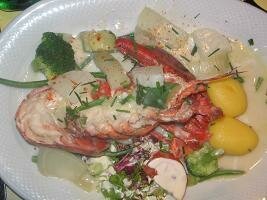
waterzooie avec homard?

waterzooie avec homard?

“Want to go to Brussels this weekend?”  My friend Stu emailed, posing the question.  You know I did.   

“Only if we can see the Atomium,” I  banter back. ”Deal.” “AND that I get to eat Waterzooie, classic Belgian soup.”  “Okay, okay!”

Four hours and a lot of traffic and and a lot of rain later, first stop: the Atomium.  It was the centerpiece of the 1958 World’s Fair, and it is still breathtaking and breathtakingly modern, sitting off in its own remote field.

Now for the waterzooie.  Here’s what I said about it 10 years ago when I published the chicken version on soupsong.com: 

Waterzooie or Waterzootsje–originating in Flanders–is one of the great national soups of the world. Belgians are pretty loose with the ingredients, though. Not only does every family have its own recipe that varies eggs, cream, and lemon–but some use fish instead of chicken. In fact, Escoffier himself captured the recipe as a fish and wine soup. Apparently wine is the ONLY ingredient all these variations have in common–and even then I have heard of variations that recommend dark Belgian beer instead of wine. This particular recipe, however, is made for the hearts and stomachs of poultry lovers–it is chicken times a thousand, and wonderfully silky and rich to boot. And just exactly what does Waterzooie mean? I hunted for weeks to find out. It translates to “a simmering, watery thing.” In other words, eggs and cream notwithstanding, the broth should not be too thick. Serve hot as a meal to 8 people–ideally with boiled potatoes, brown bread, and butter on the side.”

But as we listened to the blandishments of resto pimps on the crowded rue des Bouchers (street of butchers), we heard “Free aperitif!” “Free waffles!” “Special beer!” “Waterzooie with lobster!”

“Lobster! Did you hear THAT?”

Now we are in a bidding war of restaurants promising this heavenly dish and eventually end up in La Belle Epoch, where we are ushered to a tight little table in an elevated corner overlooking the street’s wet cobblestones. The waiter stares at us in disbelief. “We have no waterzooie with lobster.” We assure him that’s the only reason we’re sitting in his restaurant. He huddles with the man out front and comes back, grim-faced. “Okay, we have waterzooie with lobster.” “How much for it?” Stu thinks he says 13 euro.

And here you see it. Not a soup. Not 13 euro, but 30–about $43. So we don’t recommend La Belle Epoch by a long stretch. But for all that, the lobster waterzooie was absolutely delicious. And we highly recommend the chicken waterzooie recipe on soupsong.com. Marvelous!

November 12, 2008

Patriotic poems and pot au feu in small town France

Filed under: History and culture, Restaurant review, Soup, soup recipes — pat @ 7:41 pm
Honoring Barbizon heroes on 11/10

Honoring Barbizon heroes on 11/10

Leave the cold; enter pot au feu heaven

It was a funny day, me deliberately leaving behind all the heavily “planned activities at US battlefield cemeteries for Veteran’s Day” to strike out into the French countryside.  On such an autumn holiday I thought why not explore the landscapes of the Barbizon school, maybe even climb around the fabled rocks and crags of Fontainebleu forest?   I sure wasn’t in any hurry to get up or get out; wasn’t even sure the car would start after all those weeks in Amman.  But there I was in a parking lot behind the town around noon, picking my way over  John Constable Way and up and down the steps of St. Martin Chapel, emerging, to my complete surprise, into the main town square just as the music struck up.  You can see the chapel in the picture, partly blocked by the giant head of Vercingetorix, doomed leader of the Gauls against Caesar’s legions in 51 BC, who was the centerpiece of the town’s war memorial, funded in part by American subscription. 

Everyone in town showed up.  It was not our Veterans’ Day commemoration; it was specifically the 90th anniversary of Armistice Day, the end of the brutal and devastating trench warfare of WWI that literally destroyed the flower of France.  And those losses were very specific for the families who showed up at the ceremony.  Old fat guys carried the flags and laid the flowers.  The mayor, sashed in red, white, and blue, gave a moving speech.  Eight kids read the poems they’d written to honor the dead and (always) La Gloire de France, though all the red-faced boys had to be coaxed by the local teacher to read their works of art.  I was completely surprised and moved–this was no big orchestrated ceremony with political overtones; this was all about people like you and me thinking about family members who went off to war for any number of reasons and laid down their lives for it–or, with any luck, lived to tell about it.

So what’s the upshot?  Everyone left the ceremony and immediately filled up all the restaurants in town to enjoy the day.  Restaurant La Boheme featured one of the great soul foods of France–pot au feu.  It is exactly the right dish for a cold day in autumn and so soulful in its simplicity and heartiness that I hope you will just bite the bullet and make it from scratch.  Easy enough to do, if you just take it in stages: Classic pot au feu.

November 5, 2008

Royal soup on the heels of an American election day?

Filed under: History and culture, Soup, soup recipes — pat @ 8:11 pm

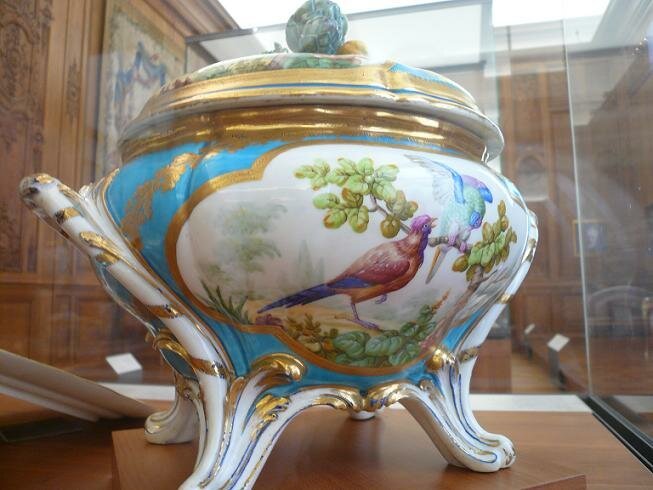
Sèvres Pot à oille standing tall in the Petit Palais

Madame de Pompadour surveys her lover Louis XV and her soupe domain

Ahem, may I first say:  it’s a great day to be an American.

Okay, I promised you Madame de Pompadour, a Sèvres tureen, and a soup recipe, and I am going to deliver.  Just look at the pictured beauties.  Disoriented from 3 weeks under the hot blue skies of Amman, I set out on a cold, rainy lunch hour to reconnect with Paris.  Bang!  Almost immediately I found this gorgeous pot à oille, (a round instead of oval tureen) in the Petit Palais, just across and up the street from my office.  Funny how one little item can lead you such a merry chase all over French history, manners, customs, and cuisine.

It turns out that soup tureens were not made or used until the late 17th century.  Before then, poor families would eat directly out of the cooking pot with big spoons; rich families had their soup ladled from the kitchen marmite into individual bowls, covered, and served at table.

Then Saxony porcelain companies created gorgeous tureens for serving the soup course at table.  Think Royal Meissen/Dresden china.  Suddenly there was a charming way to focus attention on the Lord or Lady of the table doing the ladling, which, after all, is graceful and not as tricky as carving a roast.  This new fashion caught the attention of Louis XV’s official mistress, Madame de Pompadour, and she thought it would be awfully nice to rival Dresden with a French china that would blow it out of the water.  That’s when she discovered the small Sèvres factory around Chateau de Vincennes, very French, on the southeastern corner of Paris.

In no time at all she got the King’s interest and endorsement, moved the operation not far from Versailles, and hired the most exquisite artists (Boucher!) and craftsman to produce a soft-paste porcelain brilliant with colors and designs never before imagined.  Like the beauty pictured here.

And there you have it.  At the end of the production line, there were the petits soupers, two or three times a week, where Madame de Pompadour would cosily serve the King and an intimate group of guests–like her favorite, Voltaire–in the King’s private dining room, appropriately decorated with De Troy’s “Lunch with Oysters” and Lancret’s “Lunch with Ham.”  On the menu:  an exquisite soup to whet the appetite.

Two have come down through history named after the woman herself.  The clear Soupe à la Pompadour is a delicate consommé thickened with tapioca, then heated with thin strips of black Italian truffles (ideally from Norcia in Umbria), of poached chicken breasts, and of tongue.  The thick Purée a la Pompadour , by contrast, is a tomato purée garnished with pearls of sago palm and a julienne of lettuces. I am going to try them out this week and post the recipes on the weekend.  Perfect for an election party?  Why not?

October 29, 2008

Seduced by oysters

Filed under: Soup, soup recipes — pat @ 9:34 pm
Soup in my sink

Soup in my sink

Soup getting close to my belly

Soup getting close to my belly


It’s a cold autumn night in Paris and I’m walking home with my new hairdo from Mickael at en a parté, thinking about the new post I’m about to make on Sevrès tureens, Madame Pompadour, and 18th century French soup.  Then it hits me:  MUST HAVE OYSTER SOUP!   After all, I’m stopping by Casino’s anyway to check out the possibilities for Halloween candy.  And, how sweet, there they are:  a special on No. 3 oysters from Arcachon. Mmmmmmm.  It all comes together.  Plump, juicy oysters, butter and cream from Normandie, Muscadet wine from Bretagne–yes, definitely pop the first 6 oysters from shell to mouth to get into the spirit of the thing–and a nice garnish of cayenne pepper, shaved lemon peel, and parsley.  So if you can just hold off for another week about that incredible Soupe à la Pompadour, I’d love you to join me for Soupe aux Huitres.  It is SO easy and SO fast, especially if you don’t have to shuck the oysters.

SOUPE AUX HUITRES (for 4)

24 small oysters with their liquor (or 12 big ones, cut in half)
1 cup dry white wine
1 cup heavy cream
1/2 cup crushed biscuit crackers
6 Tablespoons butter, cut in little pieces
Salt (taste first, you may not need it) and finely ground white pepper

Garnish:  sprinkle of cayenne pepper, finely cut lemon peel, a few parsley leaves

Put the oysters, their liquor, and the wine in a saucepan and bring to a fast boil.  Immediately reduce heat to very low, skim as needed, then stir in cream, crushed crackers, and butter. Swirl the pan until the butter is incorporated.  Season carefully, swirling a little more.  Ladle into bowls and garnish with cayenne, lemon peel strips, and parsley.

October 24, 2008

Benign Neolithic Bi-Babies Bless Lentil Soup

Filed under: History and culture, Soup, soup recipes — pat @ 10:25 am
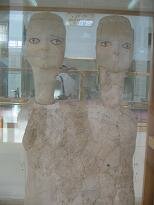
Neolithic cuties from Ain Ghazal

Neolithic cuties from Ain Ghazal

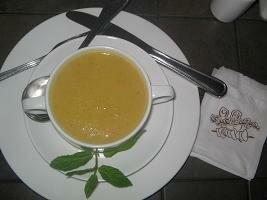
Hisaa al adas

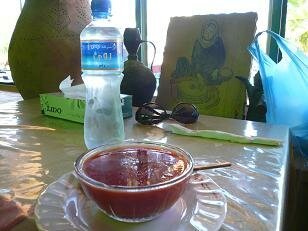
Hisaa al adas bhamud

Okay, this is my most shameless conjunction to date. This fabulous statue, dating back some 8,000 years and part of a family group at the Amman Archeological Museum, doesn’t have anything at all to do with this particular bowl of lentil soup.

This statue and the other 31 in existence were discovered at Ain Ghazal in 1974 when a highway was being bulldozed from Amman to the nearby city Zerqa. Back when I worked in Washington, DC, I’d fallen in love with one of them–it is dramatically spotlighted in a hallway at the Sackler Gallery–and now here I was, pretty much on the spot of its creation.

Ain Ghazal was inhabited for over 2000 years, starting around 7250 BCE, and over time its people developed complex rituals, created and buried these mysterious plaster statues, domesticated sheep and cattle, built plastered homes, and became subsistence farmers who grew wheat barley, chickpeas, peas, and…and…and…LENTILS. Whew, I knew I’d come up with a nexus if I did enough research.

To honor this great moment for me, standing in the museum surrounded by these sweet-faced ET-like creatures (and let’s not even think about the astonishing other exhibits–like actual Dead Sea Scrolls; ancient copper scrolls that tantalize with a story of a still undiscovered treasure site; Nabatean pornography; skulls and life-size pottery mummies; limestone and marble statues; the list is endless and endlessly rich), may I invite you to make and eat a bowl of Jordanian lentil soup? Hisaa al adas is a classic made from brown lentils, rice, herbs, and spices. Hisaa al adas bhamud, recipe below, is a rich lemony classic made of red lentils, vegetables, herbs, and spices–absolutely sensational!

Hisaa al adas bhamud for 4

5 cups water (or light broth)
1 and 1/2 cup red lentils
1/2 pound zucchini, chopped fine
2 medium potatoes, peeled and chopped fine
2 Tablespoons olive oil
1 onion, chopped fine
1 large clove garlic, crushed with 1/4 teaspoon salt
1/4 cup cilantro and/or parsley, minced
1 teaspoon cumin
1/4 cup lemon juice
salt and pepper to taste
Garnish: sprigs of mint and lemon slices

Bring the water (or broth) to a boil and add the lentils, return to a boil, reduce heat, cover and cook for 30 minutes. Add the zucchini and potatoes, reboil, then reduce heat, cover, and let simmer for another 20 minutes. Meanwhile, saute the onions in oil over low heat until transparent, then stir in the garlic and cilantro/parsley for a minute, then the cumin, and scrape everything into the soup, which has finished cooking, and simmer for 10 more minutes. When ready to serve, stir in the lemon juice, taste for seasoning, and ladle into bowls with a sprig of mint for garnish–or serve the mint and lemon slices on the side.

October 15, 2008

Holy Land Soup in Jerash

Filed under: Soup, soup recipes — pat @ 2:29 pm
Temple of Zeus

Temple of Zeus

Hisaa al tomatem at the Royal Jordanian resto, thanks to Suleyman

Hisaa al tomatem at the Royal Jordanian resto,
with gracious thanks to Suleyman


One minute I’m swinging my feet in my Paris office, the next I’ve been offered a 3-week assignment in Amman, Jordan.  I booked my tickets the same day and flew in to Queen Alia airport last week. I hadn’t been to Jordan since 1987 when we drove as a family across the Allenby Bridge from Jericho to make our way down the King’s Highway to Petra.  This trip I had Jerash on my mind–a spectacularly intact Roman city that straddled a river and sat on top of Paleolithic, Neolithic, Bronze age and Greek civilizations, then came into its own under Roman rule.  Come the weekend, I jumped on a public bus at Abdali station and drove straight back in time for 2000 years.  You’re looking at Temple of Zeus remains through an arch of the magnificent South Amphitheater, which sat over 3000 people.  Five hours of time immersion later, I was ready to eat and headed to the open air Royal Jordanian Restaurant on the southern edge of the city. “Please help yourself to our buffet,” Suleyman said.  “Ah, but I’d really just like to refresh myself with soup and water.”  “Soup?  We don’t have soup–only in winter.”  “Oh dear, no soup?  No soup at all?” “Wait,” he said.  “Sit.  Be comfortable.”  And in no time at all, he miraculously produced a bowl of Hisaa al tomatem, a light tomato soup stuffed with small spicy lamb meatballs.  You can see how it sparkles.  It’s easy and fast to make–why don’t you make some for lunch today?

Hisaa al tomatem (for 6)

1 lb. ground lamb or beef
2 Tablespoons minced parsley
2 Tablespoons minced onion
1 teaspoon salt
1/4 teaspoon allspice
2 Tablespoons butter
1 pound crushed tomatoes (canned are fine)
4 cups light beef stock
1 cup cooked rice
1/2 cup chopped parsley
1/4 teaspoon allspice
salt and pepper to taste
Garnish:  serve lemon slices on the side

Lightly knead the minced parsley and onion, the allspice and salt into the ground beef and shape into small balls.  Fry in butter over medium heat for 5 minutes, then pour in the tomatoes and stock.  Bring to a boil, reduce heat, cover, and simmer for 15 minutes.  Add the cooked rice and simmer another 15 minutes.  Stir in the allspice, salt and pepper to taste, and chopped parsley, cover, and cook 5 more minutes.  Ladle into bowls and service with lemon slices on the side.

Powered by WordPress