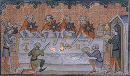
What, did he marry me to famish me? Beggars, that come unto my father's door, Upon entreaty have a present aims; If not, elsewhere they meet with charity: But I, who never knew how to entreat, Nor never needed that I should entreat, Am starved for meat, giddy for lack of sleep, With oath kept waking and with brawling fed: And that which spites me more than all these wants, He does it under name of perfect love; As who should say, if I should sleep or eat, 'Twere deadly sickness or else present death. I prithee go and get me some repast; I care not what, so it be wholesome food.
--Kate, in The Taming of the Shrew, IV, 3
* * *
For access to the corpus and for more information about Shakespeare studies, go to Michael Cumming's The Complete Shakespeare.
Shakespeare and Food
(An alphabetical garden of the Bard's esculent poesies)
| A as in almonds & apples |
B as in barley & basil |
C as in cheese & coleworts |
D as in dates & ducks |
E as in eggs & eglantine |
| F as in figs & fennel |
G as in garlic & ginger |
H as in hare & hazelnuts |
I, J as in juice & poor-john |
K, L as in leeks & lettuce |
| M as in mushrooms & mint |
N as in nutmeg & nettles |
O as in onions & oranges |
P as in parsley & peppercorns |
Q as in quail & quince |
| R as in rosemary & rice |
S as in saffron & strawberries |
T, U as in thyme & trout |
V, W, X as in veal & venison & wormwood |
Y, Z as in young fry & zucchini |
This informal survey of Shakespeare's use of food in his writings reveals much, I think, about Renaissance literary convention, about the Elizabethan table, and about Shakespeare himself. Mostly "low" characters express themselves in terms of appetite: Falstaff most prominently. Food largely stands for itself, a palpable not at all a symbolic thing suggesting larger concepts. The food is boring and rough--not even the French characters have a refined palate. And there's not much mention of it, all told, given the body of work and the central role food plays in the human drama. Wine is mentioned in 26 of the 37 plays--sack (or sherry) in 7 (mostly Falstaff calling for it); beer, malmsey, and the Welsh metheglin in a few others. If ever there was any doubt of the locus of Shakespeare's dramatic action, here's proof it's in the soul and intellect of man, not in his belly.