soupsong.com

April 18, 2009

When lilacs last in le jardin bloom’d

Filed under: History and culture,Soup,soup recipes,Uncategorized — pat @ 5:12 pm
Fragrant steetcorners

Fragrant steetcorners

Soupe au pistou

Soupe au pistou

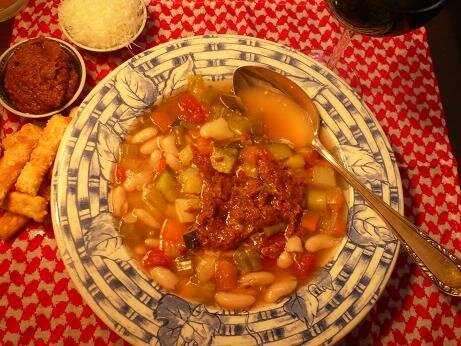
Easter Sunday, and I’m so glad to be back in Paris. It’s cool and sunny, a brilliant blue sky, and first thing in the morning I cook up a huge pot of Soupe au pistou, the ultimate French springtime soup, before heading out for a ramble in the countryside. I’m on my way to the train station, bound for Poissy, when I catch sight of this seller of lilacs and involuntarily think of Whitman’s Leaves of Grass:

In the door-yard fronting an old farm-house, near the white-wash’d palings,

Stands the lilac bush, tall-growing, with heart-shaped leaves of rich green,
With many a pointed blossom, rising, delicate, with the perfume strong I love,
With every leaf a miracle……and from this bush in the door-yard,
With delicate-color’d blossoms, and heart-shaped leaves of rich green,

A sprig, with its flower, I break.

I think, my God, here it is Easter Sunday and resurrection, lilac intimations of Whitman’s grief on war and Lincoln’s death, and springtime in Paris after being so closely held in Yemen. A lot to think about. I buy an armful–see how bashfully charming this earringed boy is?–go back home and arrange them, then set out once more for the train station.

By the end of the day, I have witnessed serial and joyful baptisms in Poissy’s 12th century Collégiale Notre Dame, a highly anticipated tradition on Easter as the Collégiale houses St. Louis’ actual baptismal font. I have wandered through the town and explored Le Corbusier’s astonishing Villa Savoye (unusual in its expansive approach to accommodate Mme. Savoye, who did not know how to back up in her new car and had to drive forwards all the way around the house in order to leave the grounds). I’ve walked along the Seine through Vilenne and on to Emile Zola’s house in Medan–reliving his battles for justice and human rights, regardless of consequences. As dusk fell and I waited, bone weary, for the return train in Vilenne, I was glad to be alone with my thoughts. I get so caught up in the moment that I just don’t think enough. And then, there’s as much pain as pleasure in it.

Vilenne to Gare St. Lazare; St. Lazare metro to Villliers; Villiers to Victor Hugo–and a quick walk past the triple fountain in the middle of the place, home. Was I happy to fire up the soup, ostentatiously prepare the little bowls of pistou and parmesan, uncork the wine? You know I was. Hot, filling, halfway between Lenten bean soup meals and the richness of Easter, it was the perfect meal for the day. In the mood for a think? You might think about having Soupe au Pistou on the back burner:

Soupe au Pistou (French Provençal Vegetable Soup with Pistou)

2 cups dried white or flageolet beans, soaked overnight, then discarding water
10 cups water
2 leeks, chopped into quarter pieces
2 carrots, chopped into quarter pieces
2 stalks celery, with leaves, chopped
2 zucchini, cubed
3 potatoes, cubed
15 green beans, cut into small pieces
3 tomatoes (or 6 canned), peeled, seeded, and chopped
¼ cup parsley, chopped
salt and pepper to taste

Garnish: Pistou
6 cloves garlic
4 Tablespoons tomato paste
¼ cup fresh basil, chopped
½ cup grated Parmesan cheese
½ cup olive oil
3-4 Tablespoons fresh parsley, chopped
Press the garlic, then whisk the tomato paste, basil, cheese, oil, and parsley with it in a blender til it is a rich paste.

In a large soup pot, bring the soaked beans and fresh water to a boil. Add all the vegetables and herbs, bring to a second boil, then reduce the heat, cover the pot, and simmer for an hour. Meanwhile, make the pistou if you don’t have any handy in the freezer.

Add the salt and pepper to the soup, stir well, and continue simmering uncovered for another 15-20 minutes.

When ready to serve, ladle the soup into big bowls. Pass the pistou–and extra Parmesan cheese, if you like–so people can load up the bowl with flavor that releases itself right under their noses.
April 11, 2009

Rapunzeled in Yemen

Filed under: History and culture,Soup — pat @ 12:54 pm
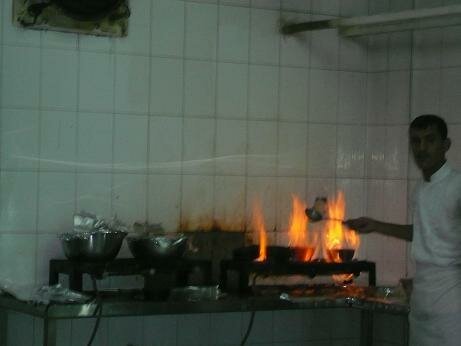
Making saltah--do not try this at home

Making saltah--do not try this at home

Magnificent saltah, brought sizzling to the table

Magnificent saltah, brought sizzling to the table

I’d no sooner arrived in Sana’a for a 4-week assignment, than 2 young suicide bombers ignited themselves on Yemeni roads. Already stiff security measures were re-doubled, and I knew I would not be able to explore this fascinating ancient culture in southern Arabia on foot. Period, end of story. So when I wasn’t working, I was curled up in a magnificent fortress with every book about Yemen I could get my hands on. Academic studies I found in the embassy library. Histories and travel guides in my boss ‘s house, where I lived. Personal accounts that I’d brought by the likes of Freya Stark, Tim Mackintosh-Smith, Steven Caton, and Eric Hansen. I’d thought this would slake my thirst for the place, but in fact it made me yearn for it…and for the fabled soup, saltah.

Here’s what Tim Macintosh-Smith has to say about saltah in Ali’s Restaurant in Sana’a: “My lunch was the same as that described by Ibn al-Mujawir in the thirteenth century: wheat bread, hulbah–fenugreek flour whisked to a froth with water–and meat. Ali himself stands in a cloud of smoke on a platform high above the ground, ladling beef broth, eggs, rice and peppers into a row of stone bowls. In front of him is a rank of cauldrons, each one big enough to boil a missionary. Below him minions tend gas cylinders that send great blasts of flame shooting up. Conversations are impossible in the roar; explosions are not unknown. The bowl of saltah, as they call the mixture, is brought to you red-hot, carried with a pair of pliers and topped with a seething yellowish-green dollop of hulbah. Lumps of meat are flambeed in a wok-like vessel, and ten feet above this the ceiling is black from years of fireballs. Men squat on the floor, on benches, on tables (the ones in suits and ties are from the Foreign Ministry across the road). Those who have not yet been served wail and shriek for attention — ‘Ya Ali! Ya Alayyy — while Ali stands, erect and unhearing, his body immobile within a parabola of arms — all his own, like those of a Hindu idol. The lucky ones who have been served eat with the saltah spitting in their faces, sweat pouring from their brows. The walls are covered with a huge photographic mural of the gardens at Versailles: parterres, statues of nymphs, cooling fountains.

“Lunch at Ali’s is not merely a matter of eating. It is the first step on the way to kayf. The meaning of this the term has been discussed by Sir Richard Burton. One might call it, he wrote, ‘The savouring of animal existence…the result of a lively impressible, excitable nature, and exquisite sensibility of nerve; it argues a facility for voluptuousness unknown to northern regions…’; but in the end the translator of The Arabian Nights admitted defeat. Kayf is ‘a word untranslatable in our mother tongue.’ Lexicographers, who cannot be so realistic, have described it as a mood, humour or frame of mind. I, who chew the leaf of the qat tree, shall attempt a definition.

“Ali’s restaurant is all to do with the humours. Blood, phlegm, yellow and black bile must be in balance to ensure perfect health and to enable the qat chewer to attain his goal of kayf; since qat excites the cold and dry black bile, prophylaxis against its ill effects means that the blood, which is hot and wet, must be stimulated. Hence the heat, the sweat, the bubbling saltah.”

So, as you can imagine, as I sat in my stone tower, my yearning for saltah grew, and I did not keep this a secret from my colleagues. Perhaps I could pay an embassy driver to bring me a bowl straight from Ali’s Restaurant? Perhaps I could ask the cooks in the embassy cafeteria if they could make it for lunch? Perhaps I could try making it myself in my boss’s kitchen?

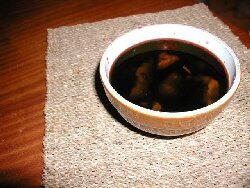
In the end, and perhaps with the thought of a fireball blackened ceiling in our kitchen, my heart’s desire was realized at the end of my assignment. Not only was I able to get a traditional saltah bowl to bring back to Paris, but we all took our chances and went out to Al Fakher Restaurant for the real thing, pictured above.

Please know that I achieved kayf without the qat. This soup is absolutely sensational. It’s thick and piquant, layered with flavors and textures of minced meat, onions, tomatoes, eggs, cilantro, rice or lentils or potatoes, all cooked in broth in a raging fire–but the hulbah topping takes it way beyond the “awfully good” category. Soaked fenugreek is whipped with garlic, onions, and spices and poured into the boiling hot soup, where it coagulates in a thick froth. As the soup spits at you, you carve chunks of the two layers with a spoon and suck it in–heaven! Will I try to make it here in the 16th arrondissement? Time will tell. I’m cautiously beginning to season my saltah bowl…

April 4, 2009

Homage to Nancy

Filed under: History and culture,Soup,soup recipes — pat @ 1:11 pm
Nancy, we miss you

Nancy, we miss you

Czarnina

Czarnina

Back in May 2002, I was lucky enough to be interviewed by Candy Sagan of the Washington Post to be headlined in its Food Section. And I was doubly lucky, because the week after the article came out my phone rang and the voice at the other end said it was impossible that the Post’s “Souper Woman” did not know about Washington DC’s “infamous Bi-Annual Soup Party.” On the spot, I was invited to attend the upcoming one in 2 week’s time.

That was pure Nancy. Nancy Manuszak was a little slip of a woman who packed a TNT punch–forging people and good times together with gusto, smoking and drinking up a storm, impossibly good hearted, incredibly complicated, and Polish to her toes. If it wasn’t her infamous soup parties, it was sausage making. If it wasn’t Friday night hen parties at controversial films, it was happy hour oysters and champagne at Old Ebbits. She greeted me as the honored guest at that first soup party and went on to proofread and challenge every statement of my book when it was still in manuscript form. She came to Paris my first Christmas here, toting a 1974 guide from her last visit, and complained about everything that had changed since then. Always we talked about soup–and especially Czarnina, which she recommended above all other soups and which I was never able to make since fresh duck or pig’s blood is not an easy ingredient to come by. “I’ll have to take your word for it,” I would say. “Humph,” she’d reply, lighting another cigarette.

In fact, Nancy died suddenly just when I’d gotten back from my first ever trip to Poland and was midway through an email to her to say, dammit, I STILL couldn’t find a bowl of Czarnina, not even in Krakow…but that I had a great new story about one related to it from Michener’s Poland. Her brother Zak wrote to me and to her hundreds of friends across the world with the news. Now her local friends in DC–Sheila and Judy and Doris and Harriet and all the others–are throwing a last, glorious Soup Party, with balloons, on April 18 to commemorate the outrageous life and opinions of Nancy Manuszak. And I can’t go in anything but spirit. So, Nancy, let me tell you this last story about Polish Black Soup. I have no doubt you’ll figure out a way to tap into the web from heaven to read it.

“Ignacy Mniszech himself went into the kitchen to supervise preparation of the soup, a task at which he spent most of that day, absenting himself from the noontime meal so that he could avoid responding to Bukowski’s implied proposal of marriage. He spent that time slaughtering a young pig and carefully catching all its blood in a ewer, which he brought back to the kitchen, where he added vinegar and salt to the blood and set the ewer aside.

“Asking the cooks for what meat stock they had, he added to it bits of cooked pork and chicken, two large handfuls of chopped vegetables, three heavy soupbones and six large dried mushrooms that he and his daugher had gathered that autumn.

“‘Prunes!’ he called, and cooks hurried up with a large handful. ‘Cherries!’ and they came up with a cupful of dried delicacies, which he tossed into the brew.

“He tended the soup all afternoon, tasting it now and then and soliciting advice from his professionals. ‘I want this to be the best. More salt, do you think?’ When it was done to everyone’s approval, a distinguished golden Polish soup, he stirred in a large helping of crumbled honey cake to bind the various elements together.

“‘An excellent soup,’ he said before the evening meal, and when he heard the guests assembling in the dining hall he divided his soup into two portions, one extremely large, the other so small that it would serve only one person, and into this latter helping he stirred the dark blood and vinegar, keeping it over the fire until it turned an ebon black.

“‘Dinner!’ he shouted as he left the kitchen, and behind him came four servants bearing soup bowls for the guests, who sniffed approvingly as their rich portions of amber colored soup were placed before them. Ignacy took the final bowl from the fourth servant and walked silently, ceremoniously to where Feliks Bukowski sat. Deftly, using both his big hands, he placed the bowl of black soup before the impetuous suitor, and when Feliks looked down at it and saw the terrible blackness he knew that his proposal of marriage had been rejected, and so did everyone else at the table.

“Convention required that he make no comment, betray no emotion. Like a soldier assigned a hateful duty, he ate his black soup, cruielly aware that the soup of the others was a rich golden borwn, and after Feliks had finished his bitter dish, Ignacy Mniszech, big and bald and brazen, rose and announced to his guests, ‘On this day my daughter Elzbieta is announcing her engagement to Roman Lubonski, son of my dear friend–Count Lubonski in Poland, Baron Lubonski in Austria. Wedding’s to be at the Mniszech palace in Warsaw, and you are all to attend.’”

Nancy, I’m missing you a lot. Your absence is a bitter, black soup to eat. “Humph,” I can hear you say.

March 20, 2009

Can There Be Too Much Polish Soup?

Filed under: History and culture,Restaurant review,Soup — pat @ 3:04 pm
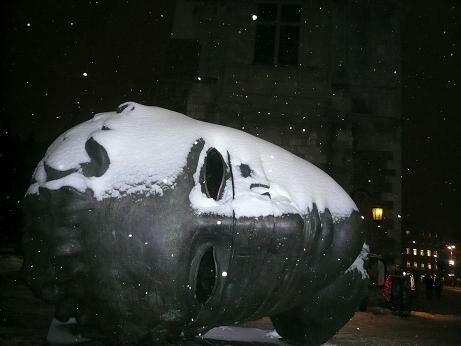
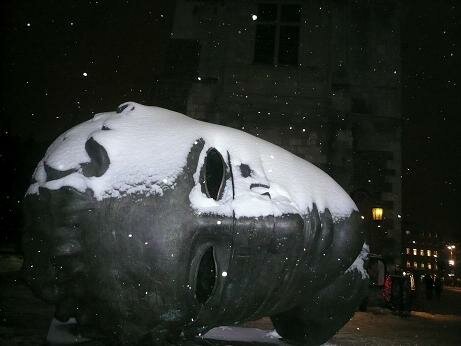
Giant snowy head pondering the question

Giant snowy head pondering the question

The answer: No!

The answer: No!

Why no soup blogs for nearly a month? Easy–I have been on the road. First a pleasure trip to Seattle (where I ate no soup) to celebrate daughter Meg’s birthday and cuddle darling petite enfant Rosalind…then, unexpectedly, a 30-day assignment to…Sana’a, Yemen.

! ! !

Let me tell you, as I sit here in southern Arabia ringed by brown mountains, the hot sun beating out of a cloudless, deep blue sky, my quick trip to snowy Krakow, Poland, with friend Elizabeth seems years instead of weeks past. But it was a marvelous trip, and literally so full of soup that I’ve had to split the blog into four.

We went on a whim–Transavia Air flew out of Orly round trip for $182–and landed late at night in a blizzard. And by the time we arrived at the little La Fontaine Bed and Breakfast, right off Market Square, we were starved. After a circuit around the square, full of high spirited people despite the hour, and after getting turned away at restaurants bursting at the seams, I was so happy to find Pod Sloncem, meaning “Under the Sun,” located in a 13th century basement and offering cable TV “so you can have dinner without missing out on the most important sports events.” Why “under the sun”? If you go to its website, you will see a giant sun, eyes closed and tongue protruding, carved right into the stone foundations.

My first meal is Poland was completely yummy:
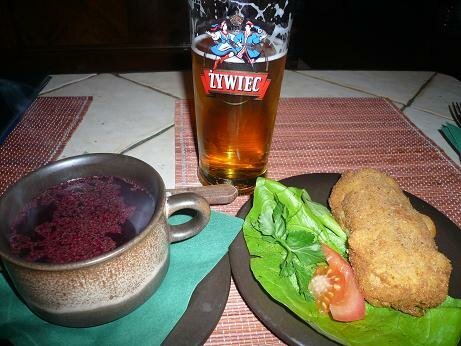
Czerwony barszczy, podawany z krokietem z kapusta i grzybami (clear and sour red beet soup with a chopped herb garnish, served with a fried croquette suffed with cabbage and mushrooms)–washed down with the excellent Zywtec beer. I remember feeling so good, so tired, tummy full, walking home through the snow. On that note, I’ll put part I of this soupy blog to bed and get on with the next one. Truly, there cannot be too much Polish soup.

And yes, I recommend Pod Sloncem for a good hearty meal, not to mention not missing the most important sports events!
Pod Sloncem
Rynek Glówny 43
31-013 Kraków
Tel.: 012 422 93 78

Nothing Less Than a Parade of Soups

Filed under: History and culture,Restaurant review,Soup — pat @ 3:02 pm
Another kind of parade...to Krzysztofory Palace

Another kind of parade...to Krzysztofory Palace

Let the soup parade begin!

Let the soup parade begin!

Elizabeth and I stumbled into an exquisite exhibit of Nativity Scenes at the Krzysztofory Palace Museum–and couldn’t tear ourselves away. As many as a hundred towering structures, many larger than a full grown man, were strung with lights and moving parts and populated with the most beloved traditions and history of Krakow–its dragon, its architecture, devils, grim reapers, Tartars, peasants, kings, queens, nobles, merchants, in many cases you really have to look sharp to find tiny little Mary and Joseph huddled over a little crib. This was the 66th year that artists of all ages created their entries and lined up at midnight on the first Thursday of December to parade to the palace. Lucky Elizabeth and I caught the very last day the scenes were on view.

And, lucky again, one good parade led to another. Polskie Jadlo Compendium Culinarium, close to St. Florian’s Gate, literally offered a “Parade of Soups” (Defilada zup Polskich)–I got to choose 4 out of 11 traditional Polish soups for 15 zlotys ($4.50). Imagine! There was classic sour white barszcz, “white soup” (whey boiled with cream and served with ham, bacon, eggs, and fennel), “ziober kwasnica” (sauerkraut soup), mushroom soup, chicken soup with meat dumplings, barszcz with yeast knish, Christmas barszcz, clear red barszcz, beef tripe soup, bread top soups, and chicken noodle soup. Here you see my choices, clockwise, the Christmas barszcz served with mushroom pierogi; the sauerkraut soup, boiled on the shoat’s snout, I was told; classic sour white barszcz with white sausage, eggs, and potatoes; and dense mushroom soup topped with thick cream. All absolutely sensational.

And please know that the restaurant was darling. I was greeted warmly at the door, seated, and brought a loaf of Polish village bread, a clay pot of homemade lard stuffed with meat bits, better not ask what, and mined salt for sprinkling. The walls were bright turquoise and decorated with embroideries, jars of pickles and preserves, copper lamps, religious pictures, and a large crucifix just under the arched ceiling. All the tables and benches were rough hewn. Lively drinking music pulsed. And tables of men and of couples were red cheeked from the snow and the beer.

Do I recommend this place? You know I do–and I hope to return myself one of these fine days.
Polskie Jadlo Compendium Culinarium
ul. Sw. Jana 30
31-018 Krakow
+48 12 433 98 25

Boletus Mushroom Soup Fit for a King

Filed under: History and culture,Soup — pat @ 3:01 pm
I'll Sing and Play to That

I'll Sing and Play to That

When bowls aren't available....

When bowls aren't available....

I didn’t know when I walked into the Church of St. Mary (Kosciól Mariacki) that no pictures were allowed unless you paid a stiff fee. So I really got my hand slapped when I fell in love with this polychrome statue, playing its harp in a dark corner, and snapped it. “Shall I delete the picture?” I asked. “No, silly person,” the security guy said. “Just no more.” Viet Stoss’ High Altar, the Ciborium, the Slacker Crucifix–all these were magnificent, but I was drawn back again and again to this sweet figure at ground level, wanting to take his hand and pat his cheek. I sought out the Camera Buster. “Who is it?” I asked. “Oh,” he muttered, “I was afraid you were going to ask. It’s…it’s…it’s…it’s on the tip of my tongue. It’s, you know, the king who played a harp.” “A Polish King?” “No, no, the one in the Bible.”

King David!

“Yes, that’s the one.”

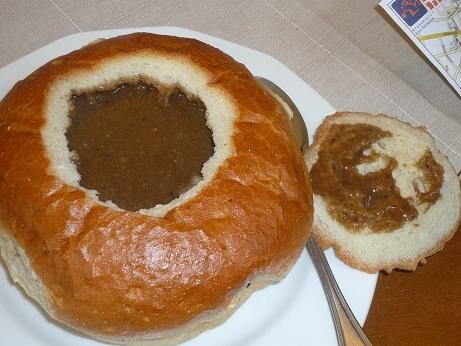
I just love that this great Jewish king is down on the floor, almost as a greeter, in the famous Market Square cathedral, not far at all from Auschwitz. It bore a lot of thinking about, really, and I was glad to find this bowl of rich mushroom soup (Zupa Grzybow) nearby, served in a traditional round of Polish bread. Hard to believe that these mushrooms sell for a king’s ransom today as it is exactly this soup that has nourished Poland’s poor since time immemorial, thanks to forests rich with them. I brought some dried ones back to Paris with me: stay tuned for a recipe.

The Very Heart of Poland

Filed under: History and culture,Soup,soup recipes — pat @ 3:00 pm
Wawel Cathedral--the spiritual heart

Wawel Cathedral--the spiritual heart

Bigos--the culinary heart

Bigos--the culinary heart

I was not going to leave Poland without a fine dish of Bigos–one of the most popular soups on my website, at least in drawing extremely opinionated commentary. Not for vegetarians! It is crammed with meats and sausages, with the sweetness of apples more than balanced by the sharpness of sauerkraut–and it is traditionally served as a good-luck New Year’s dish. Well, I say that, but it’s a relatively recent tradition since only Polish aristocracy could hunt game on their estates…and only they could afford so much meat.

Adam Mickiewicz, in his 1834 epic Pan Tadeusz , speaks to the heart of this tradition, which resonates with Poles around the world:

“Bigos was being cooked in every kettle
In human language it is hard to settle
The marvels of its odor, hue and taste;
In poetry’s description one has traced
Only the clinking words and clanging rhymes….
This bigos is no ordinary dish,
For it is aptly framed to meet your wish.
Founded upon good cabbage, sliced and sour,
Which, as men say, by its own zest and power
Melts in one’s mouth, it settles in a pot
And its dewy bosom folds a lot
Of the best portions of selected meats;
Scullions parboil it then, until heat
Draws from its substance all the living juices,
And from the pot’s edge, boiling fluid sluices
And all the air is fragrant with the scent.”

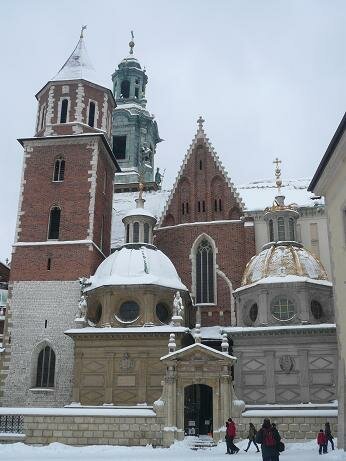
But the soup itself, it’s not pretty, is it? And unexpectedly thick. So I leave you to contemplate the culinary heart of Poland in the very heart of Polish history–at Krakow’s towering Wawel Cathedral, home of the relics of St. Stanislaw and Saint Jadwiga, boneyard of Jagiellonian kings, and final resting place of that extraordinary poet and patriot Adam Mickiewicz. And do rush out to get the fixings of Bigos–recipe at https://soupsong.com/rbigos.html.

February 21, 2009

Oh, that Dog who Smokes

Filed under: History and culture,Restaurant review,Soup,Uncategorized — pat @ 4:06 pm
Barking up the wrong tree

Barking up the wrong tree

classic soupe de poisson

classic soupe de poisson

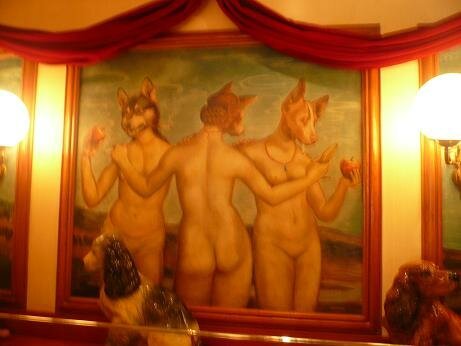
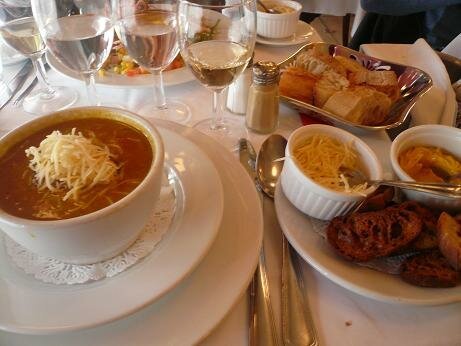
It was a sunny Sunday afternoon after a winter of cold and misery. Carmen and I had scheduled a rendezvous, but after my disastrous choice of a pleasant but seedy guinguette for our last meeting, I put her in charge of restaurant reservations. She chose Au Chien Qui Fume–which, it turns out, positively bristles with history. Not to mention extreme nuttiness. According to its own take on things, this restaurant started out in 1740 as a small inn in the heart of old Paris, right off the Pont Neuf…but it was blasted away by the Haussman reconstruction and only reappeared in 1920 when a new restaurant was opened by a man who owned a poodle that smoked cigars and a terrier that smoked a pipe. I don’t know about you, but I am taking all of this cum grano salis. Au Chien Qui Fume was the belle of the old Les Halles ball, until that febrile “belly of Paris” moved to Rungis in 1971. Now it remains popular–yes for its food, but obviously also for the novelty of its dog theme–and it sits at the corner of a clean and odorless green space in sight of the storied Saint-Eustache gothic church. It’s a darling restaurant; it’s completely ridiculous; and it serves excellent food.

Ten guesses on my first course. Soup, of course: la soupe de poisson from Provence. It was a selection on “Menu Bazil à 33,70 €” and it was yummy, served with the traditional crouton, parmesan, and rouille (recipe for rouille on soupsong’s Aziminu). Second course La Daurade Royale Grillée au Thym, Tomate, Epinards, Pommes Safranées, a great fish platter–I was actually shown the whole freshly grilled fish in its wire cage before it was deconstructed into fillets and served with thyme, tomatoes, spinach, and saffroned potatoes. A glass of white wine, coffee and chocolates, a stroll in and around Saint Eustache to see where Richelieu, Mme. Pompadour, and Moliere had been baptised–an absolutely delicious day.

But what about that Soupe de Poisson? Please note its particular construction: la soupe DE poisson, not la soupe AUX poissons–intimating it’s the very essence of fish, not just made of fishes. Surely it started out with fishermen and their wives making do with the small and broken leftovers of the daily catch–smooshing them in a pot and straining the flesh and goodness out, leaving the bones and skin behind. Then, it being France, it got improved over time until at a certain point it became a masterpiece. I love that about France.

In fact, though, the soup is not that hard to make, as Anthony Bourdain, author of Kitchen Confidential demonstrates:

6 tablespoons olive oil
4 garlic cloves
2 small onions, thinly sliced
2 leeks, whites only, washed and thinly sliced
1 fennel bulb, thinly sliced
1 can (18 ounces) plum tomatoes, chopped
2 pounds tiny whole fish (such as porgies or whiting), gutted with heads intact, or 4 pounds fish bones and heads
1 Bouquet Garni
zest of 1 orange
3 strands of saffron
1 ounce Pernod
salt and pepper

Garnishes: Rouille, freshly grated Parmesan, croutons

Heat the olive oil over medium heat in a heavy pot, add the garlic, onions, leeks, and fennel, cover, and let them sweat for about 5 minutes, stirring occasionally with a wooden spoon.
Add tomatoes and cook for another 4 to 5 minutes, then add the small fish or bones. Cook for about 15 minutes, stirring occasionally. Add water to cover, as well as the bouquet garni and orange zest. Stir well; add saffron, a dash of salt and pepper, and Pernod. Lower the heat and simmer for about an hour.
Remove pot from heat and let soup cool slightly. Strain the liquid into a large bowl. Crush the remaining solids in the pot, then add them to the strainer and press as much liquid as possible from them. Return all the soup to another pot, reheat, ladle into bowls, and serve with croutons, rouille, and some grated Parmesan on the side.

Whether you make it yourself or order it out, you’ll love it. And I recommend you try it, if your travels bring you this way, at:
Au Chien Qui Fume
33, rue du Pont Neuf
75001 Paris
01.42.36.07.42

February 12, 2009

Limousine to the Limousin

Filed under: History and culture,Restaurant review,Soup,soup recipes — pat @ 8:53 pm
Limoges: A town to dine for

Limoges: A town to dine for

Chinois? Thailandais? Is there a difference?

Chinois? Thailandais? Is there a difference?

It all started with a clock. Stu bought a magnificent pendulum table clock on French eBay and needed to fetch it, somewhere on the “1000 cow” plateau (Millevaches) in Limousin (200 miles south of Paris), by noon. What’s the street address, he’d asked Madame X. “Il n’y a pas de rue, Marcy est le nom du hameau ou lieu-dit. Il y a 9 maisons. Merçi, cordialement.” No street, she said, it’s just a little hamlet called Marcy made up of 9 homes. Thanks, cordially.

Stu picked me up in Paris at o’dark thirty and I was purring by the time we broke south on local roads, down through the flat and fecund Loire then suddenly up into rocky hills spotted with dark evergreens, patches of snow everywhere. We’d arrived in the Limousin. Cows galore. Sheep and goats too. Bye bye agriculture; hello animal husbandry.

Not easy finding Marcy! You had to be zen about it–use the GPS, follow your intuition, then call Mme. X when you were in shouting distance but had lost confidence.

Suddenly, there it was: a tiny sign on a tiny road that said (in black and in French) MARCY, then (in red) “village burned on 15 July 1944″, then (in black, large print) “by the Nazis”. We were impressed that 9 houses would have the nerve to describe themselves as a village, but when we asked about it, our sellers sniffed that in 1944 Marcy been made up of FIFTEEN homes. And when the Nazis were alerted it was serving as a safe house for the resistance, they torched the place. Six homes were obliterated. We could see on the remaining 9 homes where the new stones started and the old stones left off.

I don’t know why we were so surprised. Vichy is close by. It was a great hiding place. Deeds of derring do were hoped for and dreamed of. Really thrilling to feel that life-and-death drama come up through our shoes from the rough soil. Stu, overcome, insisted on giving Mme. X the bottle of wine he’d bought for us to take the curse off the day. We were a little sad about that later. But we had made the clock purchase by noon, right on schedule, and now were loose in the Limousin, with hours to get to our nighttime destination of Limoges and me ready to read out at length about all the best sites between here and there from the zillions of books I’d brought.

On the agenda: Aubusson (capital of extraordinary handmade French tapestry and rugs since the 12th century); anything that looked remotely interesting or had a historical marker on it; above all, any flea market, brocante, troc, or roadside table that we could paw through. We were so happy with the clock, we were hungry for more deals.

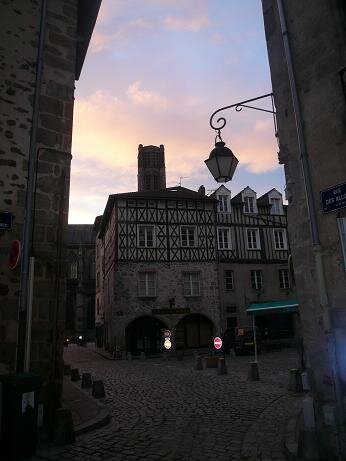
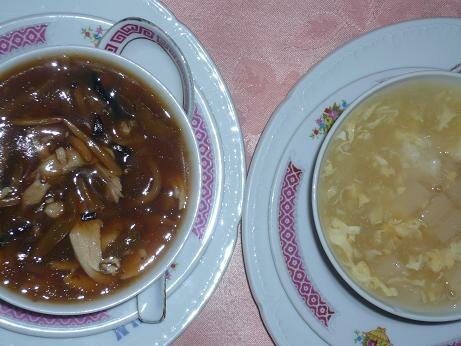
And so all our good resolutions to hit Limoges’ museums and cultural activities and porcelain houses went right out the window. We bonged around the countryside, picked through flea markets, and bought loads of cool stuff, not arriving in Limoges til well after dark. Thus the shot of cathedral square in rosy fingered dawn, as we were about to head back to Paris next morning. Thus the silly picture of our soups at Kim Lin’s “Baguettes of gold”, where we ended up after striking out everywhere else.

So, what do you think about these two soups from completely different cultures on the same table? I am excited to tell you that this illustrates perfectly something I have long wanted to share: viz., the French are so nonspecific about Asian food that Asian restaurants simply cannot make a profit unless they bundle Chinese, Thai, and Vietnamese menus under the same roof. Incredible, huh? It’s okay for Japanese restaurants to be pure, but no one else. In Limoges, in Marseilles, in Strasbourg, in Bordeaux, and above all in Paris, you cannot go into an Asian restaurant without being offered a menu that features Chinese, Vietnamese, and Thai dishes. Forgive me, I can’t get over it. I am amazed.

But the proof is in the pudding. I ordered Potage pekinois; Stu ordered potage d’asperge au crabe. A little nutty, but a great way to end an enchanting day. We recommend it, obviously a local favorite:

Restaurant Kim Lin “Baguettes d’or”
9 rue Montmouller
87000 Limoges
05.55.79.44.52

February 7, 2009

Treading the butcher block with Újházy Ede

Filed under: History and culture,Soup,soup recipes,Uncategorized — pat @ 2:25 pm
Hungarian actor in the mood for soup

Hungarian actor in the mood for soup

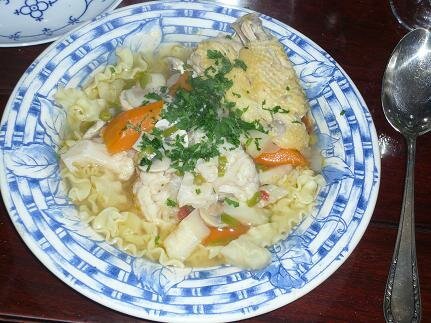
Fowl soup, Újházy style

Fowl soup, Újházy style

Once upon a time, a great Hungarian actor in the 19th century had a yen for making soup–his own Hungarian version of the French poule au pot. To ensure a concentrated flavor, Újházy Ede used a rooster, then added vegetables that differed markedly in color, shape, and texture. At the end, he served the soup over delicate egg noodles to make a dish fit for King Matthias.

His friends were enchanted. Újházy was some character, as you can see in his photo. On the Budapest stage, he was Shakespeare’s Julius Caesar and Malvolio, Molière’s Harpagon, Beaumarchais’s Bartolo, and Gárdonyi’s Gabor. He had a growly voice. My friend Sanyi translated a description that said words would explode from his enormous mouth like smoke puffs from an engine. And that, actor to his bones, his favorite word was Marha!–a Hungarian expression for stupidity–that he would deliver with such unctuous rotundity or with such heartfelt softness that the object of it felt loved rather than insulted. Plus, of course, he loved soup.

George Lang, restauranteur extraordinaire, details in his Cuisine of Hungary a number of possible variations on the original Újházy Tyúkhúsleves: brown the carrots and onions in chicken fat to achieve a Transdanubian “yellow”; add a pinch of saffron for the same effect; ditto by dry browning unpeeled onions cut in half in a frying pan and adding to the soup. Or, start out by simmering a pound of beef in the soup water before beginning the recipe. Or add marrow bones for flavor, first salting the ends of the cut bones to keep the marrow from coming out during the cooking. Or serve on the bone…or remove and discard the bones before serving.

All well and good, but the original is quite heavenly–a rich chicken soup that is just perfect for these vile and viral winter nights. Really, are you beginning to wonder, like me, if winter is EVER going to end? A blizzard rages outside my windows today AGAIN in usually snowless Paris.

Which is why, as I promised, Gergely and I met the other weekend to shop for and make this excellent soup. But we were lazy, and Woodrow Wilson Market was being dismantled by the time we got there. And here’s where Paris is so nice. We just ambled over to Trocadero, crossed the river to the Eiffel Tower and crunched over snow down Champ de Mars to end up at Rue Cler and its market. Hungry and cold, we made the soup as fast as we could, the heck with the variations. Then washed it down with a flinty Sancerre and blotted the last drops with a crusty country bread–fantastic!

Újházy Tyúkhúsleves (Chicken Soup), for 6-8 people

1 fowl (your choice: rooster, stewing hen, or tender fryer), cut into 8 pieces
12 cups cold water
1 Tablespoon salt
1 teaspoon peppercorns
slice of ginger root
1 onion, chopped
2 garlic cloves, finely chopped
1 tomato (canned is fine), peeled, seeded, and chopped
3 small carrots, peeled
2 young parsnips, peeled
1 whole celery root, peeled and cut into cubes
1/2 head cauliflower, broken into flowerets
1/2 cup peas (frozen are fine)
1/2 pound mushrooms, sliced
1 green Hungarian pepper (long, thin, and spicy), chopped
parsley, for garnish
soup noodles (which are served separately)

Put the fowl in a large soup pot with the cold water, salt, and the peppercorns and ginger tied into a cheesecloth bag. Slowly bring to a simmer, removing scum as it forms. Keep at a simmer, adding the onion, garlic, and tomato, and cook for an hour (or 2 hours, if you are using a stewing hen or rooster). Keeping the heat at a simmer, add the carrots, parsnips, celery root, cauliflower, and peas and cook for an hour or more, until the vegetables are tender. Just before you are ready to serve the soup, discard the cheesecloth bag of pepper and ginger; add the sliced mushrooms and green pepper and cook 15 minutes. You may keep the chicken/rooster pieces whole in the soup–or you may fish them out, removing the meat and putting it back in the soup, then discarding the bones and skin.

While the mushrooms and green pepper are cooking, cook the soup noodles (as many as you like) separately in plenty of salted water. When done, drain, return to the pan, stir in a little butter, and keep hot until they are served. Traditionally, they are served separate from the soup.

Bring the noodles and the soup (sprinkled with minced parsley) to the table in separate dishes. Spoon the noodles into individual bowls, then ladle the soup over top.

For another variation and for recipes of Hungarian soups and other dishes, I highly recommend you visit http://www.cookbook.hu/index_angol.htm#Soups, the Hungarian recipe site (in English) of dear friend Sanyi Fenyvesi, father of my soup partner Gergely.

« Newer PostsOlder Posts »

Powered by WordPress