soupsong.com

October 2, 2009

Collaborating, etc., in Vichy, France

vichy broomheads
vichy broomheads

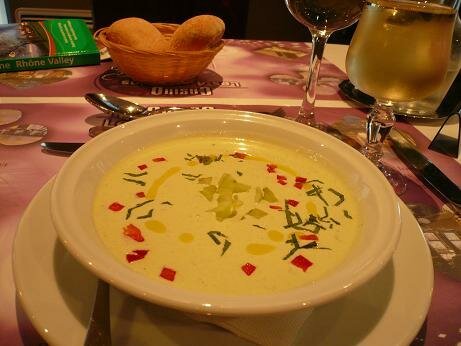
soupe d'avocat froide au citron vert, brunoise de concombre

soupe d'avocat froide au citron vert, brunoise de concombre

As I stepped off my train in Vichy’s exquisite station, I had all sorts of pre-conceptions. Yes, yes, I would find the perfect building or monument to capture the shame of Pétain’s collaborationist government with the 3rd Reich…and somehow it would also capture the long history of aristocratic pleasuring at Vichy’s thermal springs. And, oh yes, I would dine in elegance, somewhere, on native son Louis Diat’s vichyssoise and capture that on film for you too.

Oh well.

Please know that Vichy is an extraordinary town–a little down at the heels, maybe, despite the gilding, the eye-popping statuary, the exotic moorish architecture, the parks and river walks. But still dedicated to pleasure, as it has been since Emperor Napoleon III took its cool, metallic and also hot, stinky waters in the 1860s for his health. Horseracing, casinos, golf, casinos, theater, casinos, opera, casinos, and temples to health and beauty that clothe then divest you of impossibly thick white terry robes between your massages, baths, languid slumps in the hammam, you get the picture.

I had only two commitments: 1. Meeting foodie friend Catherine for a sensational lunch at Brasserie du Casino on Sunday. 2. Finding a local soup that would set your hair on fire, preferably a creation of chef Diat. First stop on Saturday morning, Brasserie du Casino–to establish that I would find a great soup there to order next day. Absolument non. There it was again–the only offering that same old bland gaspacho that is everywhere. From that point on, it was Experience the Town and Find a Soup, all day long.

How about in the oldest part of town, past Mme. de Sévigné’s house, where Pétain held his cabinet meetings, and twisting down from the heights on narrow streets to the river and the elegant pavilion housing the source of Celestin waters? Nope. Lots of restos, none served soup.

How about along the formal Parc des Sources, bristling with the priciest boutiques and most expensive restaurants? Um, no. No soup.

The center of town, cachinking from the casinos and oompah-pahing from the bandstand? Non.

Surely at the Grand Marché, a stadium of over a hundred food markets of every stripe? Rien.

In the end, the giant Les Quatre Chemins shopping center/casino complex to the north of town saved me: Soupe d’avocat froide au citron vert, brunoise de concombre in its cool panoramic restaurant just a winding staircase up from the heated, neonized casino. You can see how good it was. Thick and creamy; mild (of course, it’s French) with only a hint of lime and tarragon; tiny chunks of cucumber and sweet red pepper, a drizzle of fruity olive oil. And, you know, there it was: a 21st century version of Diat’s vichyssoise–his classic cold leek/potato soup whipped with avocado and sweetly garnished. Make it yourself from my recipe Colombian Avocado Vichyssoise .

So, a perfect and very full vacation in less than 2 days. And if I hadn’t been scouring the town for a good soup, I never would have stumbled into this pictured evidence of local wedding customs. Is it just me, or is this custom a little gender bending?

April 18, 2009

When lilacs last in le jardin bloom’d

Filed under: History and culture, Soup, Uncategorized, soup recipes — pat @ 5:12 pm

Fragrant steetcorners

Fragrant steetcorners

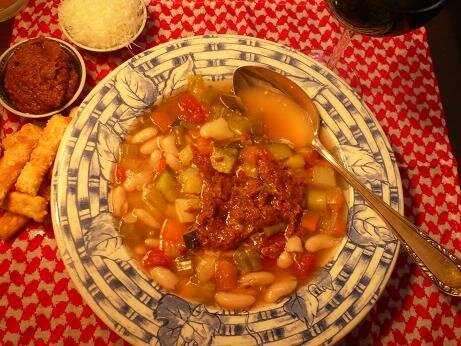
Soupe au pistou

Soupe au pistou

Easter Sunday, and I’m so glad to be back in Paris. It’s cool and sunny, a brilliant blue sky, and first thing in the morning I cook up a huge pot of Soupe au pistou, the ultimate French springtime soup, before heading out for a ramble in the countryside. I’m on my way to the train station, bound for Poissy, when I catch sight of this seller of lilacs and involuntarily think of Whitman’s Leaves of Grass:

In the door-yard fronting an old farm-house, near the white-wash’d palings,

Stands the lilac bush, tall-growing, with heart-shaped leaves of rich green,
With many a pointed blossom, rising, delicate, with the perfume strong I love,
With every leaf a miracle……and from this bush in the door-yard,
With delicate-color’d blossoms, and heart-shaped leaves of rich green,

A sprig, with its flower, I break.

I think, my God, here it is Easter Sunday and resurrection, lilac intimations of Whitman’s grief on war and Lincoln’s death, and springtime in Paris after being so closely held in Yemen. A lot to think about. I buy an armful–see how bashfully charming this earringed boy is?–go back home and arrange them, then set out once more for the train station.

By the end of the day, I have witnessed serial and joyful baptisms in Poissy’s 12th century Collégiale Notre Dame, a highly anticipated tradition on Easter as the Collégiale houses St. Louis’ actual baptismal font. I have wandered through the town and explored Le Corbusier’s astonishing Villa Savoye (unusual in its expansive approach to accommodate Mme. Savoye, who did not know how to back up in her new car and had to drive forwards all the way around the house in order to leave the grounds). I’ve walked along the Seine through Vilenne and on to Emile Zola’s house in Medan–reliving his battles for justice and human rights, regardless of consequences. As dusk fell and I waited, bone weary, for the return train in Vilenne, I was glad to be alone with my thoughts. I get so caught up in the moment that I just don’t think enough. And then, there’s as much pain as pleasure in it.

Vilenne to Gare St. Lazare; St. Lazare metro to Villliers; Villiers to Victor Hugo–and a quick walk past the triple fountain in the middle of the place, home. Was I happy to fire up the soup, ostentatiously prepare the little bowls of pistou and parmesan, uncork the wine? You know I was. Hot, filling, halfway between Lenten bean soup meals and the richness of Easter, it was the perfect meal for the day. In the mood for a think? You might think about having Soupe au Pistou on the back burner:

Soupe au Pistou (French Provençal Vegetable Soup with Pistou)

2 cups dried white or flageolet beans, soaked overnight, then discarding water
10 cups water
2 leeks, chopped into quarter pieces
2 carrots, chopped into quarter pieces
2 stalks celery, with leaves, chopped
2 zucchini, cubed
3 potatoes, cubed
15 green beans, cut into small pieces
3 tomatoes (or 6 canned), peeled, seeded, and chopped
¼ cup parsley, chopped
salt and pepper to taste

Garnish: Pistou
6 cloves garlic
4 Tablespoons tomato paste
¼ cup fresh basil, chopped
½ cup grated Parmesan cheese
½ cup olive oil
3-4 Tablespoons fresh parsley, chopped
Press the garlic, then whisk the tomato paste, basil, cheese, oil, and parsley with it in a blender til it is a rich paste.

In a large soup pot, bring the soaked beans and fresh water to a boil. Add all the vegetables and herbs, bring to a second boil, then reduce the heat, cover the pot, and simmer for an hour. Meanwhile, make the pistou if you don’t have any handy in the freezer.

Add the salt and pepper to the soup, stir well, and continue simmering uncovered for another 15-20 minutes.

When ready to serve, ladle the soup into big bowls. Pass the pistou–and extra Parmesan cheese, if you like–so people can load up the bowl with flavor that releases itself right under their noses.

February 21, 2009

Oh, that Dog who Smokes

Filed under: History and culture, Restaurant review, Soup, Uncategorized — pat @ 4:06 pm

Barking up the wrong tree

Barking up the wrong tree

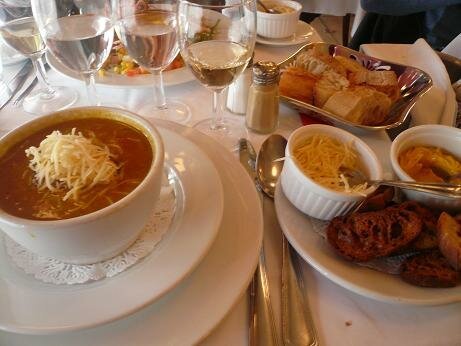
classic soupe de poisson

classic soupe de poisson

It was a sunny Sunday afternoon after a winter of cold and misery. Carmen and I had scheduled a rendezvous, but after my disastrous choice of a pleasant but seedy guinguette for our last meeting, I put her in charge of restaurant reservations. She chose Au Chien Qui Fume–which, it turns out, positively bristles with history. Not to mention extreme nuttiness. According to its own take on things, this restaurant started out in 1740 as a small inn in the heart of old Paris, right off the Pont Neuf…but it was blasted away by the Haussman reconstruction and only reappeared in 1920 when a new restaurant was opened by a man who owned a poodle that smoked cigars and a terrier that smoked a pipe. I don’t know about you, but I am taking all of this cum grano salis. Au Chien Qui Fume was the belle of the old Les Halles ball, until that febrile “belly of Paris” moved to Rungis in 1971. Now it remains popular–yes for its food, but obviously also for the novelty of its dog theme–and it sits at the corner of a clean and odorless green space in sight of the storied Saint-Eustache gothic church. It’s a darling restaurant; it’s completely ridiculous; and it serves excellent food.

Ten guesses on my first course. Soup, of course: la soupe de poisson from Provence. It was a selection on “Menu Bazil à 33,70 €” and it was yummy, served with the traditional crouton, parmesan, and rouille (recipe for rouille on soupsong’s Aziminu). Second course La Daurade Royale Grillée au Thym, Tomate, Epinards, Pommes Safranées, a great fish platter–I was actually shown the whole freshly grilled fish in its wire cage before it was deconstructed into fillets and served with thyme, tomatoes, spinach, and saffroned potatoes. A glass of white wine, coffee and chocolates, a stroll in and around Saint Eustache to see where Richelieu, Mme. Pompadour, and Moliere had been baptised–an absolutely delicious day.

But what about that Soupe de Poisson? Please note its particular construction: la soupe DE poisson, not la soupe AUX poissons–intimating it’s the very essence of fish, not just made of fishes. Surely it started out with fishermen and their wives making do with the small and broken leftovers of the daily catch–smooshing them in a pot and straining the flesh and goodness out, leaving the bones and skin behind. Then, it being France, it got improved over time until at a certain point it became a masterpiece. I love that about France.

In fact, though, the soup is not that hard to make, as Anthony Bourdain, author of Kitchen Confidential demonstrates:

6 tablespoons olive oil
4 garlic cloves
2 small onions, thinly sliced
2 leeks, whites only, washed and thinly sliced
1 fennel bulb, thinly sliced
1 can (18 ounces) plum tomatoes, chopped
2 pounds tiny whole fish (such as porgies or whiting), gutted with heads intact, or 4 pounds fish bones and heads
1 Bouquet Garni
zest of 1 orange
3 strands of saffron
1 ounce Pernod
salt and pepper

Garnishes: Rouille, freshly grated Parmesan, croutons

Heat the olive oil over medium heat in a heavy pot, add the garlic, onions, leeks, and fennel, cover, and let them sweat for about 5 minutes, stirring occasionally with a wooden spoon.
Add tomatoes and cook for another 4 to 5 minutes, then add the small fish or bones. Cook for about 15 minutes, stirring occasionally. Add water to cover, as well as the bouquet garni and orange zest. Stir well; add saffron, a dash of salt and pepper, and Pernod. Lower the heat and simmer for about an hour.
Remove pot from heat and let soup cool slightly. Strain the liquid into a large bowl. Crush the remaining solids in the pot, then add them to the strainer and press as much liquid as possible from them. Return all the soup to another pot, reheat, ladle into bowls, and serve with croutons, rouille, and some grated Parmesan on the side.

Whether you make it yourself or order it out, you’ll love it. And I recommend you try it, if your travels bring you this way, at:
Au Chien Qui Fume
33, rue du Pont Neuf
75001 Paris
01.42.36.07.42

February 7, 2009

Treading the butcher block with Újházy Ede

Filed under: History and culture, Soup, Uncategorized, soup recipes — pat @ 2:25 pm

Hungarian actor in the mood for soup

Hungarian actor in the mood for soup

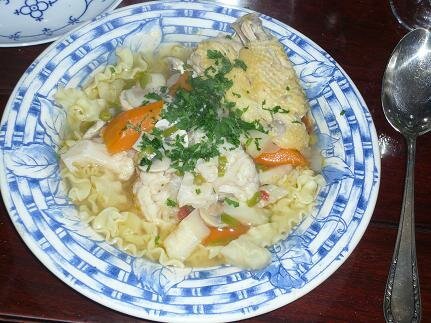
Fowl soup, Újházy style

Fowl soup, Újházy style

Once upon a time, a great Hungarian actor in the 19th century had a yen for making soup–his own Hungarian version of the French poule au pot. To ensure a concentrated flavor, Újházy Ede used a rooster, then added vegetables that differed markedly in color, shape, and texture. At the end, he served the soup over delicate egg noodles to make a dish fit for King Matthias.

His friends were enchanted. Újházy was some character, as you can see in his photo. On the Budapest stage, he was Shakespeare’s Julius Caesar and Malvolio, Molière’s Harpagon, Beaumarchais’s Bartolo, and Gárdonyi’s Gabor. He had a growly voice. My friend Sanyi translated a description that said words would explode from his enormous mouth like smoke puffs from an engine. And that, actor to his bones, his favorite word was Marha!–a Hungarian expression for stupidity–that he would deliver with such unctuous rotundity or with such heartfelt softness that the object of it felt loved rather than insulted. Plus, of course, he loved soup.

George Lang, restauranteur extraordinaire, details in his Cuisine of Hungary a number of possible variations on the original Újházy Tyúkhúsleves: brown the carrots and onions in chicken fat to achieve a Transdanubian “yellow”; add a pinch of saffron for the same effect; ditto by dry browning unpeeled onions cut in half in a frying pan and adding to the soup. Or, start out by simmering a pound of beef in the soup water before beginning the recipe. Or add marrow bones for flavor, first salting the ends of the cut bones to keep the marrow from coming out during the cooking. Or serve on the bone…or remove and discard the bones before serving.

All well and good, but the original is quite heavenly–a rich chicken soup that is just perfect for these vile and viral winter nights. Really, are you beginning to wonder, like me, if winter is EVER going to end? A blizzard rages outside my windows today AGAIN in usually snowless Paris.

Which is why, as I promised, Gergely and I met the other weekend to shop for and make this excellent soup. But we were lazy, and Woodrow Wilson Market was being dismantled by the time we got there. And here’s where Paris is so nice. We just ambled over to Trocadero, crossed the river to the Eiffel Tower and crunched over snow down Champ de Mars to end up at Rue Cler and its market. Hungry and cold, we made the soup as fast as we could, the heck with the variations. Then washed it down with a flinty Sancerre and blotted the last drops with a crusty country bread–fantastic!

Újházy Tyúkhúsleves (Chicken Soup), for 6-8 people

1 fowl (your choice: rooster, stewing hen, or tender fryer), cut into 8 pieces
12 cups cold water
1 Tablespoon salt
1 teaspoon peppercorns
slice of ginger root
1 onion, chopped
2 garlic cloves, finely chopped
1 tomato (canned is fine), peeled, seeded, and chopped
3 small carrots, peeled
2 young parsnips, peeled
1 whole celery root, peeled and cut into cubes
1/2 head cauliflower, broken into flowerets
1/2 cup peas (frozen are fine)
1/2 pound mushrooms, sliced
1 green Hungarian pepper (long, thin, and spicy), chopped
parsley, for garnish
soup noodles (which are served separately)

Put the fowl in a large soup pot with the cold water, salt, and the peppercorns and ginger tied into a cheesecloth bag. Slowly bring to a simmer, removing scum as it forms. Keep at a simmer, adding the onion, garlic, and tomato, and cook for an hour (or 2 hours, if you are using a stewing hen or rooster). Keeping the heat at a simmer, add the carrots, parsnips, celery root, cauliflower, and peas and cook for an hour or more, until the vegetables are tender. Just before you are ready to serve the soup, discard the cheesecloth bag of pepper and ginger; add the sliced mushrooms and green pepper and cook 15 minutes. You may keep the chicken/rooster pieces whole in the soup–or you may fish them out, removing the meat and putting it back in the soup, then discarding the bones and skin.

While the mushrooms and green pepper are cooking, cook the soup noodles (as many as you like) separately in plenty of salted water. When done, drain, return to the pan, stir in a little butter, and keep hot until they are served. Traditionally, they are served separate from the soup.

Bring the noodles and the soup (sprinkled with minced parsley) to the table in separate dishes. Spoon the noodles into individual bowls, then ladle the soup over top.

For another variation and for recipes of Hungarian soups and other dishes, I highly recommend you visit http://www.cookbook.hu/index_angol.htm#Soups, the Hungarian recipe site (in English) of dear friend Sanyi Fenyvesi, father of my soup partner Gergely.

Powered by WordPress