soupsong.com

October 20, 2009

“He had often eaten oysters, but had never had enough.”

Filed under: History and culture,Ingredient,Soup,soup recipes — pat @ 8:04 pm
Oysters or die, if you please.

Oysters or die, if you please.

"Never had enough"

"Never had enough"

This silly drawing is from “Etiquette,” one of W. S. Gilbert’s “Bab Ballads,” which recounts the plight of two proper but very shipwrecked Englishmen. Alas, they have not been properly introduced, so they can not exchange a word and must resolutely stay on their own side of a tiny island. Peter Gray lives on the oyster side of the island, though he hates oysters; instead, “turtle and his mother were the only things he loved.” Somers lives on the turtle side of the island, though he hates turtle meat. And, tragedy!, “he had often eaten oysters, but had never had enough.” Starvation looms…no way around the proprieties…the end is near…then suddenly…. Well, it’s complicated. I encourage you to read “Etiquette” for some rather unexpected life lessons.

Lesson #1, of course: let nothing stand in the way of eating oysters. And like it or not, last week’s homage to oyster soup was father to this week’s lesson on l’ostréiculture–oysters in France.

THE HISTORY

  • When Julius Caesar and his legions of Romans discovered Ostrea edulis, the flat, “plated” European oyster, along the 2000 miles of French coastline, they flipped. But when these became society’s darlings in the 19th century, the plated oyster virtually disappeared from overfishing and disease. Oh, they are SUCH a treat…and so expensive. I buy the biggest ONE I can find every Saturday I’m in town (the meat doesn’t get tougher with age, just bigger) and look forward to eating it all day long.
  • In 1868, story goes, the good ship Le Morlaisien ran into a storm on the way to England with a cargo of live Portugaise oysters, Crassostrea angulata, and took refuge in the Gironde estuary. Its cargo was heavy, rotting, stank–the captain finally got permission to dump them overboard…where they promptly revived and took over the place. These yummy “cup” oysters, originally brought from Asia by Portuguese traders, turned France for a second time into oyster paradise.
  • Alas, in the 1960s, disease struck both Portuguese and European oysters along the French coast–and France was once again bereft of oysters. Enter the “creuse” Pacific oyster, Crassostrea gigas, imported from Japan and from British Columbia and carefully introduced and cultivated. The comeback was quick, and today l’ostréiculture is a dazzling success once again. According to expert John McCabe, some 3,400 French oyster growers produced an estimated 518 million Euros in sales in 2005.

THE OYSTERS: 7 regions–same mostly creuse oyster, all distinctively different.

  1. Normandy, from Belgium to Mont Saint Michel along the English channel: the little niche areas of cultivation here produce a crisp, refreshing, and salty oyster. Huître spéciale d’Isigny is a particular hottie.
  2. Northern Brittany, from Mont Saint Michel to Brest along the English channel: think darling and remote little Cancale where Matisse painted and where I bought my little oyster knife, which I’ve used on every oyster since 1994. It is a haven for fresh and sparkling creuses; rich and many-layered plates; and giant wild ones (sauvages), which grow very large indeed.
  3. Southern Brittany, from the Bay of Douarnenez to the Loire River on the Atlantic Ocean: okay, we’ve turn the western corner of France south onto the straight Atlantic coast, but cultivation here is complex, with bays, rivers, and streams serving for beds. Take Belon oysters. *sigh* Oh yes, let’s take them all. These are plate oysters that are coddled and overfed in the brackish waters of the Belon river until they are shamefully plump and exotically tasty. Farther south, creuse oysters undergo similar coddling in phyto-plankton-rich seas: they turn green and have a hazelnut taste. Others whose beds stick far out into the Atlantic are fresh and salty, like kissing the sea on the lips.
  4. West Central France, from the Loire to the Charentes river on the Atlantic: Now we have entered the land of Claires cultivation–where oysters are moved from their seabeds into special basins for affinage, getting clean, getting fatter, gaining depth of flavor. Think Ile de Ré, La Rochelle, and Fouras.
  5. Marennes-Oléron, from the Charentes to the Gironde river on the Atlantic: This area takes affinage to a whole new place. This is where young oysters are moved from the sea to medieval salt basins that have been converted to shallow pools and flooded with nutritious waters. Here the oysters cleanse themselves of mud and sand; they fatten; they enrich themselves; they even learn how to keep their shells shut, so they stay alive longer in the marketplace…. It’s in these pools that the fresh, salty taste of ocean oysters turn sweet, aromatic, and rich. It’s here too that emerald green oysters are produced on a Blue navicula phyto-plankton diet. These are oysters for chewing.
  6. Arcachon, from the Gironde to Spain on the Atlantic coast: More of the same in terms of technique–the claire cultivation–but of both Japanese creuse oysters AND European plate oysters. Arcachon is equally important in producing baby oysters–which none of the other regions are able to do. Any oysters harvested in May and June will be milky, filled with either sperm or eggs, in the millions.
  7. French Mediterranean, just in the Languedoc region: unlikely and always in danger of too-high temperatures and not enough tidal action, Bassin de Thau, a lake between Bezier and Monpellier, cultivates absolutely scrumptious creuse and plate oysters–quite different in taste from their French brethren. P.S. Corsica, part of the French state, is also a cultivator of oysters, though I have never seen any in French markets.

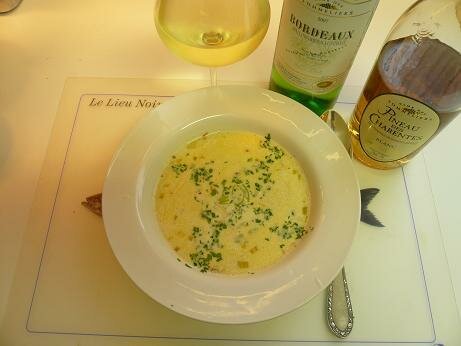
SO, if all this information has made you lust after oysters as much as me, run to the store to buy some, as I plan to do, then make the recipe below–another one adapted from Louis Anne Rothert’s Soups of France, this one from Marennes-Oléron at Charentes. She calls it Les Trois Glorieuses des Charentes” as it combines 3 of the 4 specialties of Charentes: Marennes oysters, the aperitif Pineau des Charentes, butter, and cognac.

THE RECIPE: LES TROIS GLOREUSES DES CHARENTES (per serving)
8-10 small oysters (or 3-4 big ones cut in chunks), juice reserved
1 Tablespoon butter
1 shallot, minced
1 garlic clove, minced
3/4 cup oyster juice (add fish stock or clam juice if needed)
1/2 cup heavy cream
sprinkling of white pepper
garnish: 1 Tablespoon Pineau des Charentes, minced parsley, a few thin circles of leek

Sauté the shallots in the butter over low heat, then add the garlic and stir in for a few minutes. Add the oyster juice and cook down on low heat for 5 minutes. Add the cream and bring to a simmer. When ready to serve, add the oysters and remove from the heat after 10 seconds or so, when you see the edges curl. Taste for seasoning–you probably won’t need salt if your oysters are fresh, but a little grind of white pepper is good. Ladle into your soup plate, garnish with the parsley and leeks, and sprinkle the Pineau over the top.

Dig in–you deserve it!

Please note: most of my information came straight from John McCabe’s superb Oysters.US.

October 8, 2009

‘Tis the season…

Filed under: Cookbook review,History and culture,Soup,soup recipes — pat @ 9:47 pm
Dedicated to Traditional French Soups

Dedicated to Traditional French Soups

Soupe Locmariaquer

Soupe Locmariaquer

I woke up this morning thinking about soup. Still too early for Paris to turn on the heat so, with all my casement windows open, I was double wrapped in down and still had freezing feet. Another sign of the season — old friends from early soupsong.com days are checking in. All of it feels good, heading into days of kicking through horsechestnut leaves after work, anticipating the warmth and goodness of the soup kettle just steps away.

Do you know this book? Lois Anne Rothert published The Soups of France in 2002. It’s a beauty. Forget about haute cuisine, formal restaurant service, and, in the words of 19th century gourmand Alexandre-Balthazar-Laurent Grimod de la Reynière, that “soup is to dinner what the portico or the peristyle is to an edifice. That is to say, not only is it the first part, but it should be conceived in such a way as to give an exact idea of the feast, very nearly as the overture to an opera should announce the quality of the whole work.”

Forget all that. In this book, soup IS the edifice; it IS the feast. Rothert focuses specifically on “big” meal-in-a-pot soups that are tied to specific Franch regions. Soupe au Pistou from Provence. Garbure from South West France. Matelote from Normandie and the Loire. Cotriade from Brittany. She says that, at this point in time, her book is “an essential work of safekeeping.” And it’s true: I rarely find these soups on a menu anywhere in France. They are disappearing. And you know I’ve been looking.

Likewise, Lois Rothert herself is hard to track down. She permits a small smiling picture of herself on the flyleaf of the book, proudly wearing her age with frazzled hair, oversized glasses, and an open collared jeans shirt–but is otherwise mostly invisible in the book and on the web. Fluent in French; educated at La Varenne; restauranteuse for 7 years in Fort Wayne, Indiana; mother of 4 children; winters in Indiana and summers outside Seattle in Cle Elum–that’s about it. But she knows France, knows food, and has produced a book that sings. Just look at that bowl of Soupe Locmariaquer, fat with oysters and smoked ham, from Brittany. I’ve adapted the grandmother’s recipe that she sweet-talked from the owner of the Hotel L’Escale at tiny Locmariaquer. This version is much simpler–basically the classic French potato soup that every housewife used to have on the burner…then stuffed with fresh oysters and crisp lardons right before serving.

Soupe Locmariaquer: Soupe Bonne Femme with Oysters and Crisp Ham Bits (for 6)

1 Tablespoon butter
4 leeks, cleaned and washed, then sliced (up into the green) into a 1/3-inch dice (1 and 1/2 cups)
1/2 cup diced onion
4-5 potatoes, peeled and diced (3 cups)
6 cups hot milk
sprigs of fresh rosemary, thyme, and a half bay leaf
1 teaspoon salt
1 Tablespoons butter
1/4 pound lardons (or thick bacon), cut into 1-inch pieces
24 medium-sized oysters (at least! This would be a measly 4 per bowl)
2 Tablespoons butter enrichment
Garnish: thinly sliced leeks and toasted croutes

Heat 1 T. butter in a saucepan over medium low heat, stir in the leeks and onions, and sweat slowly, covered, until they are soft, but not brown. Add the potatoes and hot milk with the salt and herbs, bring to a boil, then reduce heat and simmer for 30-40 minutes, covered, until the potatoes are soft.

While the soup is cooking, saute the lardons/bacon in a Tablespoon of butter over medium heat until the fat has rendered. Drain on paper towels and reserve.

Shuck the oysters, carefully reserving the juice and strain through cheese cloth if necessary.

When the soup is done, remove the herbs and add the oyster liquor and 2 Tablespoons of butter enrichment. Taste to see if it needs salt–it may well not, since the oyster juice is salty–and maybe grind some white pepper into it. Mash the soup to thicken it with the potatoes, without completely creaming it. It should be lumpy.

When ready to serve, slide the oysters into the simmering broth (15 or so seconds is enough to plump them). Stir in the crisp ham bits. Ladle into bowls and top with thinly sliced leeks and croutons on the side.

Bottom line: if you want to grasp French foodways and see right into the heart of the French stomach, run don’t walk to your local online used bookstore. Lois Rothert’s The Soups of France is pricey, but all treasures are.

October 2, 2009

Collaborating, etc., in Vichy, France

vichy broomheads

vichy broomheads

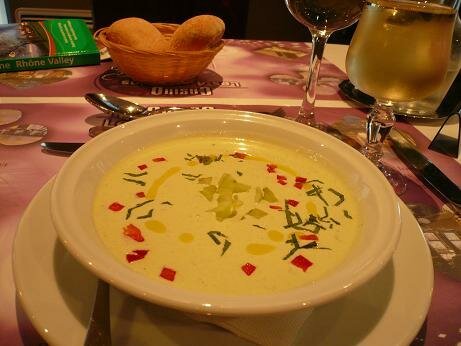
soupe d'avocat froide au citron vert, brunoise de concombre

soupe d'avocat froide au citron vert, brunoise de concombre

As I stepped off my train in Vichy’s exquisite station, I had all sorts of pre-conceptions. Yes, yes, I would find the perfect building or monument to capture the shame of Pétain’s collaborationist government with the 3rd Reich…and somehow it would also capture the long history of aristocratic pleasuring at Vichy’s thermal springs. And, oh yes, I would dine in elegance, somewhere, on native son Louis Diat’s vichyssoise and capture that on film for you too.

Oh well.

Please know that Vichy is an extraordinary town–a little down at the heels, maybe, despite the gilding, the eye-popping statuary, the exotic moorish architecture, the parks and river walks. But still dedicated to pleasure, as it has been since Emperor Napoleon III took its cool, metallic and also hot, stinky waters in the 1860s for his health. Horseracing, casinos, golf, casinos, theater, casinos, opera, casinos, and temples to health and beauty that clothe then divest you of impossibly thick white terry robes between your massages, baths, languid slumps in the hammam, you get the picture.

I had only two commitments: 1. Meeting foodie friend Catherine for a sensational lunch at Brasserie du Casino on Sunday. 2. Finding a local soup that would set your hair on fire, preferably a creation of chef Diat. First stop on Saturday morning, Brasserie du Casino–to establish that I would find a great soup there to order next day. Absolument non. There it was again–the only offering that same old bland gaspacho that is everywhere. From that point on, it was Experience the Town and Find a Soup, all day long.

How about in the oldest part of town, past Mme. de Sévigné’s house, where Pétain held his cabinet meetings, and twisting down from the heights on narrow streets to the river and the elegant pavilion housing the source of Celestin waters? Nope. Lots of restos, none served soup.

How about along the formal Parc des Sources, bristling with the priciest boutiques and most expensive restaurants? Um, no. No soup.

The center of town, cachinking from the casinos and oompah-pahing from the bandstand? Non.

Surely at the Grand Marché, a stadium of over a hundred food markets of every stripe? Rien.

In the end, the giant Les Quatre Chemins shopping center/casino complex to the north of town saved me: Soupe d’avocat froide au citron vert, brunoise de concombre in its cool panoramic restaurant just a winding staircase up from the heated, neonized casino. You can see how good it was. Thick and creamy; mild (of course, it’s French) with only a hint of lime and tarragon; tiny chunks of cucumber and sweet red pepper, a drizzle of fruity olive oil. And, you know, there it was: a 21st century version of Diat’s vichyssoise–his classic cold leek/potato soup whipped with avocado and sweetly garnished. Make it yourself from my recipe Colombian Avocado Vichyssoise .

So, a perfect and very full vacation in less than 2 days. And if I hadn’t been scouring the town for a good soup, I never would have stumbled into this pictured evidence of local wedding customs. Is it just me, or is this custom a little gender bending?

September 26, 2009

cuckoo for coco de Paimpol

Filed under: History and culture,Ingredient,Soup,soup recipes — pat @ 10:41 am
Shelled cocos with their pods

Shelled cocos with their pods

Breton pumpkin soup with cocos

Breton pumpkin soup with cocos

“Coco de Paimpol”? Suddenly these big speckly pods were all over local French markets. I’d never seen beans like them before–soft yellow pods marbled with violet arabesques–and the name was crazy: coconuts from a remote village in the northwest of France??? Of course, I bought them immediately.

Thank goodness for impulses.

Shelled, they are big, fat, beautiful, white beans. Cooked, they are bigger and fatter, exquisitely tender, even melting, and nutty in taste. They’re only sold in the pod or frozen, never dried. They don’t disintegrate, no matter low long you cook them, but their skin is so thin that they pop when your teeth just graze them. Hard to beat THAT for taste sensation. And, indeed, like the best French wines and cheeses, these beans have earned the covetted AOC rating.

What a story: The time: the 1920s. The place: South America. The drama: a young, homesick Breton sailor finds these gorgeous new-world beans in a port of call and brings back a handful to plant in his native soil, at La Pointe de l’Arcouest in the Trégor-Goëlo region of Brittany. Like young Jack of the Beanstalk’s, they practically exploded out of the ground. That particular bean and that particular microclimate turned out to be a perfect match–and they quickly spread to all the local gardens in town. Fateful magic? I think so. In the dark days of heavy World World II bombing and privation, instead of starving…it was cocos for breakfast, cocos for lunch, and cocos for dinner for the good people of Trégor-Goëlo.

But cocos came into their own in postwar France when their sheer abundance made them into a cash crop. And they hit their gourmandise stride in 1998 when they achieved that Appellation d’origine contrôlée (AOC) certification–a rarity among beans. What makes them AOC? They’re only planted in Trégor-Goëlo, and only at a certain density and only with certain fertilizer. Perhaps above all, they’re only harvested BY HAND because of the fragility of the pods, then briefly stored and rushed to market strictly by the rules.

And here is where France has so much fun with its love of fine food. Some 3000 plumeurs flock into Trégor-Goëlo in July for a lot of harvesting and a lot of partying during the summer. There are competitions in picking, competitions in shelling and recipes, and a hotly contested election for Best Plumeur of the Year.

In the spirit of this coco phenomenon, I offer you one of the recipes from Prince de Bretagne itself: Soupe potiron coco de Paimpol for 4 people:

  • 1 cup cocos, cooked in unsalted water with a bay leaf and onion pierced with a clove for 35 minutes…or fully cooked second-best white beans of your choice
  • 1 pound of pumpkin or other orange squash, peeled and cubed and steamed for about 20 minutes–then pureed and mixed with 1 cup heavy cream (or yoghurt if you’re watching calories). Season to taste with salt and white pepper.

At this point you only have to assemble the soup. Ladle the pumpkin soup equally into 4 bowls. Drain the heated cocos or beans and spoon into the center of each bowl. Sprinkle with coarse sea salt and pepper, and serve piping hot. And what’s that next to my bowl? Oh that Woodrow Wilson Market in Paris–fresh, fat chanterelle mushrooms quickly sauteed in butter. Delicious!

I know it’s cruel to tease those of you not able to get these cutie cocos, but the recipe is nice for all that, with those second-best beans of your choice.

One last issue: What ABOUT that name–why “coconuts”? The controversy rages, of course, as it always does in France when food is concerned. But why not the easy vernacular explanation–”coco” being one’s “little sweetie pie”? Plump and melting and a little nutty…sounds like a little darling from Paimpol to me.

September 18, 2009

Un bouillon de poule revives the Saint of the Day

Filed under: History and culture,Soup,soup recipes — pat @ 4:54 pm

Roland de Medici

Bouillon for the Blessed

Bouillon for the Blessed

There’s no way around it, I am hooked on Saint Du Jour.

“The Saint of the Day” appears as a small daily column in the free Paris metro newsrag, Direct Matin Plus–and is just short enough and easy enough for me to read in transit between Place Victor Hugo and Etoile metro stops on my way to work. Not a bad way to start the day, in fact, pondering these hagiographic tales of virtue and martyrdom.

Take as an example this past Tuesday, September 15, dedicated to Bienheureux Roland (that is, “Blessed” Roland de Medici, who is one step up from “Venerable” and one step short of “Saint” in the canonization process):

“In 1386, in the north of Italy, some hunters discovered our poor hero, more dead than alive, dressed only in an old goat skin, shells, and foliage, and dying of hunger…. It was Roland de Medici who, 30 years earlier, had made a vow to retreat alone to the forest. Nourishing himself only with grasses and wild fruits, he passed the hours in meditation, standing on one leg. He said that he saw the face of Jesus in the sun during his prayers. When Princess Pallavicini heard about this, she sent him her confessor, who, after listening to Roland for 2 hours, declared that after so many years of wandering and of a solitary life, Roland was ‘pure of all sin, even those of omission.’ The confessor took him under his care–AND MADE HIM A BOUILLON OF HEN TO DRINK THAT PROLONGED HIS LIFE FOR 26 DAYS. Roland only died on September 15 when he saw St. Michael and some angels had arrived to conduct him to paradise.”

Other sources elaborate: Born in Florence, he was the scion of the famous de Medici family who renounced his inheritance and appeared one day, dressed in black, in the forests of Parma. Only when his clothes rotted away did he substitute the goatskin. Which is how the Princess found him during that day of hunting, flat on his back in rotting leaves and at the point of death. He refused by signs to go to her castle and only agreed to break his lifetime vow of silence to the Carmelite confessor who was administering last sacraments.

Forgive me, but I can’t help but note that the miracle of chicken soup is part of this story. I stopped at the store on the way home and bought a poule. I cut it up and chopped the bones. I put it in a pot of ice cold water with some fresh-pulled little onions and greens and, at a snail’s pace, brought it to a simmer over low heat, to extract every morsel of goodness. I let it bubble for 6 hours. To make an appropriate offering to this pious man, I meant to clarify the broth when it was done–so that, as in Louis XIV’s commission to his cooks, I could “see my reflection in it.”

Voila! In the end, the broth was so pure and so concentrated that I only had to skim the fat and pour it into a bowl. Those are my kitchen drapes in the reflection…but I think they look properly inspirational. You just can’t beat chicken soup. If St. Michael and the angels hadn’t shown up, Bienheureux Roland might still be alive today.

September 11, 2009

Bon Baiser de Bruges

Filed under: History and culture,Soup,soup recipes — pat @ 5:59 pm
Brugesiastic stuff

Brugesiastic stuff

Waterzooie part II

Waterzooie part II

Don’t you just want to slap yourself when you go to a cool place and forget your camera? That would be me this weekend on a trip to Bruges, a medieval Flemish city caught and preserved mostly in the 14th century. Thus my photos, when I got back, of things I bought there (chocolate, tapestry pillow, 18th century chimney tile of the Bruges lion) and what I ate there (a perfect facsimile, if I do say so myself).

Am I obsessed with the Flemish soup Waterzooie? Maybe. At least as far as getting it right. I wrote earlier of my very doubtful Lobster Waterzooie in Brussels and couldn’t wait to get back to Belgium to make a correction. Except I forgot to take the camera. *sigh* But this really IS exactly like the bowl I had at Sint Joris (St. George) Brasserie on Markt Square, except with the local Bruges beer instead of this “gloriously bronze” Westmalle Triple that I brought back to Paris with me.

And what I love about this particular Waterzooie is that it is not only delicious and authentic but also totally easy, much easier than my original recipe at https://soupsong.com/rwaterzo.html. Try this per person:

  • 1 chicken thigh and 1 chicken drumstick
  • 1-inch green part of leek, cleaned and chopped
  • 1 garlic clove, peeled and chopped
  • 1 cup water or chicken stock
  • 4-5 small waxy potatoes, peeled
  • 1 cup heavy cream
  • 1 Tablespoon flour; salt and white pepper to taste
  • 1-inch peeled carrot, grated
  • garnish: parsley, finely minced

Put the chicken pieces, leeks, garlic, and potatoes in a pot, add the stock, bring to a boil, then reduce to a simmer, cover tightly, and poach for an hour–until the chicken is tender but not falling off the bone. Remove the chicken pieces and potatoes, whisk in the flour and seasonings over medium heat until thick, then whisk in the cream and grated carrots. Remove the skin from the chicken pieces, add the chicken and potatoes back into the pot, and let simmer for 10 minutes. In each bowl, arrange one thigh and one drumstick and surround with potatoes, pour the sauce over each bowl, then sprinkle with parsley. How easy is that? Serve with knife, fork, and soupspoon–and don’t forget the Belgian beer.

But my personal recommendation is to go to Bruges, and the sooner the better, to experience it in its own setting. What a city! If you have short pockets and low standards, you can stay in a hostel like the Hotel Lybeer for 27 euros, which includes a great breakfast in a crystal chandeliered common room, a discount card for all city events, and Bruges-by-Day/Bruges-by-Night maps “made by locals” that is hilarious and spot-on for what you should and should not do. But, eek, remember to take a towel for that shower down the hall….

September 4, 2009

Love Soup: The World of Anna Thomas

Filed under: Cookbook review,Soup,soup recipes — pat @ 7:47 pm
Love Soup

Love Soup

Love French Lentil Soup

Love French Lentil Soup

When I was in Seattle this summer and daughter Meg was in the urping first months of pregnancy, she said, “Mom, my refrigerator is crushed full of greens and veggies from the farm that are going bad. I can’t deal with them right now. Help!” Boy, do I wish I had had Anna’s book then. Yes I made some borshch, but all those semi-tired collards and mustards and spinaches and chards? Where was Love Soup when I needed it?

It was in the hands of publicist Rebecca Carlisle at Norton, who’d asked me if I’d review it…and it just arrived this week. I was so glad to get it, just as the weather has begun to cool and La Rentrée has commenced in France.

Anna Thomas, famous for her 1973 Vegetarian Epicure, written when she was a struggling grad student, has gotten marvelously comfortable in the kitchen since then. Her take on soup and her mostly self-created recipes in this book are exciting, but not precious–you can hear on every page that she is writing her book for real people and customizing recipes to please, not to be showy. That’s important when you’re making up soup recipes, I think, because unless soup is traditional or designed for a particular experience, it really doesn’t call for recipes–just for a sense of how to put available ingredients together in an inspired sort of way. And Ana has lessons to teach.

Love Soup is a big book; is written above all for vegetarians; and is romantic, matching produce with their just seasons in a way that connects each soup to the earth and to people. What’s new? A number of things.

  • It is as specific and various on vegetable broth recipes as most soup books are on meat and fish stocks–and this is huge, as clear/dark/rich/light foundations to soups are at least and probably more important to vegetarians who want a soup that sings.
  • It is crazy for “green soups”–just what I needed in Seattle.
  • It is crazy for using roast vegetables in soups. I love this! Tapping into the density and sweetness of roasted vegetables, so different from raw-vegetable soup, creates all new flavors and textures in the final soup bowl.
  • It is awash with inside information on ingredients and preparation, gained from both study and experience.
  • American and European measures are detailed in every recipe.

Where to start? In honor of France and in honor of friend Stu, who is currently obsessed with all things lentil soup, I chose her “French lentil stew with roasted carrots and mint for 6″ to try out this weekend. Wow.

1 and 1/2 pounds carrots, peeled and cut into 1-inch pieces
1 and 1/2 pounds onions, peeled and cut into 1/2-inch wedges
4 Tbsp olive oil
sea salt and pepper
1 generous cup French green lentils (Lentilles vertes du Puy)
4 cups cold water
4 cups vegetable broth
1 generous Tbsp. chopped fresh mint
1-2 Tbsp. fresh lemon juice
1-2 Tbsp. red chile salsa (I used the classic Basque espelette pepper sauce, just cause I’m lucky enough to be able to get it)
Garnishes: feta cheese (I substituted Poitou goat cheese) and fruity olive oil drizzles

Begin by tossing the carrots and onions separately in a bowl with a Tablespoon of olive oil, salt, and pepper to coat them, then roasting them in separate pans in a 375 degree oven for an hour, stirring occasionally. You need to keep them separate as the onions may cook more quickly and need to be stirred more often. Take them out when soft and browned, let the cool a little, then chop them coarsely.

Meanwhile, wash the lentils and put them in a pot with 4 cups of cold water. Bring to a boil, reduce the heat, and simmer, covered, for 25 minutes. Add the chopped vegetables, the vegetable broth, 1 Tablespoon of lemon juice, salt to taste, and your pepper sauce of choice. I was lucky to have gotten a jar of Basque espelette peppers while visiting Bayonne this summer in the corner of southwest France–as a rule, the French do not like spicy foods and rarely use pepper sauce. But Espelette is extraordinary–buy it if you can find it.

Simmer the soup for about 10 minutes to marry the flavors. Taste to see if it needs more salt, pepper, or lemon juice. Add more broth if you want it soupier. Ladle into soup bowls and garnish each with cheese and a drizzle of fruity olive oil.

Many thanks, Anna, for a great contribution to the world of soup cookbooks.

Anna thomas, LOVE SOUP: 160 All-New Vegetarian Recipes from the Author of The Vegetarian Epicure [W. W. Norton & Company; September 21, 2009; $22.95 paperback original].

August 29, 2009

Where’ve I been–captured by aliens?

Filed under: History and culture,Restaurant review,Soup,soup recipes — pat @ 12:50 pm
Summer goodbyes at the Café de la Paix

Summer goodbyes at the Cafe de la Paix

French twist on a classic Spanish soup

French twist on a classic Spanish soup

Well, you’d certainly think I’d been whisked away by little green men, for all I’ve been blogging. But, alas, I return with no Alien Soup recipes…only some that are Out Of This World. I hope you’ll look for them in the days ahead.

Here, though, you see a bittersweet occasion at the famous Café de la Paix. The hard core of the Paris Embassy book club is sending Elizabeth back to a new assignment in Washington and Dominique into the pleasures of la retraite, her much anticipated retirement. See how happy they both look at the front of the picture? In the case of Elizabeth, it’s an illusion. An unreconstructed lover of all things Italian, she finally admitted to Scarlett O’Hara pangs, realizing only at the end that her heart had been stolen by the Rhett Butler of Paris.

I ordered the onion soup (Soupe à l’oignon gratinée), which was okay. Dominique ordered gaspacho, pictured here. And it’s this French take on the classic Spanish soup that I want to talk about. “Gaspacho” (and I put it in quotes advisedly) is a classic of French summer cuisine. It is on the menu everywhere, from the quickest lunch takeout to the most elegant restaurant. But is it gazpacho? I’ve ordered it a number of times and found it similar to Spanish gazpacho only in that it was cold and had tomatoes in it.

Was that the case here? Already you must be scratching your head over the pot full of Parmesan slices. Just listen to my post-event interview with Dominique:

Pat: “Tell me, Dominique, was it sweet, spicy? Blandly tomato or flavorful with garlic, cucumber, and peppers? Could you taste vinegar in it…and if so, could you describe it? Was the soup smooth or chunky? And while I can see the croutons in one little bowl…was that shavings of Parmesan cheese in the other???”

Dominique: “I remember the shavings of Parmesan as very pleasant. It tasted predominantly of tomato, rather fluid in texture, not particularly sweet, but with no noticeable trace of vinegar, possibly with slices of cucumber and/or pepper if you say so (can you see them?). There must have been garlic but surprisingly the taste was not striking. All in all, a pleasant refreshing flavor much overshadowed by the charming company. Does this mean it could be improved? Well, that may be a failing of the place living more on its reputation than on the actual quality of its cuisine.”

A charming, thoughtful, and factual account, always Dominique’s signature. So be warned: when you order gaspacho in France, you are likely going to get a nicely seasoned, cold tomato puree with garnishes more suited for a hot soup.

A last word on what Dominique wickedly called “the place living more on its reputation than on the actual quality of its cuisine”. Café de la Paix is gorgeous, an icon of Paris, and parked right in front of the over-the-top Garnier Opéra–as close as we could get to Elizabeth’s fave opera house. It opened its doors on June 30, 1862, as the café/restaurant of the Grand Hotel, immediately catered to visitors of the Universal Exhibition of 1867…and soon became a favorite watering hole of luminaries like Massenet, Zola, and Maupassant. We’d just finished a highly contentious book club on that last Prince of Darkness and hoped we were sitting at Maupassant’s very table.

Pat: So, Dominique, was it worth all $16 for that cup of gaspacho?
Dominique: Évidemment!

April 25, 2009

Santé or Germiny? It’s a Sorrel Thing.

Filed under: History and culture,Soup,soup recipes — pat @ 8:19 pm
winter is over!

winter is over!

sorrel soup--health or prestige?

sorrel soup--health or prestige?

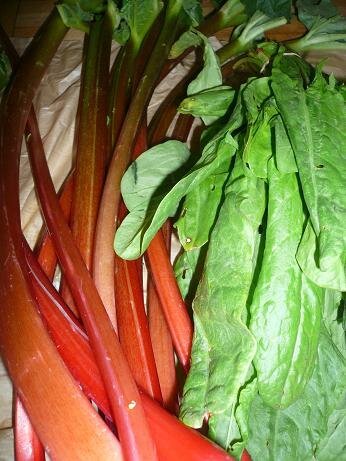
So I’m strolling through my fave Président Wilson marché early on a Saturday morning, already panting in anticipation. And there it is Joël Thiébault’s fabled stand, seemingly a city block long of every sort of sparkling fresh vegetable you could dream of, in season, just plucked from the earth at Carrières-sur-Seine, west of Paris. The cheerful serveurs hand me a wire basket and by the time I get to the cashier, no matter how darkly I mutter under my breath to myself to be moderate, it’s filled to the brim. Today I found a couple of longtime springtime friends, pictured. Rhubarb and sorrel. These, along with a couple AOC belon oysters THAT I SIMPLY CANNOT RESIST, have me whistling all the way back to my apartment.

Sorrel! Do you know it? So tart, so greenly lemon, so sour from its oxalic acid, so crisp and fine when it’s raw…and turning into a slimy mess the minute it hits heat and liquid. I have struggled with sorrel. It’s been eaten since ancient times as Rumex acetosa, cultivated tenderly, and known as “sour dabs” or dock. John Evelyn, 17th century English diarist and gardener, says about it, “…it gave so grateful a quickness to a salad that it should never be omitted”–and I agree.

But, yes, I have struggled with it in the soup pot. Back in Falls Church, when it was thick in my garden, I tried any number of recipes and any number of ideas without success. Okay, fine, I’ll just eat it raw, I decided.

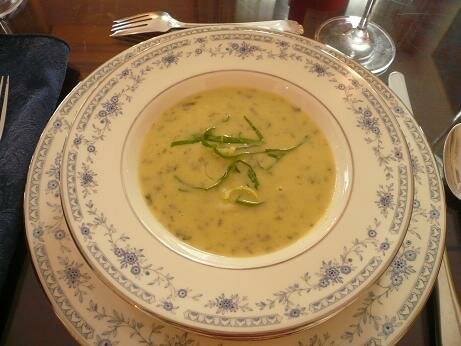
But. But now I’m in France with Joël Thiébault’s sorrel, for heaven’s sake. So I start with Crème Santé (Creamy Health Soup) in Louis Diat’s Basic French Cookbook. It’s so simple and so pure. Clean and shred enough sorrel to make 1/2 up, firmly packed. Melt a tablespoon of butter in a small saucepan, stir in the sorrel over low heat, and cook til all the moisure has cooked away, about 15 minutes. Stir it into 6 cups of Potage Parmentier, heat, then stir in over low heat 1 egg yolk mixed with a half-cup of heavy cream. Reheat, stirring, without bringing to a boil, then ladle into flat soup plates and garnish with fresh chervil (or shredded sorrel).

This time it’s terrific–and not just hot, as I served it (pictured) to Carmen last Sunday, but also cold, as I served it to Ana on Monday when she locked herself out of her apartment and needed some TLC and a little Santé to boot while her keys were being located.

So let’s try the big magilla, I think: the classic sorrel soup of French haute cuisine, Potage Germiny. This is the one that always slimed on me in Falls Church. And you know what? It’s exactly the same as Crème Santé–except it uses beef broth instead of water as a base…and the sorrel is boiled before it goes into the soup.

Please know that all the fuss about Santé and haute cuisine literally boils down to the fact that sorrel is a natural laxative. Potage Germiny was created in 1869 by chef de cuisine Adolphe Dugléré at his Café Anglais in Paris for the very very old, at that point, Comte de Germiny, former Minister of Finance and Governor of the Bank of France. Ah, regularity–a welcome thing to an old man. So while it’s true that, in Rowley Leigh’s words, “sorrel soup, with its dirty grey-green colouring, is sadly no pin up,” there is room on an old gourmet’s table for Potage Germiny.

Me, I’m not that old (yet). I tried the recipe again…and it slimed. Apparently no way around it when you boil the sorrel first. So I threw it out and am sticking to Crème Santé with its technique of removing the water in a butter saute.

And what about the rhubarb and oysters? The rhubarb made up into such an adorable little latticed pie, and the oysters were so layered in flavor, that, as in the case of the walrus and the carpenter calling out to their delicacies, “answer came there none–and this was scarcely odd, because I’d eaten every one.”

April 18, 2009

When lilacs last in le jardin bloom’d

Filed under: History and culture,Soup,soup recipes,Uncategorized — pat @ 5:12 pm
Fragrant steetcorners

Fragrant steetcorners

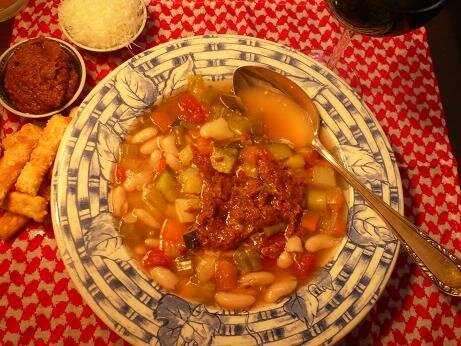
Soupe au pistou

Soupe au pistou

Easter Sunday, and I’m so glad to be back in Paris. It’s cool and sunny, a brilliant blue sky, and first thing in the morning I cook up a huge pot of Soupe au pistou, the ultimate French springtime soup, before heading out for a ramble in the countryside. I’m on my way to the train station, bound for Poissy, when I catch sight of this seller of lilacs and involuntarily think of Whitman’s Leaves of Grass:

In the door-yard fronting an old farm-house, near the white-wash’d palings,

Stands the lilac bush, tall-growing, with heart-shaped leaves of rich green,
With many a pointed blossom, rising, delicate, with the perfume strong I love,
With every leaf a miracle……and from this bush in the door-yard,
With delicate-color’d blossoms, and heart-shaped leaves of rich green,

A sprig, with its flower, I break.

I think, my God, here it is Easter Sunday and resurrection, lilac intimations of Whitman’s grief on war and Lincoln’s death, and springtime in Paris after being so closely held in Yemen. A lot to think about. I buy an armful–see how bashfully charming this earringed boy is?–go back home and arrange them, then set out once more for the train station.

By the end of the day, I have witnessed serial and joyful baptisms in Poissy’s 12th century Collégiale Notre Dame, a highly anticipated tradition on Easter as the Collégiale houses St. Louis’ actual baptismal font. I have wandered through the town and explored Le Corbusier’s astonishing Villa Savoye (unusual in its expansive approach to accommodate Mme. Savoye, who did not know how to back up in her new car and had to drive forwards all the way around the house in order to leave the grounds). I’ve walked along the Seine through Vilenne and on to Emile Zola’s house in Medan–reliving his battles for justice and human rights, regardless of consequences. As dusk fell and I waited, bone weary, for the return train in Vilenne, I was glad to be alone with my thoughts. I get so caught up in the moment that I just don’t think enough. And then, there’s as much pain as pleasure in it.

Vilenne to Gare St. Lazare; St. Lazare metro to Villliers; Villiers to Victor Hugo–and a quick walk past the triple fountain in the middle of the place, home. Was I happy to fire up the soup, ostentatiously prepare the little bowls of pistou and parmesan, uncork the wine? You know I was. Hot, filling, halfway between Lenten bean soup meals and the richness of Easter, it was the perfect meal for the day. In the mood for a think? You might think about having Soupe au Pistou on the back burner:

Soupe au Pistou (French Provençal Vegetable Soup with Pistou)

2 cups dried white or flageolet beans, soaked overnight, then discarding water
10 cups water
2 leeks, chopped into quarter pieces
2 carrots, chopped into quarter pieces
2 stalks celery, with leaves, chopped
2 zucchini, cubed
3 potatoes, cubed
15 green beans, cut into small pieces
3 tomatoes (or 6 canned), peeled, seeded, and chopped
¼ cup parsley, chopped
salt and pepper to taste

Garnish: Pistou
6 cloves garlic
4 Tablespoons tomato paste
¼ cup fresh basil, chopped
½ cup grated Parmesan cheese
½ cup olive oil
3-4 Tablespoons fresh parsley, chopped
Press the garlic, then whisk the tomato paste, basil, cheese, oil, and parsley with it in a blender til it is a rich paste.

In a large soup pot, bring the soaked beans and fresh water to a boil. Add all the vegetables and herbs, bring to a second boil, then reduce the heat, cover the pot, and simmer for an hour. Meanwhile, make the pistou if you don’t have any handy in the freezer.

Add the salt and pepper to the soup, stir well, and continue simmering uncovered for another 15-20 minutes.

When ready to serve, ladle the soup into big bowls. Pass the pistou–and extra Parmesan cheese, if you like–so people can load up the bowl with flavor that releases itself right under their noses.

« Newer PostsOlder Posts »

Powered by WordPress