Dedicated to Traditional French Soups

Soupe Locmariaquer
I woke up this morning thinking about soup. Still too early for Paris to turn on the heat so, with all my casement windows open, I was double wrapped in down and still had freezing feet. Another sign of the season — old friends from early soupsong.com days are checking in. All of it feels good, heading into days of kicking through horsechestnut leaves after work, anticipating the warmth and goodness of the soup kettle just steps away.
Do you know this book? Lois Anne Rothert published The Soups of France in 2002. It’s a beauty. Forget about haute cuisine, formal restaurant service, and, in the words of 19th century gourmand Alexandre-Balthazar-Laurent Grimod de la Reynière, that “soup is to dinner what the portico or the peristyle is to an edifice. That is to say, not only is it the first part, but it should be conceived in such a way as to give an exact idea of the feast, very nearly as the overture to an opera should announce the quality of the whole work.”
Forget all that. In this book, soup IS the edifice; it IS the feast. Rothert focuses specifically on “big” meal-in-a-pot soups that are tied to specific Franch regions. Soupe au Pistou from Provence. Garbure from South West France. Matelote from Normandie and the Loire. Cotriade from Brittany. She says that, at this point in time, her book is “an essential work of safekeeping.” And it’s true: I rarely find these soups on a menu anywhere in France. They are disappearing. And you know I’ve been looking.
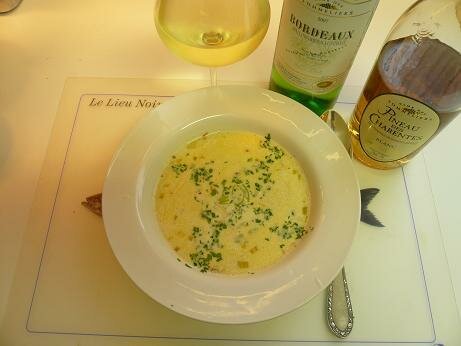
Likewise, Lois Rothert herself is hard to track down. She permits a small smiling picture of herself on the flyleaf of the book, proudly wearing her age with frazzled hair, oversized glasses, and an open collared jeans shirt–but is otherwise mostly invisible in the book and on the web. Fluent in French; educated at La Varenne; restauranteuse for 7 years in Fort Wayne, Indiana; mother of 4 children; winters in Indiana and summers outside Seattle in Cle Elum–that’s about it. But she knows France, knows food, and has produced a book that sings. Just look at that bowl of Soupe Locmariaquer, fat with oysters and smoked ham, from Brittany. I’ve adapted the grandmother’s recipe that she sweet-talked from the owner of the Hotel L’Escale at tiny Locmariaquer. This version is much simpler–basically the classic French potato soup that every housewife used to have on the burner…then stuffed with fresh oysters and crisp lardons right before serving.
Soupe Locmariaquer: Soupe Bonne Femme with Oysters and Crisp Ham Bits (for 6)
1 Tablespoon butter
4 leeks, cleaned and washed, then sliced (up into the green) into a 1/3-inch dice (1 and 1/2 cups)
1/2 cup diced onion
4-5 potatoes, peeled and diced (3 cups)
6 cups hot milk
sprigs of fresh rosemary, thyme, and a half bay leaf
1 teaspoon salt
1 Tablespoons butter
1/4 pound lardons (or thick bacon), cut into 1-inch pieces
24 medium-sized oysters (at least! This would be a measly 4 per bowl)
2 Tablespoons butter enrichment
Garnish: thinly sliced leeks and toasted croutes
Heat 1 T. butter in a saucepan over medium low heat, stir in the leeks and onions, and sweat slowly, covered, until they are soft, but not brown. Add the potatoes and hot milk with the salt and herbs, bring to a boil, then reduce heat and simmer for 30-40 minutes, covered, until the potatoes are soft.
While the soup is cooking, saute the lardons/bacon in a Tablespoon of butter over medium heat until the fat has rendered. Drain on paper towels and reserve.
Shuck the oysters, carefully reserving the juice and strain through cheese cloth if necessary.
When the soup is done, remove the herbs and add the oyster liquor and 2 Tablespoons of butter enrichment. Taste to see if it needs salt–it may well not, since the oyster juice is salty–and maybe grind some white pepper into it. Mash the soup to thicken it with the potatoes, without completely creaming it. It should be lumpy.
When ready to serve, slide the oysters into the simmering broth (15 or so seconds is enough to plump them). Stir in the crisp ham bits. Ladle into bowls and top with thinly sliced leeks and croutons on the side.
Bottom line: if you want to grasp French foodways and see right into the heart of the French stomach, run don’t walk to your local online used bookstore. Lois Rothert’s The Soups of France is pricey, but all treasures are.