soupsong.com

June 20, 2014

Tico Victory Soup

FIFACostaRica  Sopa de Pollo

How excited are Costa Ricans about the World Cup?  So excited that after the first grudge-match victory against Uruguay, a little Pino grocery in remote Northern Zone bedecked its entrance with balloon enthusiasm worthy of a stadium entrance.  Imagine what it’s done today, defeating Italy.  Wahoo!

I am just back from visiting family in San Jose and confess I have caught FIFA fever.  What better way to celebrate than with Sopa de Pollo, a soup so traditional and so revered that a local cookbook, Meals a la tica by “Sandy,” calls it “Old Hen Soup–It revives even the dead!”  I had a bowl (pictured) at La Choza de Laurel in La Fortuna, at the foot of Arenal volcano, and I can testify to the fact that it revived me, at least half dead from a long, dizzying drive through the Cordillera de Tilarán.  Just look at that scrumptious chicken soup, stuffed with corn, potato, yucca, chayote, carrot, peppers, onion, garlic, herbs and spices–and served with rice and hot corn tortillas on a banana leaf with homemade chilero (piquant, pickled veggies) and salsa lizano on the side.  The restaurant is also charming:  open-air, farmhouse style, chicken on the rotisserie, grandkids so happy after that long drive to be running out to the back barn to play with the kittens.  I recommend it if you are planning a trip (and you should!) to Arenal volcano.  Check it out at http://www.lachozadelaurel.com/.

As for the soup, well!  You don’t have to wait for a Costa Rican vacation to try it.  Here is Sandy’s recipe:

SOPA DE POLLO (for 6)

  • 1 stewing hen, plucked and cleaned
  • 9 cups water
  • 1/2 pound yuca, cut in pieces
  • 1 pound potatoes, peeled and cut in pieces
  • 1 green chayote, peeled and cut in pieces
  • 1 carrot, peeled and cut in pieces
  • 1 sweet red pepper, seeded and cut in pieces
  • 1 onion, chopped
  • 2 cloves garlic, chopped
  • chopped cilantro, celery leaves, and thyme
  • 1 nest of angel hair pasta
  • pinch of achiote
  • salt to taste

Boil the chicken for an hour or more, until tender.  Remove chicken from pot and let cool while you skim the broth.  Add all the vegetables together, return to a boil, lower heat and simmer for 25 minutes.  Shred the chicken and add it back into the pot with the herbs, pasta, achiote, and season to taste.  Cook 5-10 more minutes, until the pasta is cooked and the chicken heated, then ladle into large bowls with rice, corn tortillas, chileros, and hot sauce on the side.

Pura vida!


June 6, 2014

Take Me Out to the Ballgame

Filed under: Restaurant review,Soup,soup recipes — pat @ 6:42 pm

ballgametortillasoup

Boy, nothing as American as baseball…and tortilla soup?

It was the prettiest afternoon of the year yesterday when friend Mitch and I strolled over to National Park at the Navy Yard to watch my home team, with Natitude, thrash my old hometown team, the Philadelphia Phillies.  So hilarious in the 4th inning watching the bobblehead US Presidents Race from centerfield around first base to the Nats’ dugout.  Thomas Jefferson beat out George Washington, Abraham Lincoln, Teddy Roosevelt, and William Taft by a mile.  Even so, tough to see the Phils go down.

All that cheering and rooting on a hot day, no wonder we were hungry and thirsty after the game–and wanting to let the crowd thin.  Mitch came up with Agua 301, a  pretty new and upscale traditional Mexican restaurant/café right on the riverfront. And oh la la, the Chicken Tortilla Soup (pictured) was exquisite:  spiced shredded chicken arriving in the bowl…a side plate of avocado, pico de gallo, tortilla strips, and chile rajas…and a handsome waiter to swirl a beaker of guajillo tomato broth into the chicken.  Excellent presentation and complex layers of flavor, texture, and bite.  All the food was good, but it’s worth going to Agua 301 for this soup alone.  Read all about this place at www.agua301.com.

If you’re not in the area, though, and want to try your hand at making Sopa de Tortilla, you need to know that there are as many different variations of this classic Mexican soup as there are Mexican cooks and Mexican food enthusiasts.  The following recipe–admittedly simple–will give you a good start:

SOPA DE TORTILLA

Garnishes: fried corn tortillas; small cubes of fresh cheese (queso fresco or farmer’s cheese) or Monterey Jack; fine chopped avocado; fine chopped red pepper, wedges of lime; and crumbled ancho.

First cut off the stem of the ancho, cut it in half, and throw out the seeds. Reserve 1/4 of the dried chile to use as garnish, then soak the rest of it in hot water.

In a large saucepan, saute onion and garlic in oil over medium heat until they are golden brown–as much as 12 minutes. Puree with the tomatoes and soaked ancho, then pour back into the saucepan with the stock. Bring to a boil, then let simmer for 30 minutes. Season to taste with salt.

While broth is simmering, prepare tortillas. Traditionally, you cut day-old or dried-out corn tortillas in half, then slice the halves into thin strips–fry them on both sides in 1/3 cup of hot oil, until crisp–then drain. If time is of the essence, you can cheat with store bought.

When ready to serve, arrange cubed cheese and chopped pepper and chopped avocado in 4 flat soup bowls, then ladle over the broth, sprinkle each with the crumbled ancho, top with a mound of fried tortillas and serve with a lime wedge. The lime is important.

You’ll notice that this recipe uses the ancho chile of Michoacán. You want even hotter? Use hotter chiles. Also, I’ve selected a “pretty” combination of garnishes–but, traditionally, you can just use whatever cheese, vegetables, even chicken that you’ve got around. It’s the presentation of all these garnishes that makes it such a showstopper, as Agua 301 demonstrated. Serve hot to 4 as a substantial first course or as lunch.


May 27, 2014

Spring Soup Bliss in central France

Filed under: Restaurant review,Soup,soup recipes — pat @ 2:12 am
Assembling the greens

Assembling the greens

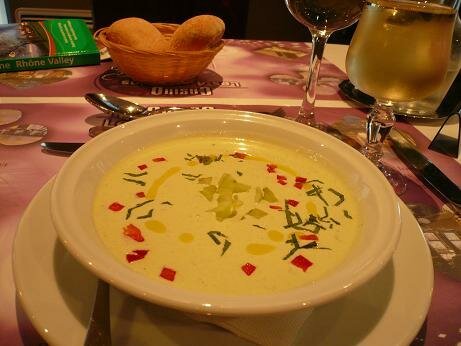
Back in 2009, you saw my friend Catherine over a bowl of  Gratinee lyonnaise in the beautiful city of Lyon.  What I didn’t tell you is that she was the creator in 1989 (then the 10-year director) of the Taste Of Tasmania food festival in Australia; chef manager for the Baron Diego von Buch in the UK; Régisseur principal for Her Royal Highness, the Grand Duke and the Grand Duchess of Luxembourg; and currently the owner and chef of an 11-room “Logis de France” hotel. L’Echalier, in Fussy, France.  Among other things! “Let’s,” I said when I was visiting this month, “make a marvelous soup in your kitchen to broadcast over soupsong.”  Catherine, a devotee of organic food and healthy living, said, “oh yes.  let’s make a very green tonic soup from the tops of my radishes, beets, and carrots and add some fresh-picked spinach.”  Isn’t she marvelous?  Doesn’t she put Nigella to shame?

Starting the soupGreens simmeringTonic tasting

Here Catherine is over the stove, mixing into the greens some water, chopped onions (two) and floury potatoes (two); blending; seasoning with salt, pepper, and a dash of nutmeg and tasting to get it exactly right.

taste test

And here I am in L’Echalier’s restaurant, so happy to be the taster.  Note the crusty bread from the boulangerie a few doors down.  Note the swirl of cream in the fresh soup.  (When she served this to customers, she splashed walnut oil and a toasted walnut on top.)  Note the glass of 2009 Vaucoupin Chablis, Premier Cru, Domaine Louis Robin.  Please note my assessment:  Deeply flavored, but light.  Tangy, earthy, bright, smooth.  And my recommendation:  Quick, run out and make this before spring is over! And, needless to say, I also recommend you consider a trip to this marvelous section of France, on the Cher river…close to the Loire valley…and popping with everything interesting from medieval towns, abbeys, priories, and gardens to one of the world’s largest radio telescopes, searching the universe for signs of extraterrestrial life.  L’Echalier is in the middle of everything, on La Route de Paris–great location…great hotel… great food…and Catherine! See rave reviews on TripAdvisor.com; contact information as follows:

  • Mme. Catherine Brys’ L’Echalier
  • 30 Route de Paris
  • 18110 Fussy
  • +33 (0)2 48 69 31 72 (hotel)
  • +33 (0)6 37 51 78 57

Bon voyage et bon appetite!

October 27, 2009

Will the real French onion soup please stand up?

Filed under: History and culture,Restaurant review,Soup,soup recipes — pat @ 5:08 pm
Me, knocking on heaven\'s door

Me, knocking on heaven's door

A soup of a different color

A soup of a different color

Who knew that REAL French onion soup began its life in Lyon? So declared lyonnais Bernard Chaléat, friend of Catherine (pictured), before we ever arrived: “La soupe à l’oignon est d’origine lyonnaise!”

Me, I would have put money on its origin in Paris, old standby that its soupe à l’oignon has been historically at Les Halles and Montmartre. And I would have lost.

Come south with me from Paris to Lyon, at the confluence of the Rhone and Saone rivers–a town founded as a Roman military colony of Lugdunum in 43 BCE, then rising to prominence from its easy position on major trading routes. The town nearly backrupted itself buying the gorgeous silks that came over the silk road from China–to the point that in 1436 Louis XI declared the town should make its own silk…and in 1536, Francois I gave Lyon the French monopoly. By the 1750s Lyon had become the silk-weaving capital of Europe.

What does all this have to do with onion soup? In fact, onion soup had everything to do with Lyon’s masses of overworked/underpaid canuts (silk workers). They worked 18 hours a day; they needed hot, rich, cheap food. Voila, onion soup poured over stale bread and a little cheese thrown on top. Probably it started as a way to flavor and enrich the broth of traditional pot-au-feu–and to use up stale bread. Then it became a tradition–and was traditionally served as the last course (if the meal was lucky enough to have several courses) to fill up and warm the bellies of workers on their way back to the looms.

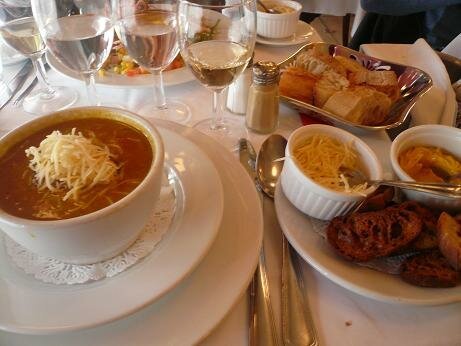
Crazy, though, that this simple beginning blossomed into today’s “gratinée lyonnaise” that insists on the addition of egg yolks and…port! Don’t ask me how a red fortified wine from the Douro Valley in Portugal found its way into this soup. In any case, you can see the upshot in the picture, under Catherine’s smiling face at Les Fines Gueules bouchon in the St. Jean district of Lyon. And you should taste it too. Despite my doubts, it’s marvelous. The chopped onions pretty much dissolve into browned richness; the egg yolks make it silky; and the port, at the end, envelopes you in heady fragrance.

Gratinée lyonnaise (for 4)

  • 2 Tablespoons butter; 2 Tablespoons oil
  • 4 medium onions, chopped
  • 6 cups beef stock (ideally, broth from your pot-au-feu)
  • salt and pepper to taste
  • 2-3 egg yolks
  • 1/2 cup red port, medium dry
  • stale sliced French bread, toasted in a slow oven until crisp through
  • 1/2-1 cup grated Comté cheese (Gruyére or Swiss is also fine, though Comté is more local to the area)

Heat the butter and oil over medium heat, toss in the onions, and sauté, stirring, for a few minutes. Reduce the heat to low, cover, and let cook until the onions have browned on the bottom. Stir the browned bits through the onion, then pour in the stock, taste for seasoning, and heat to boiling. Reduce heat to low, cover, and let simmer for at least 30 minutes. The onions should have mostly melted away.

Toast the stale French bread slices. Grate the cheese. Have the egg yolks and port handy.

When ready to serve, beat the egg yolks into the port and stir into the simmering pot. Let thicken and get silky for about 5 minutes. Place the toasted croutons into flat serving plates. Ladle the soup on top. Sprinkle each serving with as much or as little cheese as you like–but err on the light side. Such a relief to not be confronted with the Parisian throat-choking plate of cheese on top. You can serve the soup immediately or run the plates under the broiler for a quick crust.

As a last note, many thanks to Bernard and Anne Chaléat, who gave Catherine and me such an extraordinary tour of the city and its Roman aqueduct, then happily fed us in their beautiful home–all the best food of Lyon, culinary capital of France.

Finally, do I recommend Les Fines Gueules, founded by Franck Perrin and Ludovic Rouviere in 2002? Certainement! Lovely atmosphere and excellent food.
16 rue LAINERIE
69005 LYON 05
Téléphone : 04 78 28 99 14

October 2, 2009

Collaborating, etc., in Vichy, France

vichy broomheads

vichy broomheads

soupe d'avocat froide au citron vert, brunoise de concombre

soupe d'avocat froide au citron vert, brunoise de concombre

As I stepped off my train in Vichy’s exquisite station, I had all sorts of pre-conceptions. Yes, yes, I would find the perfect building or monument to capture the shame of Pétain’s collaborationist government with the 3rd Reich…and somehow it would also capture the long history of aristocratic pleasuring at Vichy’s thermal springs. And, oh yes, I would dine in elegance, somewhere, on native son Louis Diat’s vichyssoise and capture that on film for you too.

Oh well.

Please know that Vichy is an extraordinary town–a little down at the heels, maybe, despite the gilding, the eye-popping statuary, the exotic moorish architecture, the parks and river walks. But still dedicated to pleasure, as it has been since Emperor Napoleon III took its cool, metallic and also hot, stinky waters in the 1860s for his health. Horseracing, casinos, golf, casinos, theater, casinos, opera, casinos, and temples to health and beauty that clothe then divest you of impossibly thick white terry robes between your massages, baths, languid slumps in the hammam, you get the picture.

I had only two commitments: 1. Meeting foodie friend Catherine for a sensational lunch at Brasserie du Casino on Sunday. 2. Finding a local soup that would set your hair on fire, preferably a creation of chef Diat. First stop on Saturday morning, Brasserie du Casino–to establish that I would find a great soup there to order next day. Absolument non. There it was again–the only offering that same old bland gaspacho that is everywhere. From that point on, it was Experience the Town and Find a Soup, all day long.

How about in the oldest part of town, past Mme. de Sévigné’s house, where Pétain held his cabinet meetings, and twisting down from the heights on narrow streets to the river and the elegant pavilion housing the source of Celestin waters? Nope. Lots of restos, none served soup.

How about along the formal Parc des Sources, bristling with the priciest boutiques and most expensive restaurants? Um, no. No soup.

The center of town, cachinking from the casinos and oompah-pahing from the bandstand? Non.

Surely at the Grand Marché, a stadium of over a hundred food markets of every stripe? Rien.

In the end, the giant Les Quatre Chemins shopping center/casino complex to the north of town saved me: Soupe d’avocat froide au citron vert, brunoise de concombre in its cool panoramic restaurant just a winding staircase up from the heated, neonized casino. You can see how good it was. Thick and creamy; mild (of course, it’s French) with only a hint of lime and tarragon; tiny chunks of cucumber and sweet red pepper, a drizzle of fruity olive oil. And, you know, there it was: a 21st century version of Diat’s vichyssoise–his classic cold leek/potato soup whipped with avocado and sweetly garnished. Make it yourself from my recipe Colombian Avocado Vichyssoise .

So, a perfect and very full vacation in less than 2 days. And if I hadn’t been scouring the town for a good soup, I never would have stumbled into this pictured evidence of local wedding customs. Is it just me, or is this custom a little gender bending?

August 29, 2009

Where’ve I been–captured by aliens?

Filed under: History and culture,Restaurant review,Soup,soup recipes — pat @ 12:50 pm
Summer goodbyes at the Café de la Paix

Summer goodbyes at the Cafe de la Paix

French twist on a classic Spanish soup

French twist on a classic Spanish soup

Well, you’d certainly think I’d been whisked away by little green men, for all I’ve been blogging. But, alas, I return with no Alien Soup recipes…only some that are Out Of This World. I hope you’ll look for them in the days ahead.

Here, though, you see a bittersweet occasion at the famous Café de la Paix. The hard core of the Paris Embassy book club is sending Elizabeth back to a new assignment in Washington and Dominique into the pleasures of la retraite, her much anticipated retirement. See how happy they both look at the front of the picture? In the case of Elizabeth, it’s an illusion. An unreconstructed lover of all things Italian, she finally admitted to Scarlett O’Hara pangs, realizing only at the end that her heart had been stolen by the Rhett Butler of Paris.

I ordered the onion soup (Soupe à l’oignon gratinée), which was okay. Dominique ordered gaspacho, pictured here. And it’s this French take on the classic Spanish soup that I want to talk about. “Gaspacho” (and I put it in quotes advisedly) is a classic of French summer cuisine. It is on the menu everywhere, from the quickest lunch takeout to the most elegant restaurant. But is it gazpacho? I’ve ordered it a number of times and found it similar to Spanish gazpacho only in that it was cold and had tomatoes in it.

Was that the case here? Already you must be scratching your head over the pot full of Parmesan slices. Just listen to my post-event interview with Dominique:

Pat: “Tell me, Dominique, was it sweet, spicy? Blandly tomato or flavorful with garlic, cucumber, and peppers? Could you taste vinegar in it…and if so, could you describe it? Was the soup smooth or chunky? And while I can see the croutons in one little bowl…was that shavings of Parmesan cheese in the other???”

Dominique: “I remember the shavings of Parmesan as very pleasant. It tasted predominantly of tomato, rather fluid in texture, not particularly sweet, but with no noticeable trace of vinegar, possibly with slices of cucumber and/or pepper if you say so (can you see them?). There must have been garlic but surprisingly the taste was not striking. All in all, a pleasant refreshing flavor much overshadowed by the charming company. Does this mean it could be improved? Well, that may be a failing of the place living more on its reputation than on the actual quality of its cuisine.”

A charming, thoughtful, and factual account, always Dominique’s signature. So be warned: when you order gaspacho in France, you are likely going to get a nicely seasoned, cold tomato puree with garnishes more suited for a hot soup.

A last word on what Dominique wickedly called “the place living more on its reputation than on the actual quality of its cuisine”. Café de la Paix is gorgeous, an icon of Paris, and parked right in front of the over-the-top Garnier Opéra–as close as we could get to Elizabeth’s fave opera house. It opened its doors on June 30, 1862, as the café/restaurant of the Grand Hotel, immediately catered to visitors of the Universal Exhibition of 1867…and soon became a favorite watering hole of luminaries like Massenet, Zola, and Maupassant. We’d just finished a highly contentious book club on that last Prince of Darkness and hoped we were sitting at Maupassant’s very table.

Pat: So, Dominique, was it worth all $16 for that cup of gaspacho?
Dominique: Évidemment!

March 20, 2009

Can There Be Too Much Polish Soup?

Filed under: History and culture,Restaurant review,Soup — pat @ 3:04 pm
Giant snowy head pondering the question

Giant snowy head pondering the question

The answer: No!

The answer: No!

Why no soup blogs for nearly a month? Easy–I have been on the road. First a pleasure trip to Seattle (where I ate no soup) to celebrate daughter Meg’s birthday and cuddle darling petite enfant Rosalind…then, unexpectedly, a 30-day assignment to…Sana’a, Yemen.

! ! !

Let me tell you, as I sit here in southern Arabia ringed by brown mountains, the hot sun beating out of a cloudless, deep blue sky, my quick trip to snowy Krakow, Poland, with friend Elizabeth seems years instead of weeks past. But it was a marvelous trip, and literally so full of soup that I’ve had to split the blog into four.

We went on a whim–Transavia Air flew out of Orly round trip for $182–and landed late at night in a blizzard. And by the time we arrived at the little La Fontaine Bed and Breakfast, right off Market Square, we were starved. After a circuit around the square, full of high spirited people despite the hour, and after getting turned away at restaurants bursting at the seams, I was so happy to find Pod Sloncem, meaning “Under the Sun,” located in a 13th century basement and offering cable TV “so you can have dinner without missing out on the most important sports events.” Why “under the sun”? If you go to its website, you will see a giant sun, eyes closed and tongue protruding, carved right into the stone foundations.

My first meal is Poland was completely yummy:
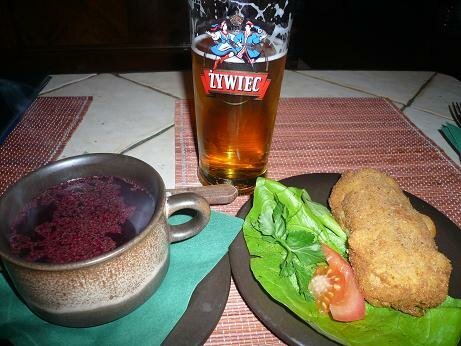
Czerwony barszczy, podawany z krokietem z kapusta i grzybami (clear and sour red beet soup with a chopped herb garnish, served with a fried croquette suffed with cabbage and mushrooms)–washed down with the excellent Zywtec beer. I remember feeling so good, so tired, tummy full, walking home through the snow. On that note, I’ll put part I of this soupy blog to bed and get on with the next one. Truly, there cannot be too much Polish soup.

And yes, I recommend Pod Sloncem for a good hearty meal, not to mention not missing the most important sports events!
Pod Sloncem
Rynek Glówny 43
31-013 Kraków
Tel.: 012 422 93 78

Nothing Less Than a Parade of Soups

Filed under: History and culture,Restaurant review,Soup — pat @ 3:02 pm
Another kind of parade...to Krzysztofory Palace

Another kind of parade...to Krzysztofory Palace

Let the soup parade begin!

Let the soup parade begin!

Elizabeth and I stumbled into an exquisite exhibit of Nativity Scenes at the Krzysztofory Palace Museum–and couldn’t tear ourselves away. As many as a hundred towering structures, many larger than a full grown man, were strung with lights and moving parts and populated with the most beloved traditions and history of Krakow–its dragon, its architecture, devils, grim reapers, Tartars, peasants, kings, queens, nobles, merchants, in many cases you really have to look sharp to find tiny little Mary and Joseph huddled over a little crib. This was the 66th year that artists of all ages created their entries and lined up at midnight on the first Thursday of December to parade to the palace. Lucky Elizabeth and I caught the very last day the scenes were on view.

And, lucky again, one good parade led to another. Polskie Jadlo Compendium Culinarium, close to St. Florian’s Gate, literally offered a “Parade of Soups” (Defilada zup Polskich)–I got to choose 4 out of 11 traditional Polish soups for 15 zlotys ($4.50). Imagine! There was classic sour white barszcz, “white soup” (whey boiled with cream and served with ham, bacon, eggs, and fennel), “ziober kwasnica” (sauerkraut soup), mushroom soup, chicken soup with meat dumplings, barszcz with yeast knish, Christmas barszcz, clear red barszcz, beef tripe soup, bread top soups, and chicken noodle soup. Here you see my choices, clockwise, the Christmas barszcz served with mushroom pierogi; the sauerkraut soup, boiled on the shoat’s snout, I was told; classic sour white barszcz with white sausage, eggs, and potatoes; and dense mushroom soup topped with thick cream. All absolutely sensational.

And please know that the restaurant was darling. I was greeted warmly at the door, seated, and brought a loaf of Polish village bread, a clay pot of homemade lard stuffed with meat bits, better not ask what, and mined salt for sprinkling. The walls were bright turquoise and decorated with embroideries, jars of pickles and preserves, copper lamps, religious pictures, and a large crucifix just under the arched ceiling. All the tables and benches were rough hewn. Lively drinking music pulsed. And tables of men and of couples were red cheeked from the snow and the beer.

Do I recommend this place? You know I do–and I hope to return myself one of these fine days.
Polskie Jadlo Compendium Culinarium
ul. Sw. Jana 30
31-018 Krakow
+48 12 433 98 25

February 21, 2009

Oh, that Dog who Smokes

Filed under: History and culture,Restaurant review,Soup,Uncategorized — pat @ 4:06 pm
Barking up the wrong tree

Barking up the wrong tree

classic soupe de poisson

classic soupe de poisson

It was a sunny Sunday afternoon after a winter of cold and misery. Carmen and I had scheduled a rendezvous, but after my disastrous choice of a pleasant but seedy guinguette for our last meeting, I put her in charge of restaurant reservations. She chose Au Chien Qui Fume–which, it turns out, positively bristles with history. Not to mention extreme nuttiness. According to its own take on things, this restaurant started out in 1740 as a small inn in the heart of old Paris, right off the Pont Neuf…but it was blasted away by the Haussman reconstruction and only reappeared in 1920 when a new restaurant was opened by a man who owned a poodle that smoked cigars and a terrier that smoked a pipe. I don’t know about you, but I am taking all of this cum grano salis. Au Chien Qui Fume was the belle of the old Les Halles ball, until that febrile “belly of Paris” moved to Rungis in 1971. Now it remains popular–yes for its food, but obviously also for the novelty of its dog theme–and it sits at the corner of a clean and odorless green space in sight of the storied Saint-Eustache gothic church. It’s a darling restaurant; it’s completely ridiculous; and it serves excellent food.

Ten guesses on my first course. Soup, of course: la soupe de poisson from Provence. It was a selection on “Menu Bazil à 33,70 €” and it was yummy, served with the traditional crouton, parmesan, and rouille (recipe for rouille on soupsong’s Aziminu). Second course La Daurade Royale Grillée au Thym, Tomate, Epinards, Pommes Safranées, a great fish platter–I was actually shown the whole freshly grilled fish in its wire cage before it was deconstructed into fillets and served with thyme, tomatoes, spinach, and saffroned potatoes. A glass of white wine, coffee and chocolates, a stroll in and around Saint Eustache to see where Richelieu, Mme. Pompadour, and Moliere had been baptised–an absolutely delicious day.

But what about that Soupe de Poisson? Please note its particular construction: la soupe DE poisson, not la soupe AUX poissons–intimating it’s the very essence of fish, not just made of fishes. Surely it started out with fishermen and their wives making do with the small and broken leftovers of the daily catch–smooshing them in a pot and straining the flesh and goodness out, leaving the bones and skin behind. Then, it being France, it got improved over time until at a certain point it became a masterpiece. I love that about France.

In fact, though, the soup is not that hard to make, as Anthony Bourdain, author of Kitchen Confidential demonstrates:

6 tablespoons olive oil
4 garlic cloves
2 small onions, thinly sliced
2 leeks, whites only, washed and thinly sliced
1 fennel bulb, thinly sliced
1 can (18 ounces) plum tomatoes, chopped
2 pounds tiny whole fish (such as porgies or whiting), gutted with heads intact, or 4 pounds fish bones and heads
1 Bouquet Garni
zest of 1 orange
3 strands of saffron
1 ounce Pernod
salt and pepper

Garnishes: Rouille, freshly grated Parmesan, croutons

Heat the olive oil over medium heat in a heavy pot, add the garlic, onions, leeks, and fennel, cover, and let them sweat for about 5 minutes, stirring occasionally with a wooden spoon.
Add tomatoes and cook for another 4 to 5 minutes, then add the small fish or bones. Cook for about 15 minutes, stirring occasionally. Add water to cover, as well as the bouquet garni and orange zest. Stir well; add saffron, a dash of salt and pepper, and Pernod. Lower the heat and simmer for about an hour.
Remove pot from heat and let soup cool slightly. Strain the liquid into a large bowl. Crush the remaining solids in the pot, then add them to the strainer and press as much liquid as possible from them. Return all the soup to another pot, reheat, ladle into bowls, and serve with croutons, rouille, and some grated Parmesan on the side.

Whether you make it yourself or order it out, you’ll love it. And I recommend you try it, if your travels bring you this way, at:
Au Chien Qui Fume
33, rue du Pont Neuf
75001 Paris
01.42.36.07.42

February 12, 2009

Limousine to the Limousin

Filed under: History and culture,Restaurant review,Soup,soup recipes — pat @ 8:53 pm
Limoges: A town to dine for

Limoges: A town to dine for

Chinois? Thailandais? Is there a difference?

Chinois? Thailandais? Is there a difference?

It all started with a clock. Stu bought a magnificent pendulum table clock on French eBay and needed to fetch it, somewhere on the “1000 cow” plateau (Millevaches) in Limousin (200 miles south of Paris), by noon. What’s the street address, he’d asked Madame X. “Il n’y a pas de rue, Marcy est le nom du hameau ou lieu-dit. Il y a 9 maisons. Merçi, cordialement.” No street, she said, it’s just a little hamlet called Marcy made up of 9 homes. Thanks, cordially.

Stu picked me up in Paris at o’dark thirty and I was purring by the time we broke south on local roads, down through the flat and fecund Loire then suddenly up into rocky hills spotted with dark evergreens, patches of snow everywhere. We’d arrived in the Limousin. Cows galore. Sheep and goats too. Bye bye agriculture; hello animal husbandry.

Not easy finding Marcy! You had to be zen about it–use the GPS, follow your intuition, then call Mme. X when you were in shouting distance but had lost confidence.

Suddenly, there it was: a tiny sign on a tiny road that said (in black and in French) MARCY, then (in red) “village burned on 15 July 1944″, then (in black, large print) “by the Nazis”. We were impressed that 9 houses would have the nerve to describe themselves as a village, but when we asked about it, our sellers sniffed that in 1944 Marcy been made up of FIFTEEN homes. And when the Nazis were alerted it was serving as a safe house for the resistance, they torched the place. Six homes were obliterated. We could see on the remaining 9 homes where the new stones started and the old stones left off.

I don’t know why we were so surprised. Vichy is close by. It was a great hiding place. Deeds of derring do were hoped for and dreamed of. Really thrilling to feel that life-and-death drama come up through our shoes from the rough soil. Stu, overcome, insisted on giving Mme. X the bottle of wine he’d bought for us to take the curse off the day. We were a little sad about that later. But we had made the clock purchase by noon, right on schedule, and now were loose in the Limousin, with hours to get to our nighttime destination of Limoges and me ready to read out at length about all the best sites between here and there from the zillions of books I’d brought.

On the agenda: Aubusson (capital of extraordinary handmade French tapestry and rugs since the 12th century); anything that looked remotely interesting or had a historical marker on it; above all, any flea market, brocante, troc, or roadside table that we could paw through. We were so happy with the clock, we were hungry for more deals.

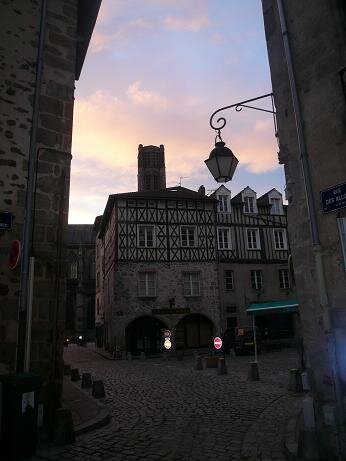
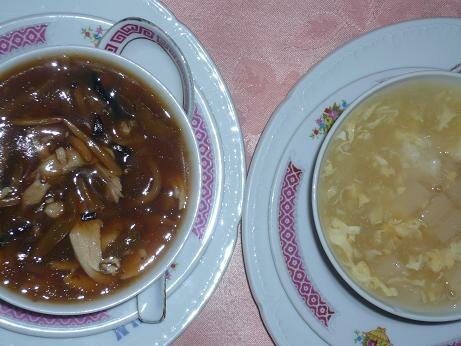
And so all our good resolutions to hit Limoges’ museums and cultural activities and porcelain houses went right out the window. We bonged around the countryside, picked through flea markets, and bought loads of cool stuff, not arriving in Limoges til well after dark. Thus the shot of cathedral square in rosy fingered dawn, as we were about to head back to Paris next morning. Thus the silly picture of our soups at Kim Lin’s “Baguettes of gold”, where we ended up after striking out everywhere else.

So, what do you think about these two soups from completely different cultures on the same table? I am excited to tell you that this illustrates perfectly something I have long wanted to share: viz., the French are so nonspecific about Asian food that Asian restaurants simply cannot make a profit unless they bundle Chinese, Thai, and Vietnamese menus under the same roof. Incredible, huh? It’s okay for Japanese restaurants to be pure, but no one else. In Limoges, in Marseilles, in Strasbourg, in Bordeaux, and above all in Paris, you cannot go into an Asian restaurant without being offered a menu that features Chinese, Vietnamese, and Thai dishes. Forgive me, I can’t get over it. I am amazed.

But the proof is in the pudding. I ordered Potage pekinois; Stu ordered potage d’asperge au crabe. A little nutty, but a great way to end an enchanting day. We recommend it, obviously a local favorite:

Restaurant Kim Lin “Baguettes d’or”
9 rue Montmouller
87000 Limoges
05.55.79.44.52

Older Posts »

Powered by WordPress