“He had often eaten oysters, but had never had enough.”

Oysters or die, if you please.
"Never had enough"
This silly drawing is from “Etiquette,” one of W. S. Gilbert’s “Bab Ballads,” which recounts the plight of two proper but very shipwrecked Englishmen. Alas, they have not been properly introduced, so they can not exchange a word and must resolutely stay on their own side of a tiny island. Peter Gray lives on the oyster side of the island, though he hates oysters; instead, “turtle and his mother were the only things he loved.” Somers lives on the turtle side of the island, though he hates turtle meat. And, tragedy!, “he had often eaten oysters, but had never had enough.” Starvation looms…no way around the proprieties…the end is near…then suddenly…. Well, it’s complicated. I encourage you to read “Etiquette” for some rather unexpected life lessons.
Lesson #1, of course: let nothing stand in the way of eating oysters. And like it or not, last week’s homage to oyster soup was father to this week’s lesson on l’ostréiculture–oysters in France.
THE HISTORY
- When Julius Caesar and his legions of Romans discovered Ostrea edulis, the flat, “plated” European oyster, along the 2000 miles of French coastline, they flipped. But when these became society’s darlings in the 19th century, the plated oyster virtually disappeared from overfishing and disease. Oh, they are SUCH a treat…and so expensive. I buy the biggest ONE I can find every Saturday I’m in town (the meat doesn’t get tougher with age, just bigger) and look forward to eating it all day long.
- In 1868, story goes, the good ship Le Morlaisien ran into a storm on the way to England with a cargo of live Portugaise oysters, Crassostrea angulata, and took refuge in the Gironde estuary. Its cargo was heavy, rotting, stank–the captain finally got permission to dump them overboard…where they promptly revived and took over the place. These yummy “cup” oysters, originally brought from Asia by Portuguese traders, turned France for a second time into oyster paradise.
- Alas, in the 1960s, disease struck both Portuguese and European oysters along the French coast–and France was once again bereft of oysters. Enter the “creuse” Pacific oyster, Crassostrea gigas, imported from Japan and from British Columbia and carefully introduced and cultivated. The comeback was quick, and today l’ostréiculture is a dazzling success once again. According to expert John McCabe, some 3,400 French oyster growers produced an estimated 518 million Euros in sales in 2005.
THE OYSTERS: 7 regions–same mostly creuse oyster, all distinctively different.
- Normandy, from Belgium to Mont Saint Michel along the English channel: the little niche areas of cultivation here produce a crisp, refreshing, and salty oyster. Huître spéciale d’Isigny is a particular hottie.
- Northern Brittany, from Mont Saint Michel to Brest along the English channel: think darling and remote little Cancale where Matisse painted and where I bought my little oyster knife, which I’ve used on every oyster since 1994. It is a haven for fresh and sparkling creuses; rich and many-layered plates; and giant wild ones (sauvages), which grow very large indeed.
- Southern Brittany, from the Bay of Douarnenez to the Loire River on the Atlantic Ocean: okay, we’ve turn the western corner of France south onto the straight Atlantic coast, but cultivation here is complex, with bays, rivers, and streams serving for beds. Take Belon oysters. *sigh* Oh yes, let’s take them all. These are plate oysters that are coddled and overfed in the brackish waters of the Belon river until they are shamefully plump and exotically tasty. Farther south, creuse oysters undergo similar coddling in phyto-plankton-rich seas: they turn green and have a hazelnut taste. Others whose beds stick far out into the Atlantic are fresh and salty, like kissing the sea on the lips.
- West Central France, from the Loire to the Charentes river on the Atlantic: Now we have entered the land of Claires cultivation–where oysters are moved from their seabeds into special basins for affinage, getting clean, getting fatter, gaining depth of flavor. Think Ile de Ré, La Rochelle, and Fouras.
- Marennes-Oléron, from the Charentes to the Gironde river on the Atlantic: This area takes affinage to a whole new place. This is where young oysters are moved from the sea to medieval salt basins that have been converted to shallow pools and flooded with nutritious waters. Here the oysters cleanse themselves of mud and sand; they fatten; they enrich themselves; they even learn how to keep their shells shut, so they stay alive longer in the marketplace…. It’s in these pools that the fresh, salty taste of ocean oysters turn sweet, aromatic, and rich. It’s here too that emerald green oysters are produced on a Blue navicula phyto-plankton diet. These are oysters for chewing.
- Arcachon, from the Gironde to Spain on the Atlantic coast: More of the same in terms of technique–the claire cultivation–but of both Japanese creuse oysters AND European plate oysters. Arcachon is equally important in producing baby oysters–which none of the other regions are able to do. Any oysters harvested in May and June will be milky, filled with either sperm or eggs, in the millions.
- French Mediterranean, just in the Languedoc region: unlikely and always in danger of too-high temperatures and not enough tidal action, Bassin de Thau, a lake between Bezier and Monpellier, cultivates absolutely scrumptious creuse and plate oysters–quite different in taste from their French brethren. P.S. Corsica, part of the French state, is also a cultivator of oysters, though I have never seen any in French markets.
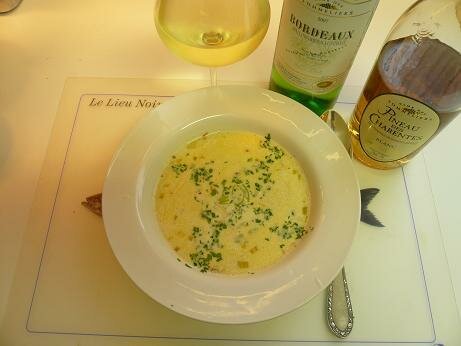
SO, if all this information has made you lust after oysters as much as me, run to the store to buy some, as I plan to do, then make the recipe below–another one adapted from Louis Anne Rothert’s Soups of France, this one from Marennes-Oléron at Charentes. She calls it Les Trois Glorieuses des Charentes” as it combines 3 of the 4 specialties of Charentes: Marennes oysters, the aperitif Pineau des Charentes, butter, and cognac.
THE RECIPE: LES TROIS GLOREUSES DES CHARENTES (per serving)
8-10 small oysters (or 3-4 big ones cut in chunks), juice reserved
1 Tablespoon butter
1 shallot, minced
1 garlic clove, minced
3/4 cup oyster juice (add fish stock or clam juice if needed)
1/2 cup heavy cream
sprinkling of white pepper
garnish: 1 Tablespoon Pineau des Charentes, minced parsley, a few thin circles of leek
Sauté the shallots in the butter over low heat, then add the garlic and stir in for a few minutes. Add the oyster juice and cook down on low heat for 5 minutes. Add the cream and bring to a simmer. When ready to serve, add the oysters and remove from the heat after 10 seconds or so, when you see the edges curl. Taste for seasoning–you probably won’t need salt if your oysters are fresh, but a little grind of white pepper is good. Ladle into your soup plate, garnish with the parsley and leeks, and sprinkle the Pineau over the top.
Dig in–you deserve it!
Please note: most of my information came straight from John McCabe’s superb Oysters.US.

