soupsong.com

September 26, 2009

cuckoo for coco de Paimpol

Filed under: History and culture,Ingredient,Soup,soup recipes — pat @ 10:41 am
Shelled cocos with their pods

Shelled cocos with their pods

Breton pumpkin soup with cocos

Breton pumpkin soup with cocos

“Coco de Paimpol”? Suddenly these big speckly pods were all over local French markets. I’d never seen beans like them before-soft yellow pods marbled with violet arabesques-and the name was crazy: coconuts from a remote village in the northwest of France??? Of course, I bought them immediately.

Thank goodness for impulses.

Shelled, they are big, fat, beautiful, white beans. Cooked, they are bigger and fatter, exquisitely tender, even melting, and nutty in taste. They’re only sold in the pod or frozen, never dried. They don’t disintegrate, no matter low long you cook them, but their skin is so thin that they pop when your teeth just graze them. Hard to beat THAT for taste sensation. And, indeed, like the best French wines and cheeses, these beans have earned the covetted AOC rating.

What a story: The time: the 1920s. The place: South America. The drama: a young, homesick Breton sailor finds these gorgeous new-world beans in a port of call and brings back a handful to plant in his native soil, at La Pointe de l’Arcouest in the Trégor-Goëlo region of Brittany. Like young Jack of the Beanstalk’s, they practically exploded out of the ground. That particular bean and that particular microclimate turned out to be a perfect match-and they quickly spread to all the local gardens in town. Fateful magic? I think so. In the dark days of heavy World World II bombing and privation, instead of starving…it was cocos for breakfast, cocos for lunch, and cocos for dinner for the good people of Trégor-Goëlo.

But cocos came into their own in postwar France when their sheer abundance made them into a cash crop. And they hit their gourmandise stride in 1998 when they achieved that Appellation d’origine contrôlée (AOC) certification-a rarity among beans. What makes them AOC? They’re only planted in Trégor-Goëlo, and only at a certain density and only with certain fertilizer. Perhaps above all, they’re only harvested BY HAND because of the fragility of the pods, then briefly stored and rushed to market strictly by the rules.

And here is where France has so much fun with its love of fine food. Some 3000 plumeurs flock into Trégor-Goëlo in July for a lot of harvesting and a lot of partying during the summer. There are competitions in picking, competitions in shelling and recipes, and a hotly contested election for Best Plumeur of the Year.

In the spirit of this coco phenomenon, I offer you one of the recipes from Prince de Bretagne itself: Soupe potiron coco de Paimpol for 4 people:

  • 1 cup cocos, cooked in unsalted water with a bay leaf and onion pierced with a clove for 35 minutes…or fully cooked second-best white beans of your choice
  • 1 pound of pumpkin or other orange squash, peeled and cubed and steamed for about 20 minutes-then pureed and mixed with 1 cup heavy cream (or yoghurt if you’re watching calories). Season to taste with salt and white pepper.

At this point you only have to assemble the soup. Ladle the pumpkin soup equally into 4 bowls. Drain the heated cocos or beans and spoon into the center of each bowl. Sprinkle with coarse sea salt and pepper, and serve piping hot. And what’s that next to my bowl? Oh that Woodrow Wilson Market in Paris-fresh, fat chanterelle mushrooms quickly sauteed in butter. Delicious!

I know it’s cruel to tease those of you not able to get these cutie cocos, but the recipe is nice for all that, with those second-best beans of your choice.

One last issue: What ABOUT that name-why “coconuts”? The controversy rages, of course, as it always does in France when food is concerned. But why not the easy vernacular explanation-”coco” being one’s “little sweetie pie”? Plump and melting and a little nutty…sounds like a little darling from Paimpol to me.

September 18, 2009

Un bouillon de poule revives the Saint of the Day

Filed under: History and culture,Soup,soup recipes — pat @ 4:54 pm

Roland de Medici

Bouillon for the Blessed

Bouillon for the Blessed

There’s no way around it, I am hooked on Saint Du Jour.

“The Saint of the Day” appears as a small daily column in the free Paris metro newsrag, Direct Matin Plus-and is just short enough and easy enough for me to read in transit between Place Victor Hugo and Etoile metro stops on my way to work. Not a bad way to start the day, in fact, pondering these hagiographic tales of virtue and martyrdom.

Take as an example this past Tuesday, September 15, dedicated to Bienheureux Roland (that is, “Blessed” Roland de Medici, who is one step up from “Venerable” and one step short of “Saint” in the canonization process):

“In 1386, in the north of Italy, some hunters discovered our poor hero, more dead than alive, dressed only in an old goat skin, shells, and foliage, and dying of hunger…. It was Roland de Medici who, 30 years earlier, had made a vow to retreat alone to the forest. Nourishing himself only with grasses and wild fruits, he passed the hours in meditation, standing on one leg. He said that he saw the face of Jesus in the sun during his prayers. When Princess Pallavicini heard about this, she sent him her confessor, who, after listening to Roland for 2 hours, declared that after so many years of wandering and of a solitary life, Roland was ‘pure of all sin, even those of omission.’ The confessor took him under his care-AND MADE HIM A BOUILLON OF HEN TO DRINK THAT PROLONGED HIS LIFE FOR 26 DAYS. Roland only died on September 15 when he saw St. Michael and some angels had arrived to conduct him to paradise.”

Other sources elaborate: Born in Florence, he was the scion of the famous de Medici family who renounced his inheritance and appeared one day, dressed in black, in the forests of Parma. Only when his clothes rotted away did he substitute the goatskin. Which is how the Princess found him during that day of hunting, flat on his back in rotting leaves and at the point of death. He refused by signs to go to her castle and only agreed to break his lifetime vow of silence to the Carmelite confessor who was administering last sacraments.

Forgive me, but I can’t help but note that the miracle of chicken soup is part of this story. I stopped at the store on the way home and bought a poule. I cut it up and chopped the bones. I put it in a pot of ice cold water with some fresh-pulled little onions and greens and, at a snail’s pace, brought it to a simmer over low heat, to extract every morsel of goodness. I let it bubble for 6 hours. To make an appropriate offering to this pious man, I meant to clarify the broth when it was done-so that, as in Louis XIV’s commission to his cooks, I could “see my reflection in it.”

Voila! In the end, the broth was so pure and so concentrated that I only had to skim the fat and pour it into a bowl. Those are my kitchen drapes in the reflection…but I think they look properly inspirational. You just can’t beat chicken soup. If St. Michael and the angels hadn’t shown up, Bienheureux Roland might still be alive today.

September 11, 2009

Bon Baiser de Bruges

Filed under: History and culture,Soup,soup recipes — pat @ 5:59 pm
Brugesiastic stuff

Brugesiastic stuff

Waterzooie part II

Waterzooie part II

Don’t you just want to slap yourself when you go to a cool place and forget your camera? That would be me this weekend on a trip to Bruges, a medieval Flemish city caught and preserved mostly in the 14th century. Thus my photos, when I got back, of things I bought there (chocolate, tapestry pillow, 18th century chimney tile of the Bruges lion) and what I ate there (a perfect facsimile, if I do say so myself).

Am I obsessed with the Flemish soup Waterzooie? Maybe. At least as far as getting it right. I wrote earlier of my very doubtful Lobster Waterzooie in Brussels and couldn’t wait to get back to Belgium to make a correction. Except I forgot to take the camera. *sigh* But this really IS exactly like the bowl I had at Sint Joris (St. George) Brasserie on Markt Square, except with the local Bruges beer instead of this “gloriously bronze” Westmalle Triple that I brought back to Paris with me.

And what I love about this particular Waterzooie is that it is not only delicious and authentic but also totally easy, much easier than my original recipe at http://www.soupsong.com/rwaterzo.html. Try this per person:

  • 1 chicken thigh and 1 chicken drumstick
  • 1-inch green part of leek, cleaned and chopped
  • 1 garlic clove, peeled and chopped
  • 1 cup water or chicken stock
  • 4-5 small waxy potatoes, peeled
  • 1 cup heavy cream
  • 1 Tablespoon flour; salt and white pepper to taste
  • 1-inch peeled carrot, grated
  • garnish: parsley, finely minced

Put the chicken pieces, leeks, garlic, and potatoes in a pot, add the stock, bring to a boil, then reduce to a simmer, cover tightly, and poach for an hour-until the chicken is tender but not falling off the bone. Remove the chicken pieces and potatoes, whisk in the flour and seasonings over medium heat until thick, then whisk in the cream and grated carrots. Remove the skin from the chicken pieces, add the chicken and potatoes back into the pot, and let simmer for 10 minutes. In each bowl, arrange one thigh and one drumstick and surround with potatoes, pour the sauce over each bowl, then sprinkle with parsley. How easy is that? Serve with knife, fork, and soupspoon-and don’t forget the Belgian beer.

But my personal recommendation is to go to Bruges, and the sooner the better, to experience it in its own setting. What a city! If you have short pockets and low standards, you can stay in a hostel like the Hotel Lybeer for 27 euros, which includes a great breakfast in a crystal chandeliered common room, a discount card for all city events, and Bruges-by-Day/Bruges-by-Night maps “made by locals” that is hilarious and spot-on for what you should and should not do. But, eek, remember to take a towel for that shower down the hall….

August 29, 2009

Where’ve I been-captured by aliens?

Filed under: History and culture,Restaurant review,Soup,soup recipes — pat @ 12:50 pm
Summer goodbyes at the Café de la Paix

Summer goodbyes at the Cafe de la Paix

French twist on a classic Spanish soup

French twist on a classic Spanish soup

Well, you’d certainly think I’d been whisked away by little green men, for all I’ve been blogging. But, alas, I return with no Alien Soup recipes…only some that are Out Of This World. I hope you’ll look for them in the days ahead.

Here, though, you see a bittersweet occasion at the famous Café de la Paix. The hard core of the Paris Embassy book club is sending Elizabeth back to a new assignment in Washington and Dominique into the pleasures of la retraite, her much anticipated retirement. See how happy they both look at the front of the picture? In the case of Elizabeth, it’s an illusion. An unreconstructed lover of all things Italian, she finally admitted to Scarlett O’Hara pangs, realizing only at the end that her heart had been stolen by the Rhett Butler of Paris.

I ordered the onion soup (Soupe à l’oignon gratinée), which was okay. Dominique ordered gaspacho, pictured here. And it’s this French take on the classic Spanish soup that I want to talk about. “Gaspacho” (and I put it in quotes advisedly) is a classic of French summer cuisine. It is on the menu everywhere, from the quickest lunch takeout to the most elegant restaurant. But is it gazpacho? I’ve ordered it a number of times and found it similar to Spanish gazpacho only in that it was cold and had tomatoes in it.

Was that the case here? Already you must be scratching your head over the pot full of Parmesan slices. Just listen to my post-event interview with Dominique:

Pat: “Tell me, Dominique, was it sweet, spicy? Blandly tomato or flavorful with garlic, cucumber, and peppers? Could you taste vinegar in it…and if so, could you describe it? Was the soup smooth or chunky? And while I can see the croutons in one little bowl…was that shavings of Parmesan cheese in the other???”

Dominique: “I remember the shavings of Parmesan as very pleasant. It tasted predominantly of tomato, rather fluid in texture, not particularly sweet, but with no noticeable trace of vinegar, possibly with slices of cucumber and/or pepper if you say so (can you see them?). There must have been garlic but surprisingly the taste was not striking. All in all, a pleasant refreshing flavor much overshadowed by the charming company. Does this mean it could be improved? Well, that may be a failing of the place living more on its reputation than on the actual quality of its cuisine.”

A charming, thoughtful, and factual account, always Dominique’s signature. So be warned: when you order gaspacho in France, you are likely going to get a nicely seasoned, cold tomato puree with garnishes more suited for a hot soup.

A last word on what Dominique wickedly called “the place living more on its reputation than on the actual quality of its cuisine”. Café de la Paix is gorgeous, an icon of Paris, and parked right in front of the over-the-top Garnier Opéra-as close as we could get to Elizabeth’s fave opera house. It opened its doors on June 30, 1862, as the café/restaurant of the Grand Hotel, immediately catered to visitors of the Universal Exhibition of 1867…and soon became a favorite watering hole of luminaries like Massenet, Zola, and Maupassant. We’d just finished a highly contentious book club on that last Prince of Darkness and hoped we were sitting at Maupassant’s very table.

Pat: So, Dominique, was it worth all $16 for that cup of gaspacho?
Dominique: Évidemment!

April 25, 2009

Santé or Germiny? It’s a Sorrel Thing.

Filed under: History and culture,Soup,soup recipes — pat @ 8:19 pm
winter is over!

winter is over!

sorrel soup--health or prestige?

sorrel soup--health or prestige?

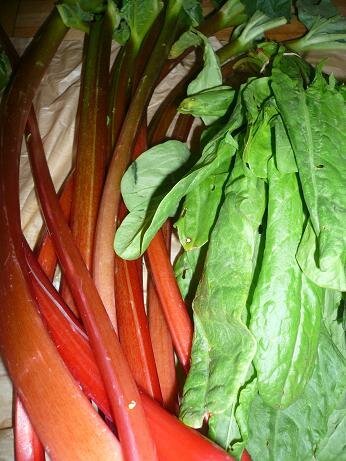
So I’m strolling through my fave Président Wilson marché early on a Saturday morning, already panting in anticipation. And there it is Joël Thiébault’s fabled stand, seemingly a city block long of every sort of sparkling fresh vegetable you could dream of, in season, just plucked from the earth at Carrières-sur-Seine, west of Paris. The cheerful serveurs hand me a wire basket and by the time I get to the cashier, no matter how darkly I mutter under my breath to myself to be moderate, it’s filled to the brim. Today I found a couple of longtime springtime friends, pictured. Rhubarb and sorrel. These, along with a couple AOC belon oysters THAT I SIMPLY CANNOT RESIST, have me whistling all the way back to my apartment.

Sorrel! Do you know it? So tart, so greenly lemon, so sour from its oxalic acid, so crisp and fine when it’s raw…and turning into a slimy mess the minute it hits heat and liquid. I have struggled with sorrel. It’s been eaten since ancient times as Rumex acetosa, cultivated tenderly, and known as “sour dabs” or dock. John Evelyn, 17th century English diarist and gardener, says about it, “…it gave so grateful a quickness to a salad that it should never be omitted”-and I agree.

But, yes, I have struggled with it in the soup pot. Back in Falls Church, when it was thick in my garden, I tried any number of recipes and any number of ideas without success. Okay, fine, I’ll just eat it raw, I decided.

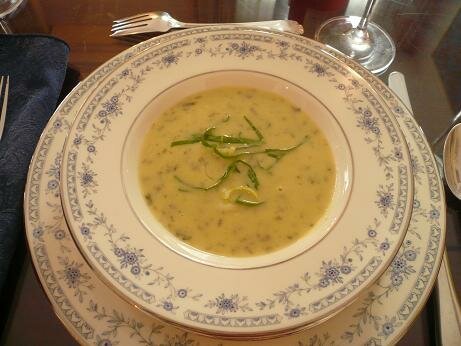
But. But now I’m in France with Joël Thiébault’s sorrel, for heaven’s sake. So I start with Crème Santé (Creamy Health Soup) in Louis Diat’s Basic French Cookbook. It’s so simple and so pure. Clean and shred enough sorrel to make 1/2 up, firmly packed. Melt a tablespoon of butter in a small saucepan, stir in the sorrel over low heat, and cook til all the moisure has cooked away, about 15 minutes. Stir it into 6 cups of Potage Parmentier, heat, then stir in over low heat 1 egg yolk mixed with a half-cup of heavy cream. Reheat, stirring, without bringing to a boil, then ladle into flat soup plates and garnish with fresh chervil (or shredded sorrel).

This time it’s terrific-and not just hot, as I served it (pictured) to Carmen last Sunday, but also cold, as I served it to Ana on Monday when she locked herself out of her apartment and needed some TLC and a little Santé to boot while her keys were being located.

So let’s try the big magilla, I think: the classic sorrel soup of French haute cuisine, Potage Germiny. This is the one that always slimed on me in Falls Church. And you know what? It’s exactly the same as Crème Santé-except it uses beef broth instead of water as a base…and the sorrel is boiled before it goes into the soup.

Please know that all the fuss about Santé and haute cuisine literally boils down to the fact that sorrel is a natural laxative. Potage Germiny was created in 1869 by chef de cuisine Adolphe Dugléré at his Café Anglais in Paris for the very very old, at that point, Comte de Germiny, former Minister of Finance and Governor of the Bank of France. Ah, regularity-a welcome thing to an old man. So while it’s true that, in Rowley Leigh’s words, “sorrel soup, with its dirty grey-green colouring, is sadly no pin up,” there is room on an old gourmet’s table for Potage Germiny.

Me, I’m not that old (yet). I tried the recipe again…and it slimed. Apparently no way around it when you boil the sorrel first. So I threw it out and am sticking to Crème Santé with its technique of removing the water in a butter saute.

And what about the rhubarb and oysters? The rhubarb made up into such an adorable little latticed pie, and the oysters were so layered in flavor, that, as in the case of the walrus and the carpenter calling out to their delicacies, “answer came there none-and this was scarcely odd, because I’d eaten every one.”

April 18, 2009

When lilacs last in le jardin bloom’d

Filed under: History and culture,Soup,soup recipes,Uncategorized — pat @ 5:12 pm
Fragrant steetcorners

Fragrant steetcorners

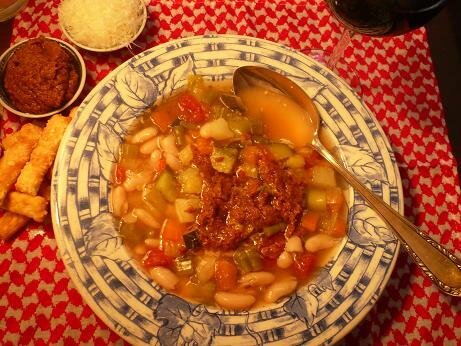
Soupe au pistou

Soupe au pistou

Easter Sunday, and I’m so glad to be back in Paris. It’s cool and sunny, a brilliant blue sky, and first thing in the morning I cook up a huge pot of Soupe au pistou, the ultimate French springtime soup, before heading out for a ramble in the countryside. I’m on my way to the train station, bound for Poissy, when I catch sight of this seller of lilacs and involuntarily think of Whitman’s Leaves of Grass:

In the door-yard fronting an old farm-house, near the white-wash’d palings,

Stands the lilac bush, tall-growing, with heart-shaped leaves of rich green,
With many a pointed blossom, rising, delicate, with the perfume strong I love,
With every leaf a miracle……and from this bush in the door-yard,
With delicate-color’d blossoms, and heart-shaped leaves of rich green,

A sprig, with its flower, I break.

I think, my God, here it is Easter Sunday and resurrection, lilac intimations of Whitman’s grief on war and Lincoln’s death, and springtime in Paris after being so closely held in Yemen. A lot to think about. I buy an armful-see how bashfully charming this earringed boy is?-go back home and arrange them, then set out once more for the train station.

By the end of the day, I have witnessed serial and joyful baptisms in Poissy’s 12th century Collégiale Notre Dame, a highly anticipated tradition on Easter as the Collégiale houses St. Louis’ actual baptismal font. I have wandered through the town and explored Le Corbusier’s astonishing Villa Savoye (unusual in its expansive approach to accommodate Mme. Savoye, who did not know how to back up in her new car and had to drive forwards all the way around the house in order to leave the grounds). I’ve walked along the Seine through Vilenne and on to Emile Zola’s house in Medan-reliving his battles for justice and human rights, regardless of consequences. As dusk fell and I waited, bone weary, for the return train in Vilenne, I was glad to be alone with my thoughts. I get so caught up in the moment that I just don’t think enough. And then, there’s as much pain as pleasure in it.

Vilenne to Gare St. Lazare; St. Lazare metro to Villliers; Villiers to Victor Hugo-and a quick walk past the triple fountain in the middle of the place, home. Was I happy to fire up the soup, ostentatiously prepare the little bowls of pistou and parmesan, uncork the wine? You know I was. Hot, filling, halfway between Lenten bean soup meals and the richness of Easter, it was the perfect meal for the day. In the mood for a think? You might think about having Soupe au Pistou on the back burner:

Soupe au Pistou (French Provençal Vegetable Soup with Pistou)

2 cups dried white or flageolet beans, soaked overnight, then discarding water
10 cups water
2 leeks, chopped into quarter pieces
2 carrots, chopped into quarter pieces
2 stalks celery, with leaves, chopped
2 zucchini, cubed
3 potatoes, cubed
15 green beans, cut into small pieces
3 tomatoes (or 6 canned), peeled, seeded, and chopped
¼ cup parsley, chopped
salt and pepper to taste

Garnish: Pistou
6 cloves garlic
4 Tablespoons tomato paste
¼ cup fresh basil, chopped
½ cup grated Parmesan cheese
½ cup olive oil
3-4 Tablespoons fresh parsley, chopped
Press the garlic, then whisk the tomato paste, basil, cheese, oil, and parsley with it in a blender til it is a rich paste.

In a large soup pot, bring the soaked beans and fresh water to a boil. Add all the vegetables and herbs, bring to a second boil, then reduce the heat, cover the pot, and simmer for an hour. Meanwhile, make the pistou if you don’t have any handy in the freezer.

Add the salt and pepper to the soup, stir well, and continue simmering uncovered for another 15-20 minutes.

When ready to serve, ladle the soup into big bowls. Pass the pistou-and extra Parmesan cheese, if you like-so people can load up the bowl with flavor that releases itself right under their noses.

April 11, 2009

Rapunzeled in Yemen

Filed under: History and culture,Soup — pat @ 12:54 pm
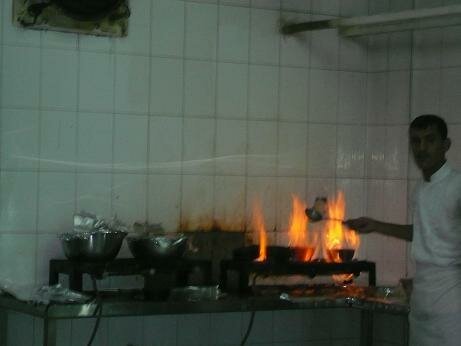
Making saltah--do not try this at home

Making saltah--do not try this at home

Magnificent saltah, brought sizzling to the table

Magnificent saltah, brought sizzling to the table

I’d no sooner arrived in Sana’a for a 4-week assignment, than 2 young suicide bombers ignited themselves on Yemeni roads. Already stiff security measures were re-doubled, and I knew I would not be able to explore this fascinating ancient culture in southern Arabia on foot. Period, end of story. So when I wasn’t working, I was curled up in a magnificent fortress with every book about Yemen I could get my hands on. Academic studies I found in the embassy library. Histories and travel guides in my boss ‘s house, where I lived. Personal accounts that I’d brought by the likes of Freya Stark, Tim Mackintosh-Smith, Steven Caton, and Eric Hansen. I’d thought this would slake my thirst for the place, but in fact it made me yearn for it…and for the fabled soup, saltah.

Here’s what Tim Macintosh-Smith has to say about saltah in Ali’s Restaurant in Sana’a: “My lunch was the same as that described by Ibn al-Mujawir in the thirteenth century: wheat bread, hulbah-fenugreek flour whisked to a froth with water-and meat. Ali himself stands in a cloud of smoke on a platform high above the ground, ladling beef broth, eggs, rice and peppers into a row of stone bowls. In front of him is a rank of cauldrons, each one big enough to boil a missionary. Below him minions tend gas cylinders that send great blasts of flame shooting up. Conversations are impossible in the roar; explosions are not unknown. The bowl of saltah, as they call the mixture, is brought to you red-hot, carried with a pair of pliers and topped with a seething yellowish-green dollop of hulbah. Lumps of meat are flambeed in a wok-like vessel, and ten feet above this the ceiling is black from years of fireballs. Men squat on the floor, on benches, on tables (the ones in suits and ties are from the Foreign Ministry across the road). Those who have not yet been served wail and shriek for attention — ‘Ya Ali! Ya Alayyy — while Ali stands, erect and unhearing, his body immobile within a parabola of arms — all his own, like those of a Hindu idol. The lucky ones who have been served eat with the saltah spitting in their faces, sweat pouring from their brows. The walls are covered with a huge photographic mural of the gardens at Versailles: parterres, statues of nymphs, cooling fountains.

“Lunch at Ali’s is not merely a matter of eating. It is the first step on the way to kayf. The meaning of this the term has been discussed by Sir Richard Burton. One might call it, he wrote, ‘The savouring of animal existence…the result of a lively impressible, excitable nature, and exquisite sensibility of nerve; it argues a facility for voluptuousness unknown to northern regions…’; but in the end the translator of The Arabian Nights admitted defeat. Kayf is ‘a word untranslatable in our mother tongue.’ Lexicographers, who cannot be so realistic, have described it as a mood, humour or frame of mind. I, who chew the leaf of the qat tree, shall attempt a definition.

“Ali’s restaurant is all to do with the humours. Blood, phlegm, yellow and black bile must be in balance to ensure perfect health and to enable the qat chewer to attain his goal of kayf; since qat excites the cold and dry black bile, prophylaxis against its ill effects means that the blood, which is hot and wet, must be stimulated. Hence the heat, the sweat, the bubbling saltah.”

So, as you can imagine, as I sat in my stone tower, my yearning for saltah grew, and I did not keep this a secret from my colleagues. Perhaps I could pay an embassy driver to bring me a bowl straight from Ali’s Restaurant? Perhaps I could ask the cooks in the embassy cafeteria if they could make it for lunch? Perhaps I could try making it myself in my boss’s kitchen?

In the end, and perhaps with the thought of a fireball blackened ceiling in our kitchen, my heart’s desire was realized at the end of my assignment. Not only was I able to get a traditional saltah bowl to bring back to Paris, but we all took our chances and went out to Al Fakher Restaurant for the real thing, pictured above.

Please know that I achieved kayf without the qat. This soup is absolutely sensational. It’s thick and piquant, layered with flavors and textures of minced meat, onions, tomatoes, eggs, cilantro, rice or lentils or potatoes, all cooked in broth in a raging fire-but the hulbah topping takes it way beyond the “awfully good” category. Soaked fenugreek is whipped with garlic, onions, and spices and poured into the boiling hot soup, where it coagulates in a thick froth. As the soup spits at you, you carve chunks of the two layers with a spoon and suck it in-heaven! Will I try to make it here in the 16th arrondissement? Time will tell. I’m cautiously beginning to season my saltah bowl…

April 4, 2009

Homage to Nancy

Filed under: History and culture,Soup,soup recipes — pat @ 1:11 pm
Nancy, we miss you

Nancy, we miss you

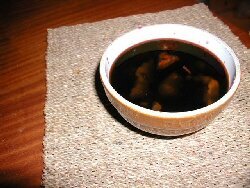
Czarnina

Czarnina

Back in May 2002, I was lucky enough to be interviewed by Candy Sagan of the Washington Post to be headlined in its Food Section. And I was doubly lucky, because the week after the article came out my phone rang and the voice at the other end said it was impossible that the Post’s “Souper Woman” did not know about Washington DC’s “infamous Bi-Annual Soup Party.” On the spot, I was invited to attend the upcoming one in 2 week’s time.

That was pure Nancy. Nancy Manuszak was a little slip of a woman who packed a TNT punch-forging people and good times together with gusto, smoking and drinking up a storm, impossibly good hearted, incredibly complicated, and Polish to her toes. If it wasn’t her infamous soup parties, it was sausage making. If it wasn’t Friday night hen parties at controversial films, it was happy hour oysters and champagne at Old Ebbits. She greeted me as the honored guest at that first soup party and went on to proofread and challenge every statement of my book when it was still in manuscript form. She came to Paris my first Christmas here, toting a 1974 guide from her last visit, and complained about everything that had changed since then. Always we talked about soup-and especially Czarnina, which she recommended above all other soups and which I was never able to make since fresh duck or pig’s blood is not an easy ingredient to come by. “I’ll have to take your word for it,” I would say. “Humph,” she’d reply, lighting another cigarette.

In fact, Nancy died suddenly just when I’d gotten back from my first ever trip to Poland and was midway through an email to her to say, dammit, I STILL couldn’t find a bowl of Czarnina, not even in Krakow…but that I had a great new story about one related to it from Michener’s Poland. Her brother Zak wrote to me and to her hundreds of friends across the world with the news. Now her local friends in DC-Sheila and Judy and Doris and Harriet and all the others-are throwing a last, glorious Soup Party, with balloons, on April 18 to commemorate the outrageous life and opinions of Nancy Manuszak. And I can’t go in anything but spirit. So, Nancy, let me tell you this last story about Polish Black Soup. I have no doubt you’ll figure out a way to tap into the web from heaven to read it.

“Ignacy Mniszech himself went into the kitchen to supervise preparation of the soup, a task at which he spent most of that day, absenting himself from the noontime meal so that he could avoid responding to Bukowski’s implied proposal of marriage. He spent that time slaughtering a young pig and carefully catching all its blood in a ewer, which he brought back to the kitchen, where he added vinegar and salt to the blood and set the ewer aside.

“Asking the cooks for what meat stock they had, he added to it bits of cooked pork and chicken, two large handfuls of chopped vegetables, three heavy soupbones and six large dried mushrooms that he and his daugher had gathered that autumn.

“‘Prunes!’ he called, and cooks hurried up with a large handful. ‘Cherries!’ and they came up with a cupful of dried delicacies, which he tossed into the brew.

“He tended the soup all afternoon, tasting it now and then and soliciting advice from his professionals. ‘I want this to be the best. More salt, do you think?’ When it was done to everyone’s approval, a distinguished golden Polish soup, he stirred in a large helping of crumbled honey cake to bind the various elements together.

“‘An excellent soup,’ he said before the evening meal, and when he heard the guests assembling in the dining hall he divided his soup into two portions, one extremely large, the other so small that it would serve only one person, and into this latter helping he stirred the dark blood and vinegar, keeping it over the fire until it turned an ebon black.

“‘Dinner!’ he shouted as he left the kitchen, and behind him came four servants bearing soup bowls for the guests, who sniffed approvingly as their rich portions of amber colored soup were placed before them. Ignacy took the final bowl from the fourth servant and walked silently, ceremoniously to where Feliks Bukowski sat. Deftly, using both his big hands, he placed the bowl of black soup before the impetuous suitor, and when Feliks looked down at it and saw the terrible blackness he knew that his proposal of marriage had been rejected, and so did everyone else at the table.

“Convention required that he make no comment, betray no emotion. Like a soldier assigned a hateful duty, he ate his black soup, cruielly aware that the soup of the others was a rich golden borwn, and after Feliks had finished his bitter dish, Ignacy Mniszech, big and bald and brazen, rose and announced to his guests, ‘On this day my daughter Elzbieta is announcing her engagement to Roman Lubonski, son of my dear friend-Count Lubonski in Poland, Baron Lubonski in Austria. Wedding’s to be at the Mniszech palace in Warsaw, and you are all to attend.’”

Nancy, I’m missing you a lot. Your absence is a bitter, black soup to eat. “Humph,” I can hear you say.

March 20, 2009

Can There Be Too Much Polish Soup?

Filed under: History and culture,Restaurant review,Soup — pat @ 3:04 pm
Giant snowy head pondering the question

Giant snowy head pondering the question

The answer:  No!

The answer: No!

Why no soup blogs for nearly a month? Easy-I have been on the road. First a pleasure trip to Seattle (where I ate no soup) to celebrate daughter Meg’s birthday and cuddle darling petite enfant Rosalind…then, unexpectedly, a 30-day assignment to…Sana’a, Yemen.

! ! !

Let me tell you, as I sit here in southern Arabia ringed by brown mountains, the hot sun beating out of a cloudless, deep blue sky, my quick trip to snowy Krakow, Poland, with friend Elizabeth seems years instead of weeks past. But it was a marvelous trip, and literally so full of soup that I’ve had to split the blog into four.

We went on a whim-Transavia Air flew out of Orly round trip for $182-and landed late at night in a blizzard. And by the time we arrived at the little La Fontaine Bed and Breakfast, right off Market Square, we were starved. After a circuit around the square, full of high spirited people despite the hour, and after getting turned away at restaurants bursting at the seams, I was so happy to find Pod Sloncem, meaning “Under the Sun,” located in a 13th century basement and offering cable TV “so you can have dinner without missing out on the most important sports events.” Why “under the sun”? If you go to its website, you will see a giant sun, eyes closed and tongue protruding, carved right into the stone foundations.

My first meal is Poland was completely yummy:
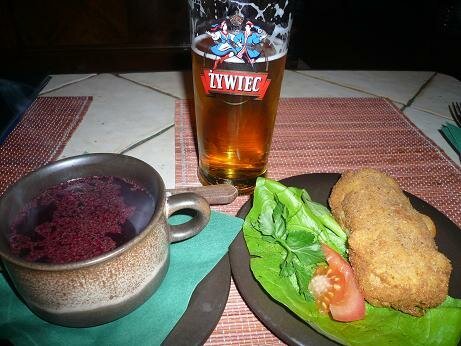
Czerwony barszczy, podawany z krokietem z kapusta i grzybami (clear and sour red beet soup with a chopped herb garnish, served with a fried croquette suffed with cabbage and mushrooms)-washed down with the excellent Zywtec beer. I remember feeling so good, so tired, tummy full, walking home through the snow. On that note, I’ll put part I of this soupy blog to bed and get on with the next one. Truly, there cannot be too much Polish soup.

And yes, I recommend Pod Sloncem for a good hearty meal, not to mention not missing the most important sports events!
Pod Sloncem
Rynek Glówny 43
31-013 Kraków
Tel.: 012 422 93 78

Nothing Less Than a Parade of Soups

Filed under: History and culture,Restaurant review,Soup — pat @ 3:02 pm
Another kind of parade...to Krzysztofory Palace

Another kind of parade...to Krzysztofory Palace

Let the soup parade begin!

Let the soup parade begin!

Elizabeth and I stumbled into an exquisite exhibit of Nativity Scenes at the Krzysztofory Palace Museum-and couldn’t tear ourselves away. As many as a hundred towering structures, many larger than a full grown man, were strung with lights and moving parts and populated with the most beloved traditions and history of Krakow-its dragon, its architecture, devils, grim reapers, Tartars, peasants, kings, queens, nobles, merchants, in many cases you really have to look sharp to find tiny little Mary and Joseph huddled over a little crib. This was the 66th year that artists of all ages created their entries and lined up at midnight on the first Thursday of December to parade to the palace. Lucky Elizabeth and I caught the very last day the scenes were on view.

And, lucky again, one good parade led to another. Polskie Jadlo Compendium Culinarium, close to St. Florian’s Gate, literally offered a “Parade of Soups” (Defilada zup Polskich)-I got to choose 4 out of 11 traditional Polish soups for 15 zlotys ($4.50). Imagine! There was classic sour white barszcz, “white soup” (whey boiled with cream and served with ham, bacon, eggs, and fennel), “ziober kwasnica” (sauerkraut soup), mushroom soup, chicken soup with meat dumplings, barszcz with yeast knish, Christmas barszcz, clear red barszcz, beef tripe soup, bread top soups, and chicken noodle soup. Here you see my choices, clockwise, the Christmas barszcz served with mushroom pierogi; the sauerkraut soup, boiled on the shoat’s snout, I was told; classic sour white barszcz with white sausage, eggs, and potatoes; and dense mushroom soup topped with thick cream. All absolutely sensational.

And please know that the restaurant was darling. I was greeted warmly at the door, seated, and brought a loaf of Polish village bread, a clay pot of homemade lard stuffed with meat bits, better not ask what, and mined salt for sprinkling. The walls were bright turquoise and decorated with embroideries, jars of pickles and preserves, copper lamps, religious pictures, and a large crucifix just under the arched ceiling. All the tables and benches were rough hewn. Lively drinking music pulsed. And tables of men and of couples were red cheeked from the snow and the beer.

Do I recommend this place? You know I do-and I hope to return myself one of these fine days.
Polskie Jadlo Compendium Culinarium
ul. Sw. Jana 30
31-018 Krakow
+48 12 433 98 25

« Newer Posts — Older Posts »

Powered by WordPress