Deprecated: Assigning the return value of new by reference is deprecated in /home/soupsong/public_html/blog/wp-settings.php on line 468

Deprecated: Assigning the return value of new by reference is deprecated in /home/soupsong/public_html/blog/wp-settings.php on line 483

Deprecated: Assigning the return value of new by reference is deprecated in /home/soupsong/public_html/blog/wp-settings.php on line 490

Deprecated: Assigning the return value of new by reference is deprecated in /home/soupsong/public_html/blog/wp-settings.php on line 526

Deprecated: Assigning the return value of new by reference is deprecated in /home/soupsong/public_html/blog/wp-includes/cache.php on line 103

Deprecated: Assigning the return value of new by reference is deprecated in /home/soupsong/public_html/blog/wp-includes/query.php on line 21

Deprecated: Assigning the return value of new by reference is deprecated in /home/soupsong/public_html/blog/wp-includes/theme.php on line 618

soupsong.com

October 31, 2009

Nobody spooks like the English

Filed under: History and culture, Soup, soup recipes — pat @ 5:28 pm

British Museum sphinx considers Halloween activities

British Museum sphinx considering Halloween activities

Prepackaged scariness

Prepackaged scariness

No one is a bigger fan of Halloween than me. The creepiness of its very concept…the intoxification of fear…the cloying sweetness of the treats and the nastiness of the tricks. Who could doubt that it’s an English holiday?

Even so, I was pretty surprised to find the pictured soup in all the London Tesco supermarkets last weekend. “Witches Brew” indeed–rather a pumpkin and tomato puree with bits of blackeyed peas and veggies floating in it.

Want a soup that’s a little more frightening? Try Spooky Soup and a Story from my old website. Or perhaps you prefer Teeny Tiny Graveyard Soup. Nothing like Halloween soup to put a chill on your bones.

Wishing you goblins of fun, wherever you are.

October 27, 2009

Will the real French onion soup please stand up?

Filed under: History and culture, Restaurant review, Soup, soup recipes — pat @ 5:08 pm

Me, knocking on heaven\'s door

Me, knocking on heaven's door

A soup of a different color

A soup of a different color

Who knew that REAL French onion soup began its life in Lyon? So declared lyonnais Bernard Chaléat, friend of Catherine (pictured), before we ever arrived: “La soupe à l’oignon est d’origine lyonnaise!”

Me, I would have put money on its origin in Paris, old standby that its soupe à l’oignon has been historically at Les Halles and Montmartre. And I would have lost.

Come south with me from Paris to Lyon, at the confluence of the Rhone and Saone rivers–a town founded as a Roman military colony of Lugdunum in 43 BCE, then rising to prominence from its easy position on major trading routes. The town nearly backrupted itself buying the gorgeous silks that came over the silk road from China–to the point that in 1436 Louis XI declared the town should make its own silk…and in 1536, Francois I gave Lyon the French monopoly. By the 1750s Lyon had become the silk-weaving capital of Europe.

What does all this have to do with onion soup? In fact, onion soup had everything to do with Lyon’s masses of overworked/underpaid canuts (silk workers). They worked 18 hours a day; they needed hot, rich, cheap food. Voila, onion soup poured over stale bread and a little cheese thrown on top. Probably it started as a way to flavor and enrich the broth of traditional pot-au-feu–and to use up stale bread. Then it became a tradition–and was traditionally served as the last course (if the meal was lucky enough to have several courses) to fill up and warm the bellies of workers on their way back to the looms.

Crazy, though, that this simple beginning blossomed into today’s “gratinée lyonnaise” that insists on the addition of egg yolks and…port! Don’t ask me how a red fortified wine from the Douro Valley in Portugal found its way into this soup. In any case, you can see the upshot in the picture, under Catherine’s smiling face at Les Fines Gueules bouchon in the St. Jean district of Lyon. And you should taste it too. Despite my doubts, it’s marvelous. The chopped onions pretty much dissolve into browned richness; the egg yolks make it silky; and the port, at the end, envelopes you in heady fragrance.

Gratinée lyonnaise (for 4)

  • 2 Tablespoons butter; 2 Tablespoons oil
  • 4 medium onions, chopped
  • 6 cups beef stock (ideally, broth from your pot-au-feu)
  • salt and pepper to taste
  • 2-3 egg yolks
  • 1/2 cup red port, medium dry
  • stale sliced French bread, toasted in a slow oven until crisp through
  • 1/2-1 cup grated Comté cheese (Gruyére or Swiss is also fine, though Comté is more local to the area)

Heat the butter and oil over medium heat, toss in the onions, and sauté, stirring, for a few minutes. Reduce the heat to low, cover, and let cook until the onions have browned on the bottom. Stir the browned bits through the onion, then pour in the stock, taste for seasoning, and heat to boiling. Reduce heat to low, cover, and let simmer for at least 30 minutes. The onions should have mostly melted away.

Toast the stale French bread slices. Grate the cheese. Have the egg yolks and port handy.

When ready to serve, beat the egg yolks into the port and stir into the simmering pot. Let thicken and get silky for about 5 minutes. Place the toasted croutons into flat serving plates. Ladle the soup on top. Sprinkle each serving with as much or as little cheese as you like–but err on the light side. Such a relief to not be confronted with the Parisian throat-choking plate of cheese on top. You can serve the soup immediately or run the plates under the broiler for a quick crust.

As a last note, many thanks to Bernard and Anne Chaléat, who gave Catherine and me such an extraordinary tour of the city and its Roman aqueduct, then happily fed us in their beautiful home–all the best food of Lyon, culinary capital of France.

Finally, do I recommend Les Fines Gueules, founded by Franck Perrin and Ludovic Rouviere in 2002? Certainement! Lovely atmosphere and excellent food.
16 rue LAINERIE
69005 LYON 05
Téléphone : 04 78 28 99 14

October 20, 2009

“He had often eaten oysters, but had never had enough.”

Filed under: History and culture, Ingredient, Soup, soup recipes — pat @ 8:04 pm

Oysters or die, if you please.

Oysters or die, if you please.

"Never had enough"

"Never had enough"

This silly drawing is from “Etiquette,” one of W. S. Gilbert’s “Bab Ballads,” which recounts the plight of two proper but very shipwrecked Englishmen. Alas, they have not been properly introduced, so they can not exchange a word and must resolutely stay on their own side of a tiny island. Peter Gray lives on the oyster side of the island, though he hates oysters; instead, “turtle and his mother were the only things he loved.” Somers lives on the turtle side of the island, though he hates turtle meat. And, tragedy!, “he had often eaten oysters, but had never had enough.” Starvation looms…no way around the proprieties…the end is near…then suddenly…. Well, it’s complicated. I encourage you to read “Etiquette” for some rather unexpected life lessons.

Lesson #1, of course: let nothing stand in the way of eating oysters. And like it or not, last week’s homage to oyster soup was father to this week’s lesson on l’ostréiculture–oysters in France.

THE HISTORY

  • When Julius Caesar and his legions of Romans discovered Ostrea edulis, the flat, “plated” European oyster, along the 2000 miles of French coastline, they flipped. But when these became society’s darlings in the 19th century, the plated oyster virtually disappeared from overfishing and disease. Oh, they are SUCH a treat…and so expensive. I buy the biggest ONE I can find every Saturday I’m in town (the meat doesn’t get tougher with age, just bigger) and look forward to eating it all day long.
  • In 1868, story goes, the good ship Le Morlaisien ran into a storm on the way to England with a cargo of live Portugaise oysters, Crassostrea angulata, and took refuge in the Gironde estuary. Its cargo was heavy, rotting, stank–the captain finally got permission to dump them overboard…where they promptly revived and took over the place. These yummy “cup” oysters, originally brought from Asia by Portuguese traders, turned France for a second time into oyster paradise.
  • Alas, in the 1960s, disease struck both Portuguese and European oysters along the French coast–and France was once again bereft of oysters. Enter the “creuse” Pacific oyster, Crassostrea gigas, imported from Japan and from British Columbia and carefully introduced and cultivated. The comeback was quick, and today l’ostréiculture is a dazzling success once again. According to expert John McCabe, some 3,400 French oyster growers produced an estimated 518 million Euros in sales in 2005.

THE OYSTERS: 7 regions–same mostly creuse oyster, all distinctively different.

  1. Normandy, from Belgium to Mont Saint Michel along the English channel: the little niche areas of cultivation here produce a crisp, refreshing, and salty oyster. Huître spéciale d’Isigny is a particular hottie.
  2. Northern Brittany, from Mont Saint Michel to Brest along the English channel: think darling and remote little Cancale where Matisse painted and where I bought my little oyster knife, which I’ve used on every oyster since 1994. It is a haven for fresh and sparkling creuses; rich and many-layered plates; and giant wild ones (sauvages), which grow very large indeed.
  3. Southern Brittany, from the Bay of Douarnenez to the Loire River on the Atlantic Ocean: okay, we’ve turn the western corner of France south onto the straight Atlantic coast, but cultivation here is complex, with bays, rivers, and streams serving for beds. Take Belon oysters. *sigh* Oh yes, let’s take them all. These are plate oysters that are coddled and overfed in the brackish waters of the Belon river until they are shamefully plump and exotically tasty. Farther south, creuse oysters undergo similar coddling in phyto-plankton-rich seas: they turn green and have a hazelnut taste. Others whose beds stick far out into the Atlantic are fresh and salty, like kissing the sea on the lips.
  4. West Central France, from the Loire to the Charentes river on the Atlantic: Now we have entered the land of Claires cultivation–where oysters are moved from their seabeds into special basins for affinage, getting clean, getting fatter, gaining depth of flavor. Think Ile de Ré, La Rochelle, and Fouras.
  5. Marennes-Oléron, from the Charentes to the Gironde river on the Atlantic: This area takes affinage to a whole new place. This is where young oysters are moved from the sea to medieval salt basins that have been converted to shallow pools and flooded with nutritious waters. Here the oysters cleanse themselves of mud and sand; they fatten; they enrich themselves; they even learn how to keep their shells shut, so they stay alive longer in the marketplace…. It’s in these pools that the fresh, salty taste of ocean oysters turn sweet, aromatic, and rich. It’s here too that emerald green oysters are produced on a Blue navicula phyto-plankton diet. These are oysters for chewing.
  6. Arcachon, from the Gironde to Spain on the Atlantic coast: More of the same in terms of technique–the claire cultivation–but of both Japanese creuse oysters AND European plate oysters. Arcachon is equally important in producing baby oysters–which none of the other regions are able to do. Any oysters harvested in May and June will be milky, filled with either sperm or eggs, in the millions.
  7. French Mediterranean, just in the Languedoc region: unlikely and always in danger of too-high temperatures and not enough tidal action, Bassin de Thau, a lake between Bezier and Monpellier, cultivates absolutely scrumptious creuse and plate oysters–quite different in taste from their French brethren. P.S. Corsica, part of the French state, is also a cultivator of oysters, though I have never seen any in French markets.

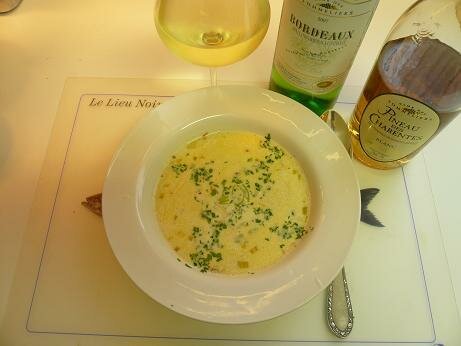
SO, if all this information has made you lust after oysters as much as me, run to the store to buy some, as I plan to do, then make the recipe below–another one adapted from Louis Anne Rothert’s Soups of France, this one from Marennes-Oléron at Charentes. She calls it Les Trois Glorieuses des Charentes” as it combines 3 of the 4 specialties of Charentes: Marennes oysters, the aperitif Pineau des Charentes, butter, and cognac.

THE RECIPE: LES TROIS GLOREUSES DES CHARENTES (per serving)
8-10 small oysters (or 3-4 big ones cut in chunks), juice reserved
1 Tablespoon butter
1 shallot, minced
1 garlic clove, minced
3/4 cup oyster juice (add fish stock or clam juice if needed)
1/2 cup heavy cream
sprinkling of white pepper
garnish: 1 Tablespoon Pineau des Charentes, minced parsley, a few thin circles of leek

Sauté the shallots in the butter over low heat, then add the garlic and stir in for a few minutes. Add the oyster juice and cook down on low heat for 5 minutes. Add the cream and bring to a simmer. When ready to serve, add the oysters and remove from the heat after 10 seconds or so, when you see the edges curl. Taste for seasoning–you probably won’t need salt if your oysters are fresh, but a little grind of white pepper is good. Ladle into your soup plate, garnish with the parsley and leeks, and sprinkle the Pineau over the top.

Dig in–you deserve it!

Please note: most of my information came straight from John McCabe’s superb Oysters.US.

October 8, 2009

‘Tis the season…

Filed under: Cookbook review, History and culture, Soup, soup recipes — pat @ 9:47 pm

Dedicated to Traditional French Soups

Dedicated to Traditional French Soups

Soupe Locmariaquer

Soupe Locmariaquer

I woke up this morning thinking about soup. Still too early for Paris to turn on the heat so, with all my casement windows open, I was double wrapped in down and still had freezing feet. Another sign of the season — old friends from early soupsong.com days are checking in. All of it feels good, heading into days of kicking through horsechestnut leaves after work, anticipating the warmth and goodness of the soup kettle just steps away.

Do you know this book? Lois Anne Rothert published The Soups of France in 2002. It’s a beauty. Forget about haute cuisine, formal restaurant service, and, in the words of 19th century gourmand Alexandre-Balthazar-Laurent Grimod de la Reynière, that “soup is to dinner what the portico or the peristyle is to an edifice. That is to say, not only is it the first part, but it should be conceived in such a way as to give an exact idea of the feast, very nearly as the overture to an opera should announce the quality of the whole work.”

Forget all that. In this book, soup IS the edifice; it IS the feast. Rothert focuses specifically on “big” meal-in-a-pot soups that are tied to specific Franch regions. Soupe au Pistou from Provence. Garbure from South West France. Matelote from Normandie and the Loire. Cotriade from Brittany. She says that, at this point in time, her book is “an essential work of safekeeping.” And it’s true: I rarely find these soups on a menu anywhere in France. They are disappearing. And you know I’ve been looking.

Likewise, Lois Rothert herself is hard to track down. She permits a small smiling picture of herself on the flyleaf of the book, proudly wearing her age with frazzled hair, oversized glasses, and an open collared jeans shirt–but is otherwise mostly invisible in the book and on the web. Fluent in French; educated at La Varenne; restauranteuse for 7 years in Fort Wayne, Indiana; mother of 4 children; winters in Indiana and summers outside Seattle in Cle Elum–that’s about it. But she knows France, knows food, and has produced a book that sings. Just look at that bowl of Soupe Locmariaquer, fat with oysters and smoked ham, from Brittany. I’ve adapted the grandmother’s recipe that she sweet-talked from the owner of the Hotel L’Escale at tiny Locmariaquer. This version is much simpler–basically the classic French potato soup that every housewife used to have on the burner…then stuffed with fresh oysters and crisp lardons right before serving.

Soupe Locmariaquer: Soupe Bonne Femme with Oysters and Crisp Ham Bits (for 6)

1 Tablespoon butter
4 leeks, cleaned and washed, then sliced (up into the green) into a 1/3-inch dice (1 and 1/2 cups)
1/2 cup diced onion
4-5 potatoes, peeled and diced (3 cups)
6 cups hot milk
sprigs of fresh rosemary, thyme, and a half bay leaf
1 teaspoon salt
1 Tablespoons butter
1/4 pound lardons (or thick bacon), cut into 1-inch pieces
24 medium-sized oysters (at least! This would be a measly 4 per bowl)
2 Tablespoons butter enrichment
Garnish: thinly sliced leeks and toasted croutes

Heat 1 T. butter in a saucepan over medium low heat, stir in the leeks and onions, and sweat slowly, covered, until they are soft, but not brown. Add the potatoes and hot milk with the salt and herbs, bring to a boil, then reduce heat and simmer for 30-40 minutes, covered, until the potatoes are soft.

While the soup is cooking, saute the lardons/bacon in a Tablespoon of butter over medium heat until the fat has rendered. Drain on paper towels and reserve.

Shuck the oysters, carefully reserving the juice and strain through cheese cloth if necessary.

When the soup is done, remove the herbs and add the oyster liquor and 2 Tablespoons of butter enrichment. Taste to see if it needs salt–it may well not, since the oyster juice is salty–and maybe grind some white pepper into it. Mash the soup to thicken it with the potatoes, without completely creaming it. It should be lumpy.

When ready to serve, slide the oysters into the simmering broth (15 or so seconds is enough to plump them). Stir in the crisp ham bits. Ladle into bowls and top with thinly sliced leeks and croutons on the side.

Bottom line: if you want to grasp French foodways and see right into the heart of the French stomach, run don’t walk to your local online used bookstore. Lois Rothert’s The Soups of France is pricey, but all treasures are.

October 2, 2009

Collaborating, etc., in Vichy, France

vichy broomheads

vichy broomheads

soupe d'avocat froide au citron vert, brunoise de concombre

soupe d'avocat froide au citron vert, brunoise de concombre

As I stepped off my train in Vichy’s exquisite station, I had all sorts of pre-conceptions. Yes, yes, I would find the perfect building or monument to capture the shame of Pétain’s collaborationist government with the 3rd Reich…and somehow it would also capture the long history of aristocratic pleasuring at Vichy’s thermal springs. And, oh yes, I would dine in elegance, somewhere, on native son Louis Diat’s vichyssoise and capture that on film for you too.

Oh well.

Please know that Vichy is an extraordinary town–a little down at the heels, maybe, despite the gilding, the eye-popping statuary, the exotic moorish architecture, the parks and river walks. But still dedicated to pleasure, as it has been since Emperor Napoleon III took its cool, metallic and also hot, stinky waters in the 1860s for his health. Horseracing, casinos, golf, casinos, theater, casinos, opera, casinos, and temples to health and beauty that clothe then divest you of impossibly thick white terry robes between your massages, baths, languid slumps in the hammam, you get the picture.

I had only two commitments: 1. Meeting foodie friend Catherine for a sensational lunch at Brasserie du Casino on Sunday. 2. Finding a local soup that would set your hair on fire, preferably a creation of chef Diat. First stop on Saturday morning, Brasserie du Casino–to establish that I would find a great soup there to order next day. Absolument non. There it was again–the only offering that same old bland gaspacho that is everywhere. From that point on, it was Experience the Town and Find a Soup, all day long.

How about in the oldest part of town, past Mme. de Sévigné’s house, where Pétain held his cabinet meetings, and twisting down from the heights on narrow streets to the river and the elegant pavilion housing the source of Celestin waters? Nope. Lots of restos, none served soup.

How about along the formal Parc des Sources, bristling with the priciest boutiques and most expensive restaurants? Um, no. No soup.

The center of town, cachinking from the casinos and oompah-pahing from the bandstand? Non.

Surely at the Grand Marché, a stadium of over a hundred food markets of every stripe? Rien.

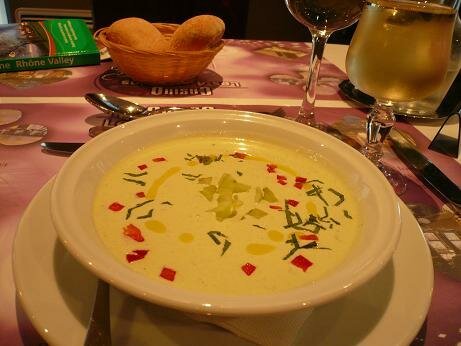
In the end, the giant Les Quatre Chemins shopping center/casino complex to the north of town saved me: Soupe d’avocat froide au citron vert, brunoise de concombre in its cool panoramic restaurant just a winding staircase up from the heated, neonized casino. You can see how good it was. Thick and creamy; mild (of course, it’s French) with only a hint of lime and tarragon; tiny chunks of cucumber and sweet red pepper, a drizzle of fruity olive oil. And, you know, there it was: a 21st century version of Diat’s vichyssoise–his classic cold leek/potato soup whipped with avocado and sweetly garnished. Make it yourself from my recipe Colombian Avocado Vichyssoise .

So, a perfect and very full vacation in less than 2 days. And if I hadn’t been scouring the town for a good soup, I never would have stumbled into this pictured evidence of local wedding customs. Is it just me, or is this custom a little gender bending?

Powered by WordPress