Deprecated: Assigning the return value of new by reference is deprecated in /home/soupsong/public_html/blog/wp-settings.php on line 468

Deprecated: Assigning the return value of new by reference is deprecated in /home/soupsong/public_html/blog/wp-settings.php on line 483

Deprecated: Assigning the return value of new by reference is deprecated in /home/soupsong/public_html/blog/wp-settings.php on line 490

Deprecated: Assigning the return value of new by reference is deprecated in /home/soupsong/public_html/blog/wp-settings.php on line 526

Deprecated: Assigning the return value of new by reference is deprecated in /home/soupsong/public_html/blog/wp-includes/cache.php on line 103

Deprecated: Assigning the return value of new by reference is deprecated in /home/soupsong/public_html/blog/wp-includes/query.php on line 21

Deprecated: Assigning the return value of new by reference is deprecated in /home/soupsong/public_html/blog/wp-includes/theme.php on line 618

soupsong.com

April 25, 2009

Santé or Germiny? It’s a Sorrel Thing.
Filed under: History and culture, Soup, soup recipes — pat @ 8:19 pm

winter is over!

winter is over!

sorrel soup--health or prestige?

sorrel soup--health or prestige?

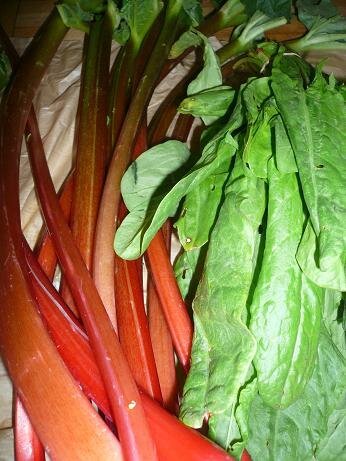
So I’m strolling through my fave Président Wilson marché early on a Saturday morning, already panting in anticipation. And there it is Joël Thiébault’s fabled stand, seemingly a city block long of every sort of sparkling fresh vegetable you could dream of, in season, just plucked from the earth at Carrières-sur-Seine, west of Paris. The cheerful serveurs hand me a wire basket and by the time I get to the cashier, no matter how darkly I mutter under my breath to myself to be moderate, it’s filled to the brim. Today I found a couple of longtime springtime friends, pictured. Rhubarb and sorrel. These, along with a couple AOC belon oysters THAT I SIMPLY CANNOT RESIST, have me whistling all the way back to my apartment.

Sorrel! Do you know it? So tart, so greenly lemon, so sour from its oxalic acid, so crisp and fine when it’s raw…and turning into a slimy mess the minute it hits heat and liquid. I have struggled with sorrel. It’s been eaten since ancient times as Rumex acetosa, cultivated tenderly, and known as “sour dabs” or dock. John Evelyn, 17th century English diarist and gardener, says about it, “…it gave so grateful a quickness to a salad that it should never be omitted”–and I agree.

But, yes, I have struggled with it in the soup pot. Back in Falls Church, when it was thick in my garden, I tried any number of recipes and any number of ideas without success. Okay, fine, I’ll just eat it raw, I decided.

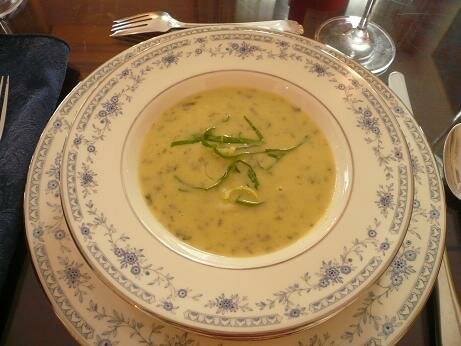
But. But now I’m in France with Joël Thiébault’s sorrel, for heaven’s sake. So I start with Crème Santé (Creamy Health Soup) in Louis Diat’s Basic French Cookbook. It’s so simple and so pure. Clean and shred enough sorrel to make 1/2 up, firmly packed. Melt a tablespoon of butter in a small saucepan, stir in the sorrel over low heat, and cook til all the moisure has cooked away, about 15 minutes. Stir it into 6 cups of Potage Parmentier, heat, then stir in over low heat 1 egg yolk mixed with a half-cup of heavy cream. Reheat, stirring, without bringing to a boil, then ladle into flat soup plates and garnish with fresh chervil (or shredded sorrel).

This time it’s terrific–and not just hot, as I served it (pictured) to Carmen last Sunday, but also cold, as I served it to Ana on Monday when she locked herself out of her apartment and needed some TLC and a little Santé to boot while her keys were being located.

So let’s try the big magilla, I think: the classic sorrel soup of French haute cuisine, Potage Germiny. This is the one that always slimed on me in Falls Church. And you know what? It’s exactly the same as Crème Santé–except it uses beef broth instead of water as a base…and the sorrel is boiled before it goes into the soup.

Please know that all the fuss about Santé and haute cuisine literally boils down to the fact that sorrel is a natural laxative. Potage Germiny was created in 1869 by chef de cuisine Adolphe Dugléré at his Café Anglais in Paris for the very very old, at that point, Comte de Germiny, former Minister of Finance and Governor of the Bank of France. Ah, regularity–a welcome thing to an old man. So while it’s true that, in Rowley Leigh’s words, “sorrel soup, with its dirty grey-green colouring, is sadly no pin up,” there is room on an old gourmet’s table for Potage Germiny.

Me, I’m not that old (yet). I tried the recipe again…and it slimed. Apparently no way around it when you boil the sorrel first. So I threw it out and am sticking to Crème Santé with its technique of removing the water in a butter saute.

And what about the rhubarb and oysters? The rhubarb made up into such an adorable little latticed pie, and the oysters were so layered in flavor, that, as in the case of the walrus and the carpenter calling out to their delicacies, “answer came there none–and this was scarcely odd, because I’d eaten every one.”

April 18, 2009

When lilacs last in le jardin bloom’d

Filed under: History and culture, Soup, Uncategorized, soup recipes — pat @ 5:12 pm

Fragrant steetcorners

Fragrant steetcorners

Soupe au pistou

Soupe au pistou

Easter Sunday, and I’m so glad to be back in Paris. It’s cool and sunny, a brilliant blue sky, and first thing in the morning I cook up a huge pot of Soupe au pistou, the ultimate French springtime soup, before heading out for a ramble in the countryside. I’m on my way to the train station, bound for Poissy, when I catch sight of this seller of lilacs and involuntarily think of Whitman’s Leaves of Grass:

In the door-yard fronting an old farm-house, near the white-wash’d palings,

Stands the lilac bush, tall-growing, with heart-shaped leaves of rich green,
With many a pointed blossom, rising, delicate, with the perfume strong I love,
With every leaf a miracle……and from this bush in the door-yard,
With delicate-color’d blossoms, and heart-shaped leaves of rich green,

A sprig, with its flower, I break.

I think, my God, here it is Easter Sunday and resurrection, lilac intimations of Whitman’s grief on war and Lincoln’s death, and springtime in Paris after being so closely held in Yemen. A lot to think about. I buy an armful–see how bashfully charming this earringed boy is?–go back home and arrange them, then set out once more for the train station.

By the end of the day, I have witnessed serial and joyful baptisms in Poissy’s 12th century Collégiale Notre Dame, a highly anticipated tradition on Easter as the Collégiale houses St. Louis’ actual baptismal font. I have wandered through the town and explored Le Corbusier’s astonishing Villa Savoye (unusual in its expansive approach to accommodate Mme. Savoye, who did not know how to back up in her new car and had to drive forwards all the way around the house in order to leave the grounds). I’ve walked along the Seine through Vilenne and on to Emile Zola’s house in Medan–reliving his battles for justice and human rights, regardless of consequences. As dusk fell and I waited, bone weary, for the return train in Vilenne, I was glad to be alone with my thoughts. I get so caught up in the moment that I just don’t think enough. And then, there’s as much pain as pleasure in it.

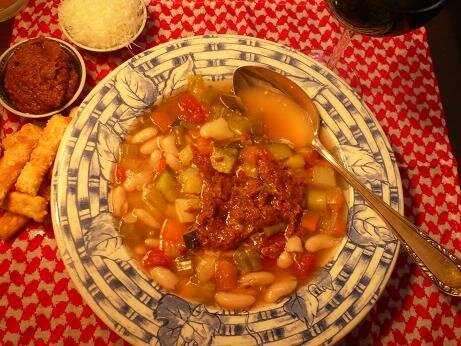
Vilenne to Gare St. Lazare; St. Lazare metro to Villliers; Villiers to Victor Hugo–and a quick walk past the triple fountain in the middle of the place, home. Was I happy to fire up the soup, ostentatiously prepare the little bowls of pistou and parmesan, uncork the wine? You know I was. Hot, filling, halfway between Lenten bean soup meals and the richness of Easter, it was the perfect meal for the day. In the mood for a think? You might think about having Soupe au Pistou on the back burner:

Soupe au Pistou (French Provençal Vegetable Soup with Pistou)

2 cups dried white or flageolet beans, soaked overnight, then discarding water
10 cups water
2 leeks, chopped into quarter pieces
2 carrots, chopped into quarter pieces
2 stalks celery, with leaves, chopped
2 zucchini, cubed
3 potatoes, cubed
15 green beans, cut into small pieces
3 tomatoes (or 6 canned), peeled, seeded, and chopped
¼ cup parsley, chopped
salt and pepper to taste

Garnish: Pistou
6 cloves garlic
4 Tablespoons tomato paste
¼ cup fresh basil, chopped
½ cup grated Parmesan cheese
½ cup olive oil
3-4 Tablespoons fresh parsley, chopped
Press the garlic, then whisk the tomato paste, basil, cheese, oil, and parsley with it in a blender til it is a rich paste.

In a large soup pot, bring the soaked beans and fresh water to a boil. Add all the vegetables and herbs, bring to a second boil, then reduce the heat, cover the pot, and simmer for an hour. Meanwhile, make the pistou if you don’t have any handy in the freezer.

Add the salt and pepper to the soup, stir well, and continue simmering uncovered for another 15-20 minutes.

When ready to serve, ladle the soup into big bowls. Pass the pistou–and extra Parmesan cheese, if you like–so people can load up the bowl with flavor that releases itself right under their noses.

April 11, 2009

Rapunzeled in Yemen

Filed under: History and culture, Soup — pat @ 12:54 pm

Making saltah--do not try this at home

Making saltah--do not try this at home

Magnificent saltah, brought sizzling to the table

Magnificent saltah, brought sizzling to the table

I’d no sooner arrived in Sana’a for a 4-week assignment, than 2 young suicide bombers ignited themselves on Yemeni roads. Already stiff security measures were re-doubled, and I knew I would not be able to explore this fascinating ancient culture in southern Arabia on foot. Period, end of story. So when I wasn’t working, I was curled up in a magnificent fortress with every book about Yemen I could get my hands on. Academic studies I found in the embassy library. Histories and travel guides in my boss ’s house, where I lived. Personal accounts that I’d brought by the likes of Freya Stark, Tim Mackintosh-Smith, Steven Caton, and Eric Hansen. I’d thought this would slake my thirst for the place, but in fact it made me yearn for it…and for the fabled soup, saltah.

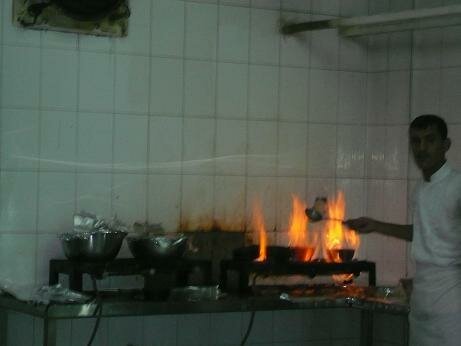
Here’s what Tim Macintosh-Smith has to say about saltah in Ali’s Restaurant in Sana’a: “My lunch was the same as that described by Ibn al-Mujawir in the thirteenth century: wheat bread, hulbah–fenugreek flour whisked to a froth with water–and meat. Ali himself stands in a cloud of smoke on a platform high above the ground, ladling beef broth, eggs, rice and peppers into a row of stone bowls. In front of him is a rank of cauldrons, each one big enough to boil a missionary. Below him minions tend gas cylinders that send great blasts of flame shooting up. Conversations are impossible in the roar; explosions are not unknown. The bowl of saltah, as they call the mixture, is brought to you red-hot, carried with a pair of pliers and topped with a seething yellowish-green dollop of hulbah. Lumps of meat are flambeed in a wok-like vessel, and ten feet above this the ceiling is black from years of fireballs. Men squat on the floor, on benches, on tables (the ones in suits and ties are from the Foreign Ministry across the road). Those who have not yet been served wail and shriek for attention — ‘Ya Ali! Ya Alayyy — while Ali stands, erect and unhearing, his body immobile within a parabola of arms — all his own, like those of a Hindu idol. The lucky ones who have been served eat with the saltah spitting in their faces, sweat pouring from their brows. The walls are covered with a huge photographic mural of the gardens at Versailles: parterres, statues of nymphs, cooling fountains.

“Lunch at Ali’s is not merely a matter of eating. It is the first step on the way to kayf. The meaning of this the term has been discussed by Sir Richard Burton. One might call it, he wrote, ‘The savouring of animal existence…the result of a lively impressible, excitable nature, and exquisite sensibility of nerve; it argues a facility for voluptuousness unknown to northern regions…’; but in the end the translator of The Arabian Nights admitted defeat. Kayf is ‘a word untranslatable in our mother tongue.’ Lexicographers, who cannot be so realistic, have described it as a mood, humour or frame of mind. I, who chew the leaf of the qat tree, shall attempt a definition.

“Ali’s restaurant is all to do with the humours. Blood, phlegm, yellow and black bile must be in balance to ensure perfect health and to enable the qat chewer to attain his goal of kayf; since qat excites the cold and dry black bile, prophylaxis against its ill effects means that the blood, which is hot and wet, must be stimulated. Hence the heat, the sweat, the bubbling saltah.”

So, as you can imagine, as I sat in my stone tower, my yearning for saltah grew, and I did not keep this a secret from my colleagues. Perhaps I could pay an embassy driver to bring me a bowl straight from Ali’s Restaurant? Perhaps I could ask the cooks in the embassy cafeteria if they could make it for lunch? Perhaps I could try making it myself in my boss’s kitchen?

In the end, and perhaps with the thought of a fireball blackened ceiling in our kitchen, my heart’s desire was realized at the end of my assignment. Not only was I able to get a traditional saltah bowl to bring back to Paris, but we all took our chances and went out to Al Fakher Restaurant for the real thing, pictured above.

Please know that I achieved kayf without the qat. This soup is absolutely sensational. It’s thick and piquant, layered with flavors and textures of minced meat, onions, tomatoes, eggs, cilantro, rice or lentils or potatoes, all cooked in broth in a raging fire–but the hulbah topping takes it way beyond the “awfully good” category. Soaked fenugreek is whipped with garlic, onions, and spices and poured into the boiling hot soup, where it coagulates in a thick froth. As the soup spits at you, you carve chunks of the two layers with a spoon and suck it in–heaven! Will I try to make it here in the 16th arrondissement? Time will tell. I’m cautiously beginning to season my saltah bowl…

April 4, 2009

Homage to Nancy

Filed under: History and culture, Soup, soup recipes — pat @ 1:11 pm

Nancy, we miss you

Nancy, we miss you

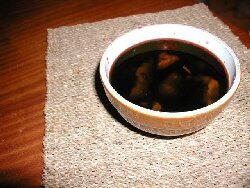
Czarnina

Czarnina

Back in May 2002, I was lucky enough to be interviewed by Candy Sagan of the Washington Post to be headlined in its Food Section. And I was doubly lucky, because the week after the article came out my phone rang and the voice at the other end said it was impossible that the Post’s “Souper Woman” did not know about Washington DC’s “infamous Bi-Annual Soup Party.” On the spot, I was invited to attend the upcoming one in 2 week’s time.

That was pure Nancy. Nancy Manuszak was a little slip of a woman who packed a TNT punch–forging people and good times together with gusto, smoking and drinking up a storm, impossibly good hearted, incredibly complicated, and Polish to her toes. If it wasn’t her infamous soup parties, it was sausage making. If it wasn’t Friday night hen parties at controversial films, it was happy hour oysters and champagne at Old Ebbits. She greeted me as the honored guest at that first soup party and went on to proofread and challenge every statement of my book when it was still in manuscript form. She came to Paris my first Christmas here, toting a 1974 guide from her last visit, and complained about everything that had changed since then. Always we talked about soup–and especially Czarnina, which she recommended above all other soups and which I was never able to make since fresh duck or pig’s blood is not an easy ingredient to come by. “I’ll have to take your word for it,” I would say. “Humph,” she’d reply, lighting another cigarette.

In fact, Nancy died suddenly just when I’d gotten back from my first ever trip to Poland and was midway through an email to her to say, dammit, I STILL couldn’t find a bowl of Czarnina, not even in Krakow…but that I had a great new story about one related to it from Michener’s Poland. Her brother Zak wrote to me and to her hundreds of friends across the world with the news. Now her local friends in DC–Sheila and Judy and Doris and Harriet and all the others–are throwing a last, glorious Soup Party, with balloons, on April 18 to commemorate the outrageous life and opinions of Nancy Manuszak. And I can’t go in anything but spirit. So, Nancy, let me tell you this last story about Polish Black Soup. I have no doubt you’ll figure out a way to tap into the web from heaven to read it.

“Ignacy Mniszech himself went into the kitchen to supervise preparation of the soup, a task at which he spent most of that day, absenting himself from the noontime meal so that he could avoid responding to Bukowski’s implied proposal of marriage. He spent that time slaughtering a young pig and carefully catching all its blood in a ewer, which he brought back to the kitchen, where he added vinegar and salt to the blood and set the ewer aside.

“Asking the cooks for what meat stock they had, he added to it bits of cooked pork and chicken, two large handfuls of chopped vegetables, three heavy soupbones and six large dried mushrooms that he and his daugher had gathered that autumn.

“‘Prunes!’ he called, and cooks hurried up with a large handful. ‘Cherries!’ and they came up with a cupful of dried delicacies, which he tossed into the brew.

“He tended the soup all afternoon, tasting it now and then and soliciting advice from his professionals. ‘I want this to be the best. More salt, do you think?’ When it was done to everyone’s approval, a distinguished golden Polish soup, he stirred in a large helping of crumbled honey cake to bind the various elements together.

“‘An excellent soup,’ he said before the evening meal, and when he heard the guests assembling in the dining hall he divided his soup into two portions, one extremely large, the other so small that it would serve only one person, and into this latter helping he stirred the dark blood and vinegar, keeping it over the fire until it turned an ebon black.

“‘Dinner!’ he shouted as he left the kitchen, and behind him came four servants bearing soup bowls for the guests, who sniffed approvingly as their rich portions of amber colored soup were placed before them. Ignacy took the final bowl from the fourth servant and walked silently, ceremoniously to where Feliks Bukowski sat. Deftly, using both his big hands, he placed the bowl of black soup before the impetuous suitor, and when Feliks looked down at it and saw the terrible blackness he knew that his proposal of marriage had been rejected, and so did everyone else at the table.

“Convention required that he make no comment, betray no emotion. Like a soldier assigned a hateful duty, he ate his black soup, cruielly aware that the soup of the others was a rich golden borwn, and after Feliks had finished his bitter dish, Ignacy Mniszech, big and bald and brazen, rose and announced to his guests, ‘On this day my daughter Elzbieta is announcing her engagement to Roman Lubonski, son of my dear friend–Count Lubonski in Poland, Baron Lubonski in Austria. Wedding’s to be at the Mniszech palace in Warsaw, and you are all to attend.’”

Nancy, I’m missing you a lot. Your absence is a bitter, black soup to eat. “Humph,” I can hear you say.

Powered by WordPress